Health & Medicine
‘I got her back. I got my entire mom back.’
How a teaching hospital and a clinical trial fixed the unfixable
I grew up in Puerto Rico on the western side of the island, where there aren’t many hospitals. And my mom, Rosa, always suffered from headaches.
I recall being 8, 9 years old and having Mom go to bed early, and we needed to be quiet because the headaches were so intense. She would periodically lose vision or complain of blurred vision; she saw floaters. She said it felt like a nail going through her skull.
Her doctor worked hard to figure out why this was happening. And some early imaging and physical exam findings were suggestive of multiple sclerosis, a chronic disease where the body’s immune system mistakenly attacks the protective covering of nerve fibers. It can cause blurred vision, muscle weakness, balance problems and cognitive changes. There is no cure.
About 1 million Americans have MS. In my mom’s case, doctors thought her optic nerve looked a certain way on scans because she was developing the disease and slowly losing her sight.
For many years she sought care, and we took her to the emergency room or the doctor’s office to get steroids, understanding — or maybe even resigned — that this would be her fate forever.
In 2009, after I graduated from medical school and finished my residency, I was practicing in Boston and my mom came to visit. During that trip, she developed the worst headache she ever had. She was in a ton of pain and reporting double vision. And even though I was a doctor, when your mom gets sick, you’re first and foremost a son. We rushed to the emergency room.
They brought her back for brain imaging to rule out something acute like a stroke or a bleed. And I remember being in her room and watching the gurney as it brought her back, soon followed by a medical resident with her results.
“I just want you to know she has MS,” I said. “And so if you see something consistent with that, I don’t want you to worry. We know about it.”
What I heard in response leveled me.
“Your mom never had MS.”
She had gotten an MRI, and the radiographical findings were consistent with a very rare form of tumor that grows down the nerve in the eye. It can look like MS on scans.
Immediately, my world collapsed — not so much because I realized my mom had the wrong diagnosis this whole time, but because it was even worse. A rare tumor? How do you treat it? What are the options? And we quickly learned the tumor was very difficult to treat, that it was in a dangerous position and very close to extending to her other optic nerve, and that the surgical options — which involved opening a patient’s skull — were so high risk that they weren’t sure it should be offered to a patient her age. (My mom was 60 at the time.)
But here’s something I haven’t told you about my mom: She went to medical school. Mom studied in Spain, fell in love with teaching and became an educator, teaching preclinical courses to medical students and, later, high school science.
And here’s something I haven’t told you about where we were: Brigham and Women’s Hospital, a teaching hospital of Harvard Medical School.
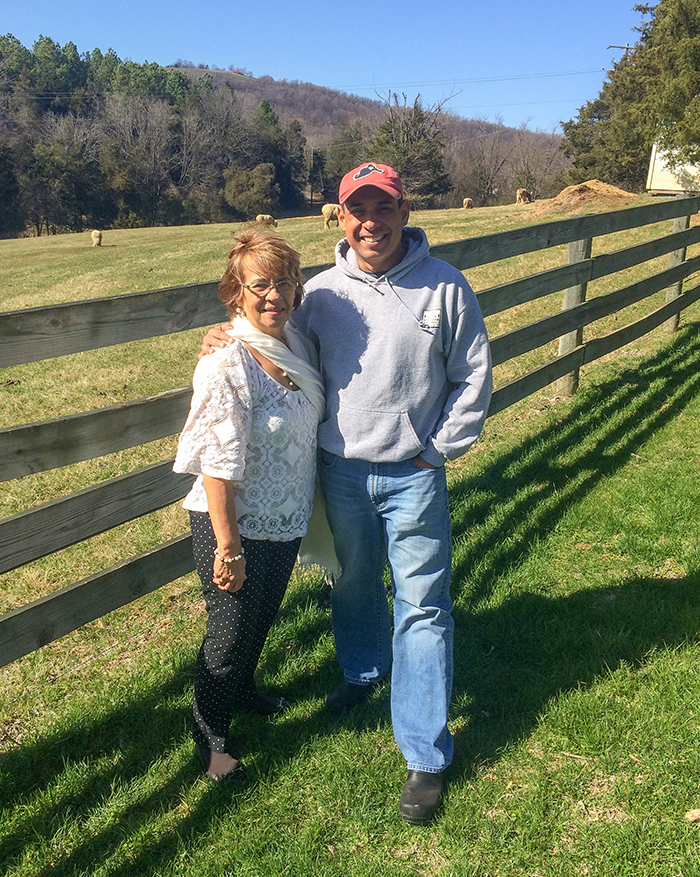
Arturo Saavedra, M.D., Ph.D., with his mom, Rosa (Courtesy of Arturo Saavedra)
Because we were at a teaching hospital, we started asking about clinical trials. And we learned about a surgeon who was experimenting with a new way of operating in that area of the body by drilling through the side of the skull and using smaller cameras to access the optic nerve, where he could carefully scrape away the tumor.
My mom’s eyes lit up. I lit up. We had a shot. And even though it was investigational, it was an option. And that option was better than no option.
We signed up, even though it involved 22 hours in surgery. She had the procedure four days later. Mom was unconscious for a while post-op but woke up in great spirits without losing her vision. She still has her vision today. She drives, she reads, she works. She’s my mom. And the tumor is gone.
I got her back. I got my entire mom back.
I share this story because it exemplifies the magic of academic medicine. My mom just wanted a chance. Hers is the type of story that helps you realize that clinical care, research and education can combine to do great things. Because there wasn’t just a clinical need, there was a research option.
At academic medical centers (a subset of teaching hospitals that are affiliated with medical schools and confer medical degrees), this is overlaid with teachers, fellows and residents, all not only interested in innovation and novel care, but who also demonstrate a love of education and have the moral imperative to both leave things better than they found them and to motivate others. America has about 220 academic medical centers. Virginia has two state public teaching hospitals: VCU Medical Center and University of Virginia Medical Center. I’ve worked at both.
Between my mom’s surgery and my time at VCU and UVA, I’ve formed a deep-seated belief in academic medical centers and their ability to save lives. Academic medicine’s educational model is based on recognizing facts and applying those facts. But there’s an even more interesting piece that we must always teach, which is how to model and encourage thinking beyond what’s known.
For example, Crohn’s disease causes chronic inflammation of the digestive tract. Symptoms can include abdominal pain, diarrhea, weight loss, fatigue and fever. About 1.6 million Americans suffer from this disease, and current therapies — a combination of the drug infliximab and an immunomodulator — can help control symptoms in up to 80% of patients.
We should absolutely teach that mechanism. But what about the other 20%? How do they get treated? Because it should be 100% of patients. If we have our hearts in the right place, we should push ourselves to get there.
We tend to teach the 80%; we need to motivate one another to reach the other 20. And maybe it’s not 20 all at the same time. Maybe it’s 7% in the next five years, and then maybe it’s a little more in the next 10. Medicine is not an end; it’s a process. We all contribute to that process. A significant part of our educational mission is to impart this sense of responsibility to our faculty, clinicians, students, residents, fellows, researchers and graduates.
And that should include developing enough fury about something that really upsets us, something we think should be better, like how neonatal deliveries should not come with an increased risk of blindness or how children across the world should not die of diarrheal diseases. That’s preventable. A lot of the greatest motivation comes from either personal experience or from something that makes you so angry that you want to try and fix it.
This is why I believe in the power of academic medicine, and why support for academic medical centers — from government grants for research and training to scholarships and professorships created through private donations — is so important.
“I share this story because it exemplifies the magic of academic medicine. My mom just wanted a chance. Hers is the type of story that helps you realize that clinical care, research and education can combine to do great things.”
Often you hear in society that money is not the end, but the means. I particularly enjoy talking to people who don’t have a background in science but are curious and motivated to do good for society. They can be our partners in the mission of academic medical centers. Because we’re not just raising money in that instance; we’re raising physicians — and nurses, respiratory technicians, radiographers and all the professionals who make academic medical centers capitals of learning, discovery and healing. We’re raising a health care team — a health care city.
Most of us don’t spend a lot of time thinking about a horrible day — the day someone hears they have cancer or that they aren’t able to have children or that they need an amputation. Many of us just don’t spend time anticipating that.
But when that terrible day comes — if it ever does, and we hope it doesn’t — what greater thing is there than to know there are people who will travel the scariest roads with you, and not only provide what’s known, but study what is unknown on your behalf? What greater thing is there than to know that on a bad day there is someone there?
All these years later, I know that my mom had more than someone walking with her on scary roads. She had a team of passionate professionals — humanists — some with scalpels, others with X-ray machines and all with one common mission: to care and to dare, in an effort to give her a chance at a better life.
