Politics & Government
Going pro
Study: Women are more effective state legislators when the state legislatures are more full time
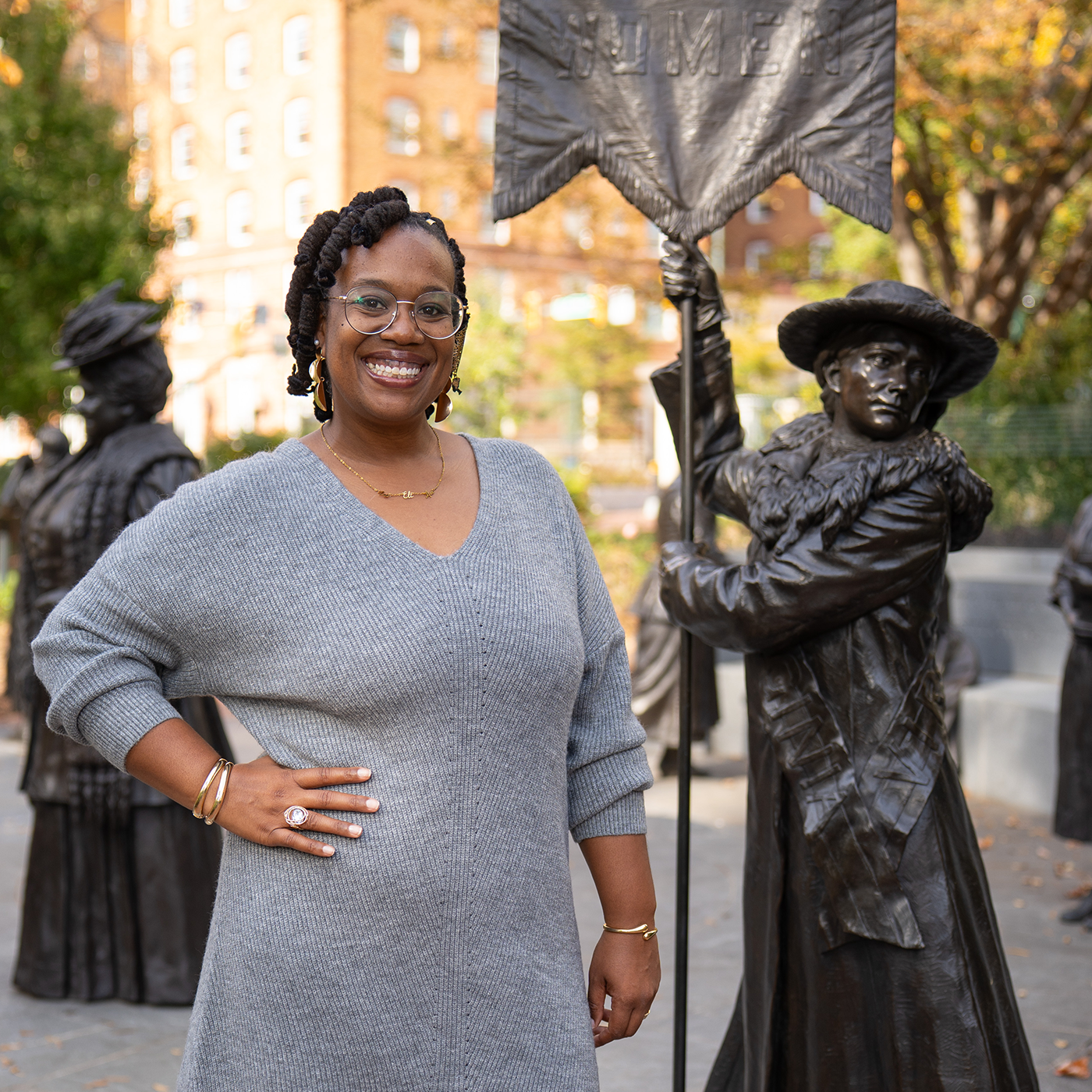
If we’re looking to make a more perfect state legislature, Jatia Wrighten, Ph.D. (B.A.’06), has tips, informed by some research of hers recently published in a scholarly journal out of the University of Chicago.
“The more diverse groups of people that we have that are elected to these state bodies, or these governing bodies, the better policy outcomes that you have — the more people who are served by these elected officials,” says Wrighten, a political science professor at the VCU College of Humanities and Sciences since 2020. “It more closely reflects people in our actual state or in our country.”
Wrighten, George Mason University’s Robert McGrath, Ph.D., and Utah State University’s Josh Ryan, Ph.D., studied the effectiveness of women in state legislatures and found that, from 2007 to 2018, the more professionalized a state legislature — in other words, the closer it is to a full-time job — the more effective women are as legislators.
“That’s not a surprise to me,” says Wrighten, who primarily studies Black women in politics. Her first book, “Oppression Made Us Leaders: Black Women, Heavy Lifting, and Leadership in State Legislatures” from Bloomsbury Press, is due out in the next year. “Women have had to move in a way that allows them to be successful in these spaces and overcome stereotypes and sexism, and so once they’re there, they do a really good job.
“... That’s exactly how you think about women who are having to overcome these higher thresholds to get into professional legislatures, that they are literally homing in on skills that lead them to leadership in these spaces, because they have to, right? It’s their day-to-day, but it also translates into actual power and actual effectiveness once they’re elected.”
Legislatures are not always representative of the populations they serve — and openly so. Just look at last year’s bout of Gerrymandering that began with Texas holding a special legislative session just to squeeze five extra Republican seats in the U.S. House of Representatives.
In terms of gender, women are half the U.S. population but hold 32% of state legislature seats. In 2025, only Colorado, New Mexico and Nevada had legislatures with women making up at least 50% percent of their membership. West Virginia had the lowest percentage (9.7%). Only 13 of its 134 state legislators were women.
“By excluding these groups of people, we have really missed out on a more effective, better- working, more representative government.”
In more professional legislatures, the study says, the women members are better educated, more likely to specialize in a certain policy and to go against party leadership. They’re also more likely to be in party and/or committee leadership and to get better committee assignments. Among the deterrents for women in state office: doubting one’s qualifications, the incumbency advantage of men, weak recruitment by party honchos and just old-fashioned gender discrimination.
“My work and the article that I co-authored is showing that by excluding these groups of people, we have really missed out on a more effective, better-working, more representative government,” Wrighten says.
The researchers defined effectiveness by quantifying the bills a legislator sponsors and stewards through “introduction, committee consideration, referral, floor consideration, passage, and enactment.” The legislators were scored with a formula that measured the “average advancement of their bills, weighted by the number of bills reaching each stage in their chamber, the chamber size, and the legislative agenda’s size.”
The study did not include the bills’ policy content.
A professional legislature, the study says, draws better candidates because members get paid enough so they don’t have to futz with day jobs when they’re out of session. This, ideally, opens public office to those who are not independently wealthy. Professional governing bodies also allow for more robust staffs.
Recent data from the National Conference on State Legislatures, a nonprofit, says the legislatures of California, Michigan, New York and Pennsylvania are the most professional. In 2021, those legislators were paid an average of $82,358. (U.S. congresspeople make $174,000.)
On the other end are Idaho, Kansas, Maine, Mississippi, New Hampshire, New Mexico, Rhode Island, Utah, Vermont and West Virginia. Legislators’ salaries in those states averaged $18,449.
Virginia is a hybrid, which describes most states. It’s a format that requires members to have offseason jobs. In 2025, the General Assembly was 30% women, and it pays its members about $18,000 a year for 60-day sessions. That’s about $37.50 per hour, which would work out to $78,000 a year.
“If we really, really want a true, in theory, democracy,” Wrighten says, “the more diverse groups of people that we have that are elected to governing bodies, the more closely it resembles people who actually live here. In my mind, that’s the goal, and knowing how we can achieve that, knowing that once we see more diverse bodies that the government is more effective. That should matter to people.”
