Campus & Community
For the Common Good
As VCU launches its $1.838 billion Unlocking Potential campaign, President Michael Rao, Ph.D., considers the responsibility of America’s public research universities and explains why the world needs more places ‘sincerely and passionately’ committed to strengthening people’s lives.
In a few hours, when he speaks at student convocation, Michael Rao, Ph.D., will be in the middle of a large and vibrant place, offering advice (and a personal story or three) to VCU’s 5,000-plus newest students.
He’ll encourage the crowd at the Stuart C. Siegel Center to soak in all that lies ahead, to embrace the idea that something new — a class, an internship, a semester in a research lab, even a friendship — might change their lives for the better. Cheerful words for an audience on the cusp.
Right now, though, the VCU president is enjoying the quiet of a Monday afternoon in the west parlor of the Scott House on Richmond’s West Franklin Street, and a lengthy conversation about how, exactly, VCU plans to make those possibilities possible. And that starts with Rao — and a memory that’s currently ringing from the depths of his cerebral cortex.
“I grew up in a town of 440 people,” he says, unprompted and settling back into his seat after a short break. “And my greatest inspirations were some of the teachers I had in high school. They were among the only people I knew who had gone to college. And so I got to college and there were a couple of people, not too many, but a couple of people who said, ‘You can do this.’ Someone said something I didn’t appreciate. He said, ‘You might be college material.’ I’m like, what does that mean?
“And so I went through the start of my college experience not being sure if I fit. And it was a place like VCU. It was a research university — an emerging research university. So that’s part of what drives me. And then I’ll sit and think about things. I mean, one of the things I have to do as president of a university is ask: Why do these places exist?”
Rao and I are about halfway through the first of two interviews. For the past 52 minutes, we’ve been talking about VCU’s future and the role of America’s public institutions. It is late August, the kind of gray, misty day that belongs on the far side of the equinox. The academic year begins tomorrow. And in one month, Rao, his cabinet and the VCU Board of Visitors will unveil Unlocking Potential: VCU’s Campaign for the Future.
The $1.838 billion fundraising campaign, which kicked off publicly Sept. 18 and continues through 2030, is organized around four pillars: increasing access and student success, leading change through innovative research, recruiting and retaining faculty and funding their research and scholarship, and sustaining institutional excellence and achieving national prominence.1
1. Learn more about the campaign, including a nuts-and-bolts breakdown of its pillars, at unlocking.vcu.edu
Rao, a longtime college president, spends a lot of time thinking about these things. In a stormy year for U.S. higher education, he seems most interested today in talking about VCU’s purpose.
“Why do these places exist?” Rao, as he sometimes does, sets up his own answer.
“Well, they don’t exist just for a handful of people; they can’t,” he says. “We have to exist, frankly, for the best that our country can be. Part of what I want to achieve through this campaign, part of what I want to achieve with everything I’m saying to you now, is how do we get more people to believe in themselves and believe that they can be successful as innovators, as entrepreneurs, as researchers, as people who really leave behind a world that’s better than the one they came into.”
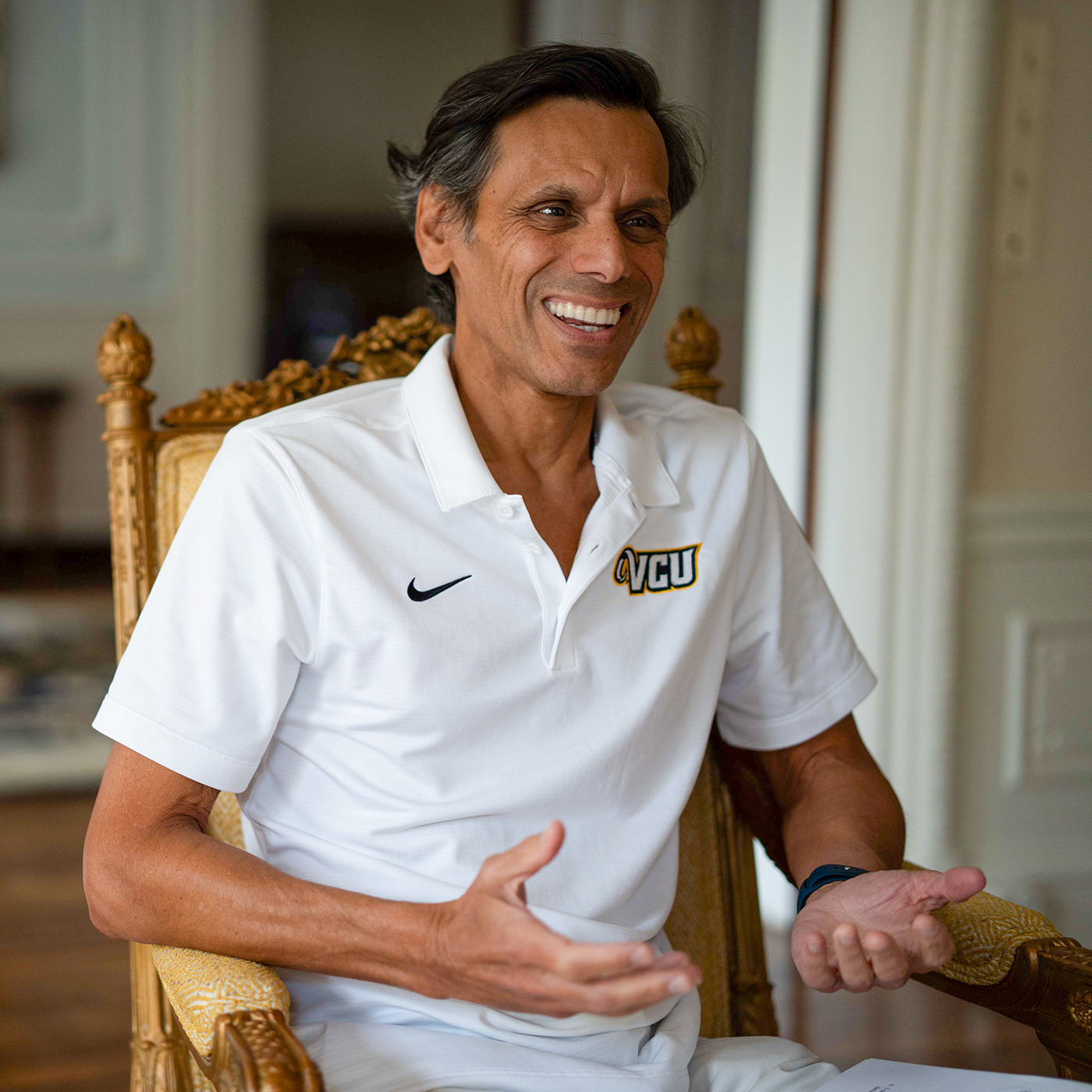
The president is sitting in a wood chair with an upholstered cushion, straight back, feet firm on the carpet, a few notes in his lap. Fifty-nine and with the frame of a swimmer, he is dressed for the aforementioned student event: a white VCU athletic polo, light slacks and sneakers. He just had a birthday, and earlier this year he celebrated something else: the completion of his 31st year as a university president. The past 17 have been at VCU, steering an academic Ship of Theseus. “This is a transient environment. You have to recognize the needs of students and patients will change regularly, and you’ve got to stay in touch with [those] changes,” he told me in 2022.
Over the decades, this idea has become Rao’s true north. Institutions must be flexible but also maintain their essence. Today, that notion has shaped a blueprint for VCU’s future, one Rao believes can be a model for public research universities: a place committed to the common good, that gives anyone with drive and potential a chance to contribute.
Today, 40% of VCU freshmen are eligible for federal Pell Grants, which help millions of low- and middle-income families pay for college. Thirty-seven percent of freshmen are first-generation students. The university awarded $1 billion in scholarships and grants from 2019-24, tops among public schools in Virginia. It has in Rao’s tenure built a liver institute, a modern art museum and elevated its cancer center to comprehensive status.2 As chairman of the VCU Health board, Rao garnered support for a new children’s hospital and an adult outpatient pavilion. He launched a public health school and increased graduation rates, research funding and social mobility for graduates.3
2. VCU Massey Comprehensive Cancer Center has been a National Cancer Institute-designated cancer center since 1975 (the year after its founding). In 2023, the NCI elevated Massey to comprehensive status. There are more than 6,000 self-identified cancer centers in America. Only 57 are rated “comprehensive” by the NCI.
3. Since 2004, VCU's six-year graduation rate has increased from 51% to 65% (the national average is 61%, according to the National Student Clearinghouse Research Center). Sponsored research funding — $568 million in 2025 — has more than doubled since 2018. A 2017 Brookings Institution study found that about 17% of VCU students move up two or more income quartiles after they graduate, among the highest on the East Coast.
The full realization of this common good philosophy is effectively an expansion of the system that helped Rao as a young man. His father died of cancer when Rao was 4 years old, and when he was 8, Rao and his mother moved from Boston to rural Pasco County, Florida, about 40 miles north of Tampa. Raised by a single parent, Rao attended the University of South Florida on scholarship, studying chemistry and volunteering at the school’s development office call center.
He worked in fundraising as a Ph.D. student at the University of Florida. As president of Central Michigan University from 2000-2009, he built a new library and a research center and started a medical school. And Rao led VCU through its most recent campaign: The Make It Real Campaign for VCU (2016-20), an $841.6 million effort that exceeded its $750 million monetary goal despite ending in the teeth of the pandemic.
Unlocking Potential has been in the works since its predecessor ended and aims to raise twice as much. Across our interviews — the second on the eve of the campaign launch and with the president this time in his customary jacket and tie — Rao spoke about the VCU model, the campaign and the civic responsibility of America’s public research universities. The conversations have been lightly edited for length and clarity.
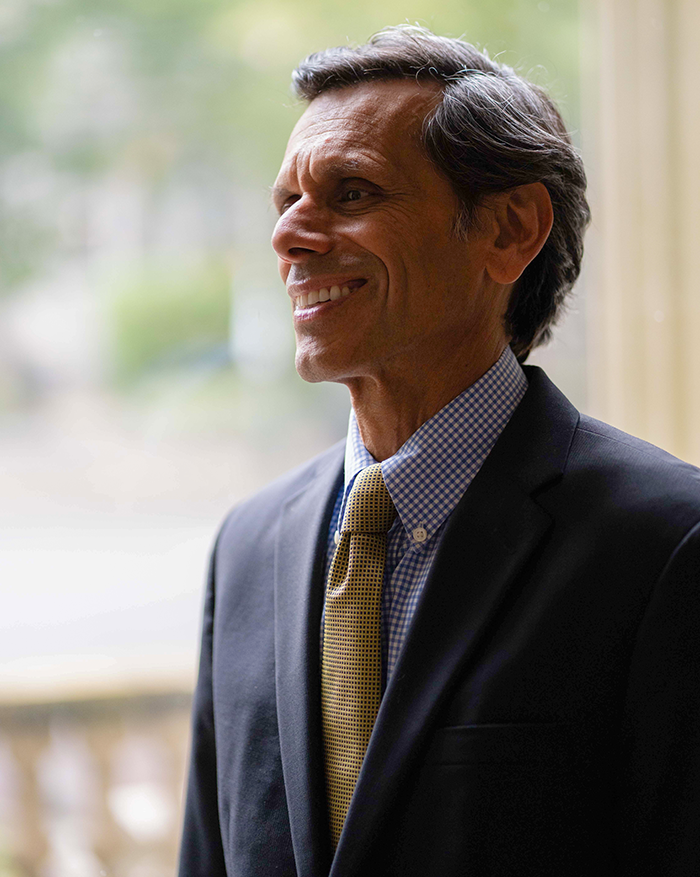
VCU President Michael Rao, Ph.D., in the Scott House (Jud Froelich)
The campaign is called Unlocking Potential. What does that mean?
It’s really about unlocking the American dream for people who have the drive and potential to achieve it. And unlocking the potential for a university that has an enormous number of different programmatic areas — unlocking their potential to work together and save and improve lives so that more people can be even stronger contributors to American society.
We’ve always had a strong impact, especially on Virginia and certainly Richmond.4 How do we increase the trajectory of that impact? This campaign is a way to get people engaged, people who have their hearts and souls connected to VCU. And it organizes a set of thoughts around our values, where we’re headed and how they can be part of that. Because ultimately, I think Unlocking Potential really is about bringing more of us together. Most things in society are challenging. When you bring people together around common purpose — something that’s good for everyone — you unlock greater potential. Because what you’re doing is, if you have a giant wheel that has to be turned, and if we all put our hands around it and turn it the same direction, we have a chance of turning it. Does that make sense?
4. VCU and the VCU Health System generate $9.5 billion in economic activity and create or support 58,000 jobs in Virginia, according to a 2022 report by the university's Office of Institutional Equity, Effectiveness and Success, Office of the Vice President for Research and Innovation and L. Douglas Wilder School of Government and Public Affairs.
It does. We went to the moon.
Yeah. I love that idea. It’s the power of inspiring each other to achieve that journey to the moon. We can convince each other that we can do it if we’re together. Whereas if you don’t have all the people in that room — like you, who just said “moon” — you don’t think about going that far. You build when you bring inspiration together. Unlocking Potential is about the future and imagining a better human experience.
You’re talking about dreaming, effectively.
I would say, yes, you’re talking about dreaming. But what you’re doing with the campaign is you are enabling the achievement of a dream.
Let’s talk about that dream. You often describe VCU in detailed terms: a public, urban, research university and academic medical center. U.S. universities have long had a foundational mission to educate, pursue knowledge, better society and create centers of discovery and intellectual discourse. Over time, though, higher ed has also changed quite a bit. The passing of the G.I. Bill (1944) and the creation of federal Pell Grants (1972) made college more accessible. The modern model for scientific research was born at large universities with major backing from the federal government. What is the role of the American public research university today and where is it going?
I think we have to be realistic about the fact that the expectations for research universities are higher on several fronts. One is we need to continue to do a better job of communicating the impact of our work. Two, we need to do a better job of engaging more people. And, three, we need to do a better job of focusing on areas that matter the most to those who invest in us.
So what matters most? One of the things that matters most to the general public is: Can you save more lives? Can you improve more people’s lives? Can you enhance the opportunities that we have to live fuller lives, more enlightened lives through the arts and humanities? Can you improve the environment? Can you help navigate problems like the weight people bear living with or taking care of loved ones who have, for example, multiple sclerosis or other neurological diseases?
And we absolutely need to be certain that we are doing everything that we can to not just emulate institutions that are perceived as exclusive and elite. By that I mean: How do you really help more people achieve the American dream? I think in many ways that starts with generating more new ideas. So what we’re doing at VCU is redefining who should be involved in what we call research and innovation.
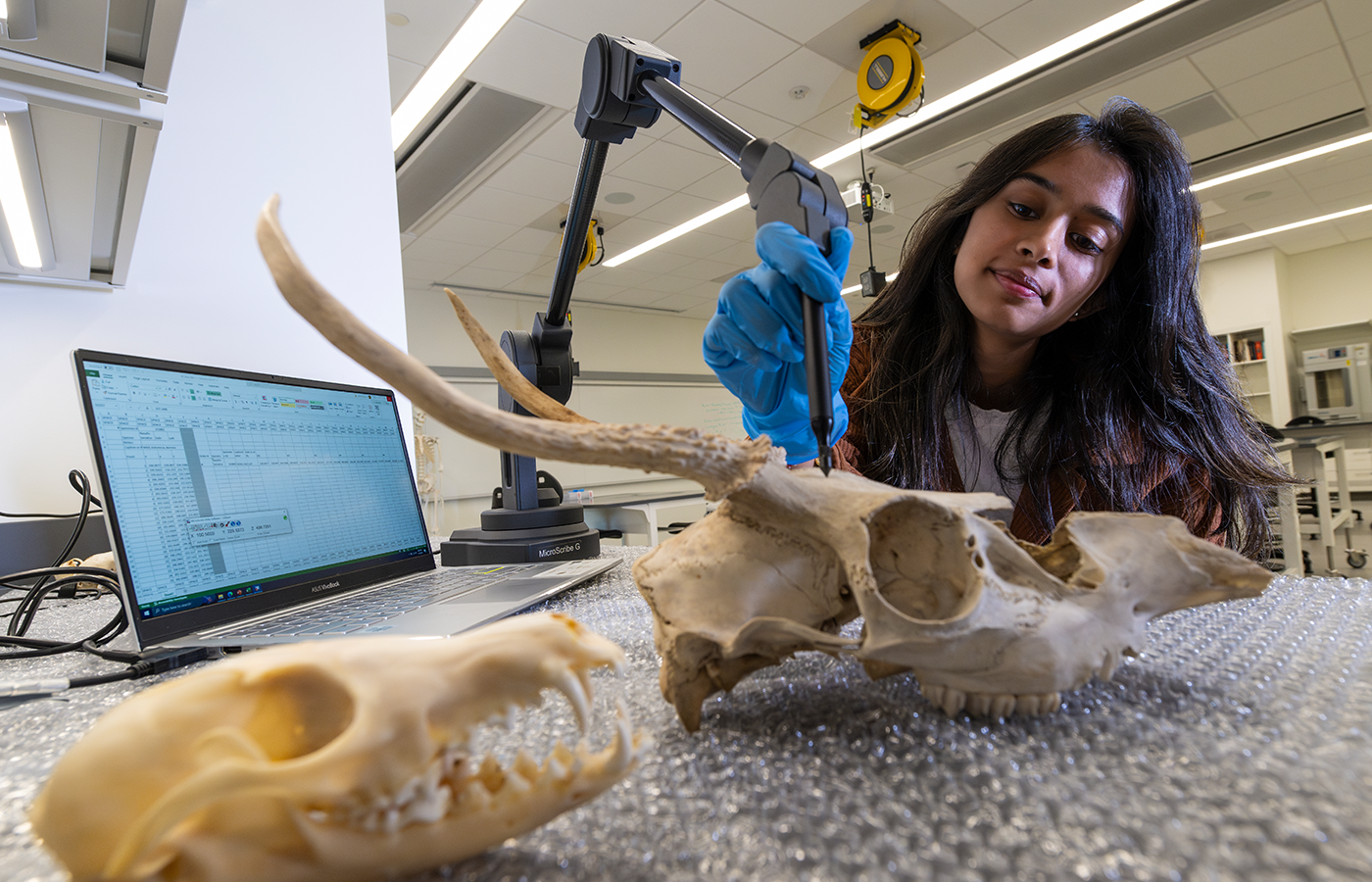
Health, physical education and exercise science student Charmi Patel scans bone replicas in a lab in VCU’s STEM Building. Patel has researched primate bones at the Smithsonian’s National Museum of Natural History. (Kevin Morley)
What do you mean by “redefining” it?
I think you have an obligation to be sure that everyone at every level — whether it’s undergraduates, transfer students, master’s students, Ph.D. students, M.D. students, D.D.S. — they all need to be a part of research because we need them to be innovators, we need them to be problem solvers, we need them to be creative, we need them to be empathetic health care providers who are determined to make things better for everyone.
And we really have to be clear about holding our standard for innovation and critical thinking. It’s high. What that creates is an institution that, at every level, is distinguishing itself through its research but also requiring students, faculty and staff to be supportive of a high-performing mission — an institution that is committed to everyone who is committed to hard work. The highest-performing institutions do not need to be exclusive. They’re going to be committed to a high standard, and with the expectation and belief that everyone, at every level of the institution, will be a part of that.
That’s how we’ve been able to go from, in my time, a bit over $200 million to $568 million in funded research. The word “access” has left people with the impression that in this collection of research universities, you’re at the bottom because you’re just letting anybody in. We’re not doing that. But we might look at a student and say, “Your grade-point average in high school was a 2.9, but your senior year was a 4.1. And candidly, we see someone who’s ready to roll. Maybe you weren’t the best test taker, but you’re an innovator. You’re committed to working hard and you will meet our standard. And the standard will be high.”
You seem to be describing a sweet spot of sorts. And I want to make sure I understand this because, within U.S. higher education, there are debates over how institutions should fulfill their missions. And this sometimes devolves into an oversimplified either/or — whether a school should be more accessible to people traditionally blocked from a college education, even if that comes at the expense of its selectivity or prestige, or so merit-based that it becomes this exclusive, inaccessible entity.
It seems you’re saying those aren’t the only choices we have, that there’s a different path where you can use the very structure and mission of a public research university to have both: more participation and a higher standard.
Absolutely. And what you have to do is find potential in people. That’s what we do. And there are more ways to find potential than simply looking at a test, looking at where someone is now. Really, you want to be looking at where they tell you they’re headed and to get a sense of their commitment to innovation and creativity, their passion to improve people’s lives. And we have to make sure that we’re combining that with a commitment to work hard, to really buckle down and understand the scientific process, the creative process, the knowledge that has been developed before.
You have to have someone who’s committed to both things. The world needs us not to just be researchers and innovators. The world needs us to create generations of people who will go out there and be committed to the same. The best thing that we can do for the United States of America and the world is to get as many people out there as we can who are committed, hard working, and sincerely and passionately want to make other people’s lives better, even if it means what they do today is going to make the lives of people better after they’re gone.
How do you create such a place?
It starts by defining what is truly public. Truly public cannot be “everybody can just walk through the door.” What it is, though, is an opportunity for everyone who’s committed to working hard to become a part of what we call research, which is effectively solving problems, answering questions, innovating and creating. You know, we use the word “research,” but it means so much more than looking into something. It’s much more about focusing and using accepted processes that have worked for years to solve problems and find answers.
Being truly public is also about the belief that when the public is investing in you, you have an obligation to engage everyone you can. Because look at it like this: You really want as many of the 340 million Americans out of the 8 billion people in the world to be successful like no other huge population of people. That’s the vision of a public entity.
And you achieve that by first believing in everyone, but then you need to be straight up with people. “We are going to expect you to work hard, we’re going to expect you to think critically, we’re going to expect you to innovate, we’re going to expect you to be a part of an experience that might be an undergraduate degree, but you’re also going to be a part of helping us understand something that humans have never been able to understand before.”
That’s the standard, and we’ll give you a chance to be a part of it, whether you have the resources or not. And that’s what the campaign is about — unlocking that potential for everyone who’s committed to the mission.
And then I think what you do is you weave it into all the parts of your institution — the educational part, the research part, the creative and scholarship part, and the health care part. It’s one reason I’m really pressing hard on internships and professional experiences for students.5 College should no longer be 120 credit hours of sitting in classrooms and remembering or regurgitating everything that you were told. It should be learning those fundamentals, those foundations and, then, like we say at the art school, building on that by creating more knowledge, more understanding, more experiences for other people.
5. In 2022, VCU's Career Services Office began providing up to $5,000 to undergraduates to help pay costs associated with their unpaid internships.
As in theory vs. practice?
You have to bring them together. It’s about what students do with what we give them. A lot of this idea was shaped by my wife, Monica, and I having two kids, two boys, and seeing how they learn best. Medical school and dental school are great examples of this. When you’re throwing so much science at students and they don’t understand how they’re going to use it, then they kind of start forgetting it, and so they have to learn it again once they start doing clinical rotations. But, as a professor, you can maybe teach that when students are closer to those rotations and contextualize what you’re expecting students to learn.
So we need to engage more people. That’s one. And we need to focus on things that matter most, like how to improve people’s lives. You know, one of the reasons I really admire the Stravitz-Sanyal Institute for Liver Disease and Metabolic Health6 is it’s truly global. It is an institute that is endeavoring to be a part of the whole world and trying to improve opportunities for people to learn about liver health and its connection to metabolism, heart disease, cardiovascular health, cancer. It took one organ that doesn’t get a lot of attention that we put a lot of time into, and it’s going to end up saving more lives than we have ever imagined. Because you can’t just keep patchworking people who have cardiovascular disease. You’ve got to look at root causes. And this gets to a root cause.
6. In 2022, Todd Stravitz, M.D. (H.S.’92), a longtime VCU liver researcher, donated $104 million through his family's Barbara Brunckhorst Foundation to help fund a new institute to study liver disease and metabolic health. The gift is the largest publicly shared donation for liver research in U.S. history. One billion people worldwide have some form of liver disease.
Then there’s the third point I mentioned — I’m coming full circle — which is how we communicate all this.
One of the challenges with a lot of what we do in science is we make lots of discoveries. Researchers at our College of Engineering and School of Pharmacy are developing a noninvasive treatment for respiratory distress syndrome, which impacts more than half of preterm infants born before 30 weeks gestation and can cause death and chronic respiratory disease. A researcher at the School of Medicine has created a suture-free solution for severed peripheral nerves — a painful condition that even the most skilled surgeons can only repair 50% of the time. How do you communicate the value of these discoveries to people who have not needed them and don’t know how to be excited about them? Or, who are the people who love the fact that we put blood, sweat and tears into creating a children’s hospital? I’ve never worked harder on anything in my life. And there are people who are enthusiasts of that children’s hospital. [But] a lot of the population’s like, “Well, I don’t really need a children’s hospital. My kids are fine.” Or, “I don’t really know why that’s so important to Mike Rao.” It’s important because I understand what it does. It saves kids’ lives. It keeps families together. It stops families from shattering.
You see where I’m going?
I do. You’re talking about being a public entity for the public good. Right? The collective good.
The collective good. And how do you communicate that value? That may not be through words, that may be through pictures, but what you’re saying to people is why this matters and why research universities matter. Why. I think we have to have more why. Why are research universities — why is this research university — so important?
How would you answer that question?
Because it is changing lives7 and it’s changing society and it’s giving society hope.
7. VCU bachelor’s degree holders earn 34% more than Virginia high school graduates, according to the State Council of Higher Education for Virginia. Patients treated at teaching hospitals have up to a 20% higher chance of survival compared with those at nonteaching hospitals, according to the Journal of the American Medical Association.
Universities teach us all how to live together. None of us live alone. We live in a society with other people. Those other people will have different views. Those other people will have different ideas. Those other people will have different approaches. They’ve grown up differently. How do we work together in a way that is civil, respectful and focused on what matters? We know that we want a more passionate commitment to improving people’s lives. One of the most important things I can say is — and this should come from the president — is here, you have such an incredibly broad range of talent, knowledge, expertise and energy from so many different fields, including the arts and humanities. One of my goals in this campaign is to get people to understand how valuable the entire place is.
A good example — I mentioned it to you before — is multiple sclerosis and the extent to which people who are living with MS and their families deal with it. Social workers are going to be critical. Monica8 and my colleagues in the arts have taught me that art is going to be critical. When do you give yourself a break from the stresses that are created by an illness that’s overtaking you? It’s going to a museum and getting yourself lost in art and great new ideas that can distract you from all of those things that could otherwise be consuming, taking a look at things created by other people, that have colors that pull you in. Imagination is important.
8. Monica Rao is a watercolorist and graphic designer.
Universities are also where discovery happens. And you want students at every level to be a part of experiencing that wonderful thing, which is that feeling of, “I now know something that no one in the world knows.” Because the fact is, there’s much more for us to know, much more for us to learn. And we know that as human beings we generate an enormous amount of energy and excitement when we have the opportunity to learn something that we didn’t previously understand, or when we learn something that helps us put all the pieces together.
Do you think, in that way, universities can be places of joy?
Universities need to be places of joy. Universities need to be places where we shape who we are. And we leave here with the ability to make the world a better place.
To me, the biggest push with this campaign is going to be: How do we use it to further strengthen faculty excellence and bring in as many students as we can who have the potential to contribute. And if you grew up in an environment where you didn’t have the resources — in other words, you were poor — you need to be a part of what we call a research university as much as anybody. We need as many people in this as possible believing that they can make a difference in the lives of thousands and not thinking that it’s about themselves as much as it’s about how they can improve the lives of others.
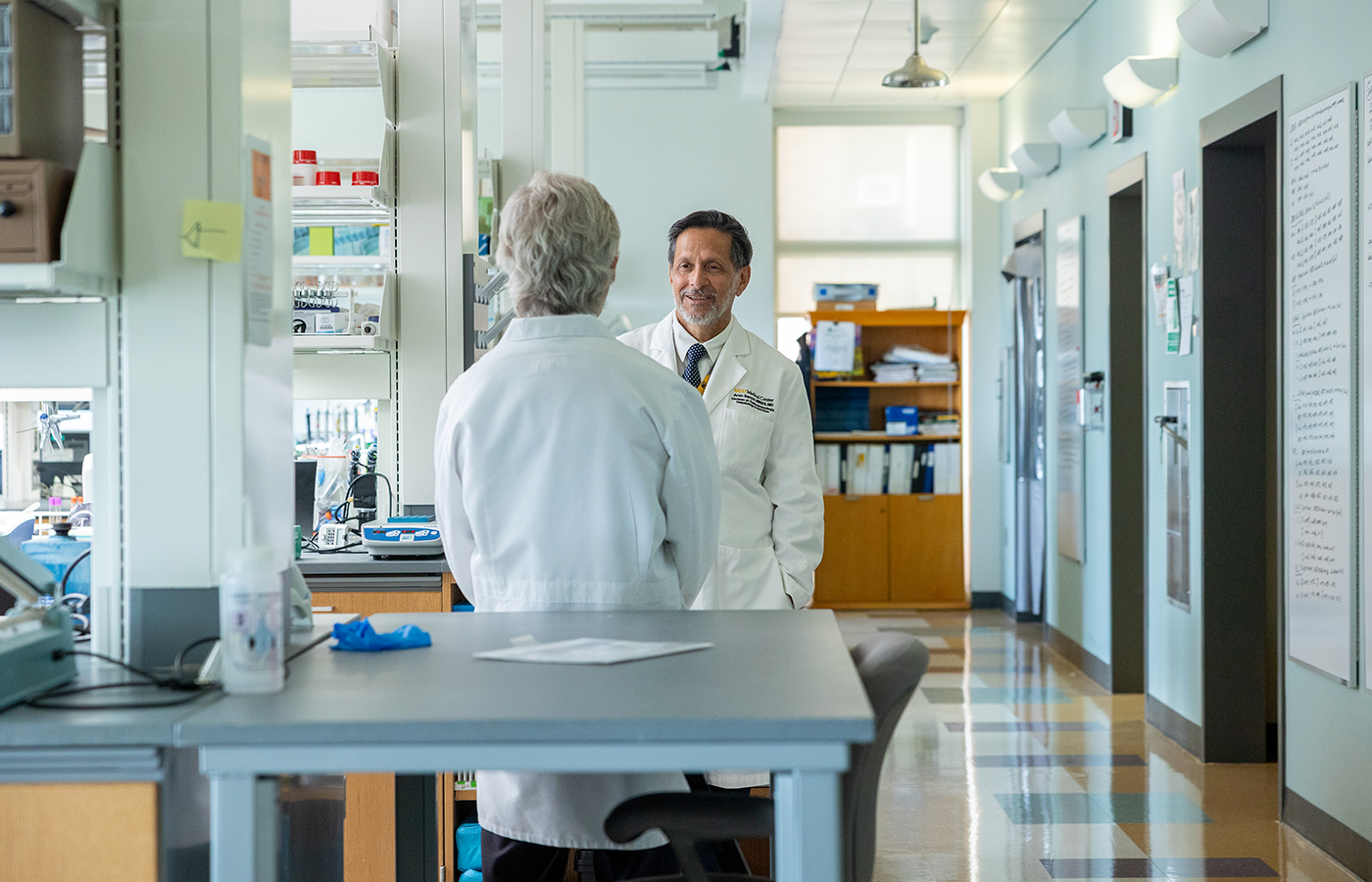
Arun Sanyal, M.D. (H.S.’90), director of the Stravitz-Sanyal Institute for Liver Disease and Metabolic Health (Tricia Evangelisto)
Earlier you said your personal story — growing up in a small town, not being sure if you fit in at college — is part of what drives you. Does it shape your point of view about the kind of institution you think VCU should be?
For sure. There’s no question that my uncertainty about where I might or might not have belonged influences that. How do I remove that uncertainty from as many students as possible — including adults who have partial college, including veterans who have come back from their service? How do you give them the sense that: We’re just looking for you to really work hard, to be critical thinkers, to be honest and to be as much in search of real truth as possible?
Do you think public institutions and universities have an obligation to do that?
Yeah, they do. And that’s where you can achieve that best model of a public research university that will help make America a best model country in a big world.
VCU has had a lot of institutional achievements in your time here. Massey becoming a comprehensive cancer center. The liver institute.
The children’s hospital.
Right, the children’s hospital. And there’s always this big celebration and acknowledgement of the achievement. You seem to also frame these as springboards into what’s next.
It’s always the way I think about it. You’re never done. And, to me, it’s energizing to set your mind that way. We all need physical breaks. But the reality is, when you have the privilege of leading, you’ve got to continue the vision. You’ve got to continue to keep as many different colors in your hands as possible, to keep painting and bringing clarity to this picture of what a research university can be.

VCUarts Dean Carmenita Higginbotham, Ph.D., at the Institute for Contemporary Art. The best research universities, Michael Rao says, are the ones that understand the power they have to improve the human condition, including through the arts and humanities. (Tricia Evangelisto)
Do you have more clarity today?
You know, some of the things we’ve achieved were ideas I came in with: When I got here in 2009, I envisioned Grace Street as a living-learning center where we moved ahead with student residences focused on community service, global studies, leadership and innovation. We also got going on the children’s hospital and making VCU Massey a comprehensive cancer center. But a lot of the things that I want to see going forward are not things I thought of back then. They’re informed by the wisdom that you gain from time, the wisdom that you gain from your feelings over time. And my feelings are really motivated by empathy for a lot of people out there who could be a part of this that aren’t and who may be some of our very best minds.
How do you take that edge off? Well, that’s what the campaign is about: removing that edge, removing a financial barrier, a status barrier. Private support becomes starter fluid.
It’s also about investing further. A good example, again, is the liver institute. Did VCU have the makings for a liver institute before? Oh, yeah, definitely. But did we have the resources to become a global liver institute that would impact metabolism, cardiovascular health and other forms of health? No, not yet at that time. And so how do we turn not yet into now through this campaign?
Then there’s faculty. We have to make sure we’re supporting and hiring faculty members who are committed to all aspects of our complex mission. In the old structures, what you typically saw in higher education were institutions that would have a senior professor who had been there for years and years, and anyone who came in would have to be subservient to that person for a long time. Today, what you have at VCU is the opportunity for people to rise rapidly, for people to be encouraged to create, to focus on things that may end up being helpful to people, as opposed to just simply sounding good academically. You’re building a team. And that team’s focus is solving problems faster and from the perspectives of many different fields, saving more lives faster — all for people who need us to move faster.
We have to make sure that the standard for our faculty performance is very, very high because your faculty is your university. And your students are, too. How do I bring more students in who might not have believed in themselves, but we know they have the drive and potential to succeed here? They’re smart enough. They’re creative enough. They’re innovative enough. They may even have experiences like I did. I mean, one of my experiences in high school — have I told you how I got through?
I don’t believe I know this story.
I got through by doing vehicle maintenance and vehicle detailing. Somebody recently said to me, “My gosh, my car is sliding all over the place.” And I said, “Well, send me a picture of your front tires. Is your car front-wheel drive?” And I looked it up and I found out that it was front-wheel drive. And I said, “Did you rotate the tires?”
What I’m saying is: Kids who have those kinds of experiences, kids who go on missions and have been all over the world and have seen people suffer, they bring a spirit, a motivation and an energy. And so how do you get those kids to believe enough in themselves to work hard and get them here?
Resources are going to be a key piece of all this, no question. And another thing that private funding can do is it often spurs on more public funding. Belief by people who have something at stake — meaning they’re giving you their personal resources — is often convincing to people distributing public resources.
When you said moon at the front end, I jumped on it. And the reason I did is sort of a culmination of all the things I’ve said: I have been a president for 31 years. And now my real obligation, my real mission, personal mission, is: What are the biggest things you can use this presidency to achieve that will really transform more lives, everyone’s lives that you can get ahold of, particularly the people who aren’t sure if they believe this is for them? I think this is a campaign of converging ideas that will inspire us to unlock more potential in every American — and in everyone that wants to be a part of this.
