
Campus & Community
Architecturally Speaking
From stately landmarks to a renovated horse stable, VCU Magazine presents a (by no means comprehensive) tour of notable campus buildings
Here’s one for you: How would you describe — or define — the Virginia Commonwealth University campus?
Well, you might start by explaining that it’s two distinct campuses: the MCV Campus at the eastern edge of downtown Richmond and the Monroe Park Campus on the western edge. (The Virginia General Assembly established the university in 1968 by combining two established Richmond institutions, the Medical College of Virginia and Richmond Professional Institute.)
What else?
Hmmm.
Well, unlike some Virginia public colleges and universities, neither VCU campus has an overriding architectural feature such as the khaki-hued and castellated stone walls of Virginia Military Institute or William & Mary’s axial grid that connects the 17th-century Wren Building with other campus landmarks and Colonial Williamsburg’s Duke of Gloucester Street.
And many campuses statewide were built in the countryside. The University of Virginia (1825) is a classical revival fantasy of redbrick buildings that line a terraced lawn in once-rural Albemarle County. Engineers at Blacksburg’s Virginia Tech (1872) diverted and sank an active creek through a long culvert to create the sprawling Drillfield, a dramatic greensward now flanked by fortresslike buildings in gray Hokie Stone. And Virginia State University’s historic campus (1883) in southern Chesterfield County commands a bluff near the Appomattox River. Its original redbrick colonial revival buildings are an architecturally chaste nod to adjacent Petersburg.
VCU’s architectural underpinnings are more difficult to neatly categorize. The intentionally urban institution is embedded in 18th- to 21st-century streetscapes populated with scores of buildings in myriad sizes, forms and styles.
When the Egyptian Building, the first purpose-built MCV facility — and therefore VCU’s first structure — was wedged into the hillside at College and Marshall streets in 1845, the crossroads had been well-trodden for more than 100 years. It has dignified and anchored the neighborhood atop Shockoe Hill ever since, while admittedly being eclipsed in scale by the ever-expanding facilities of VCU Medical Center.
Across town, Richmond Professional Institute led a peripatetic existence from its founding downtown in 1917 until 1925, when it settled permanently in the Fan. In 1925 it purchased the big-chested Gilded Age Saunders-Willard House at 827 W. Franklin St. Now known as Founders Hall, the red-brick and stone mansion graced a fashionable residential neighborhood until the early 1900s, when electric streetcars and the automobile began transporting its habitués to newer, farther suburbs.
Therefore, unlike the grounds of UVA, Tech or Virginia State (or the once-pastoral environs of Longwood, James Madison or Mary Washington, for that matter), understanding how VCU developed requires sleuthing. Consider the adventure an architectural treasure hunt of campus landmarks, many tucked next to non-VCU neighbors.
Some buildings or combinations of buildings might wink at passersby more than others. And even if they aren’t as dramatic as the Egyptian Building or as decorative as Founders Hall, they nonetheless deserve your face time. Each entry examined here symbolizes something special about the university’s ever-evolving growth and aspirations. Each also might express the importance of an individual or group or an architect whose smarts, vision, moxie or generosity played a part in stitching the intriguing quilt that helps define this unique American campus.
Slideshow
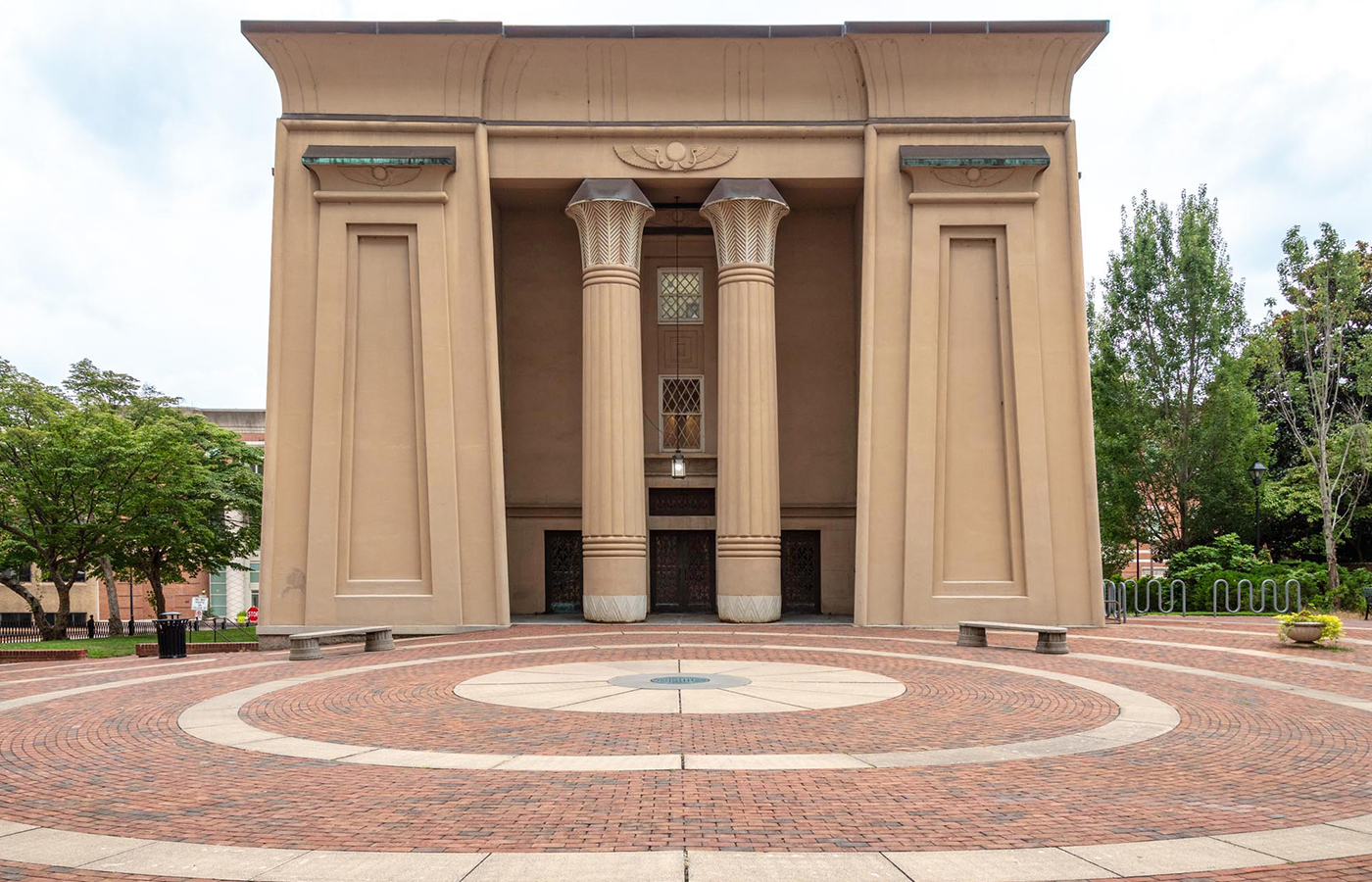
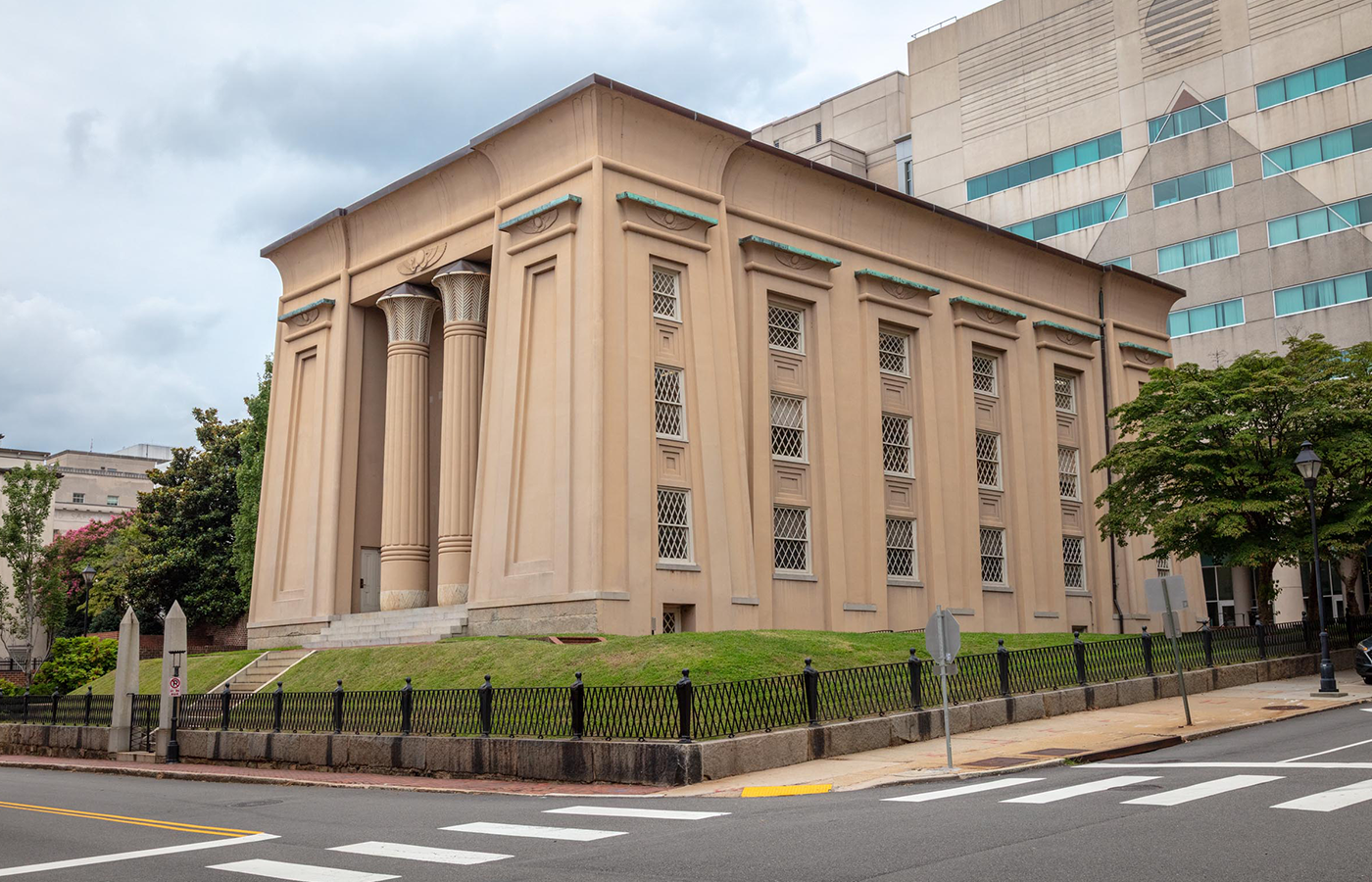
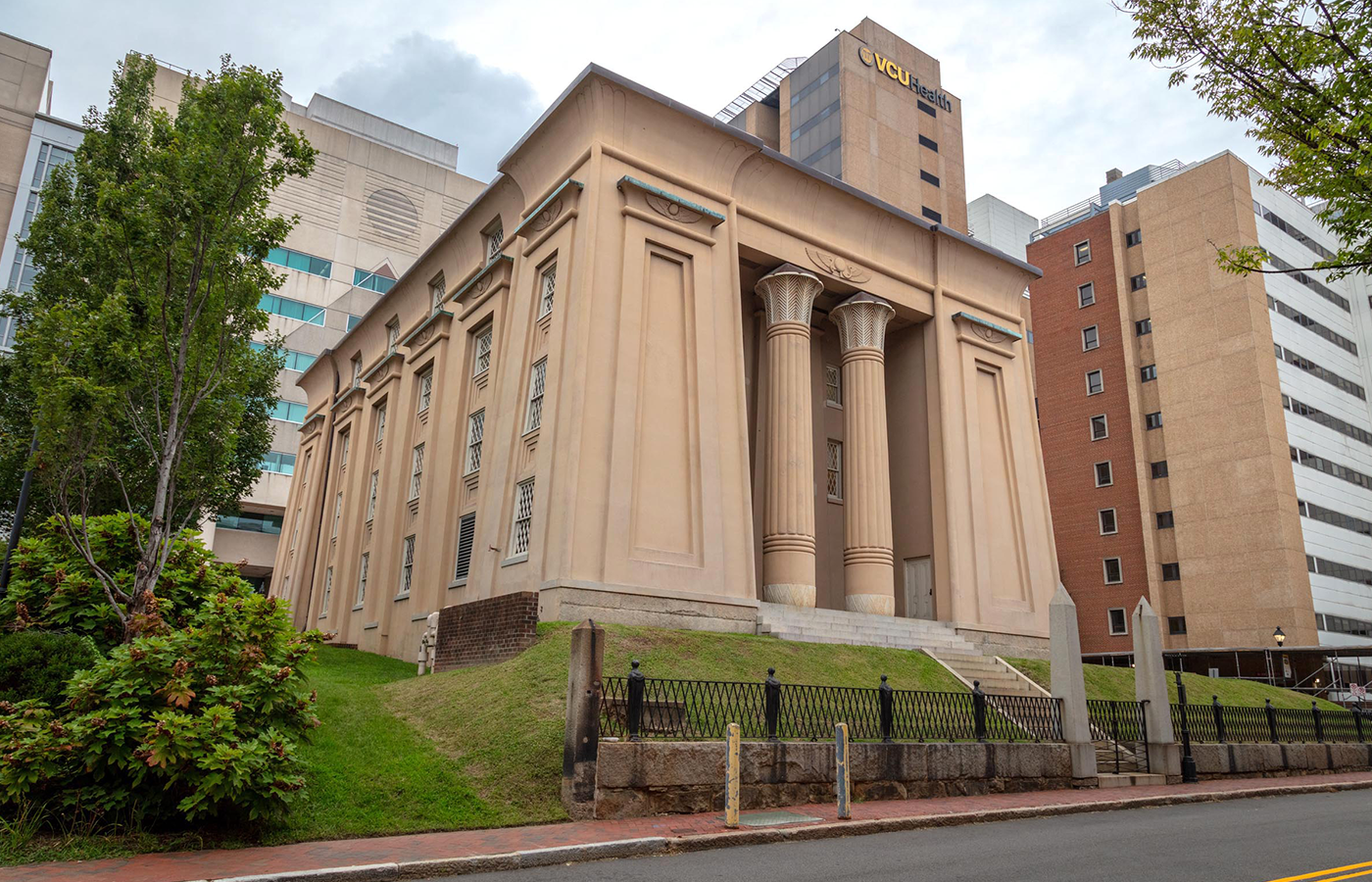
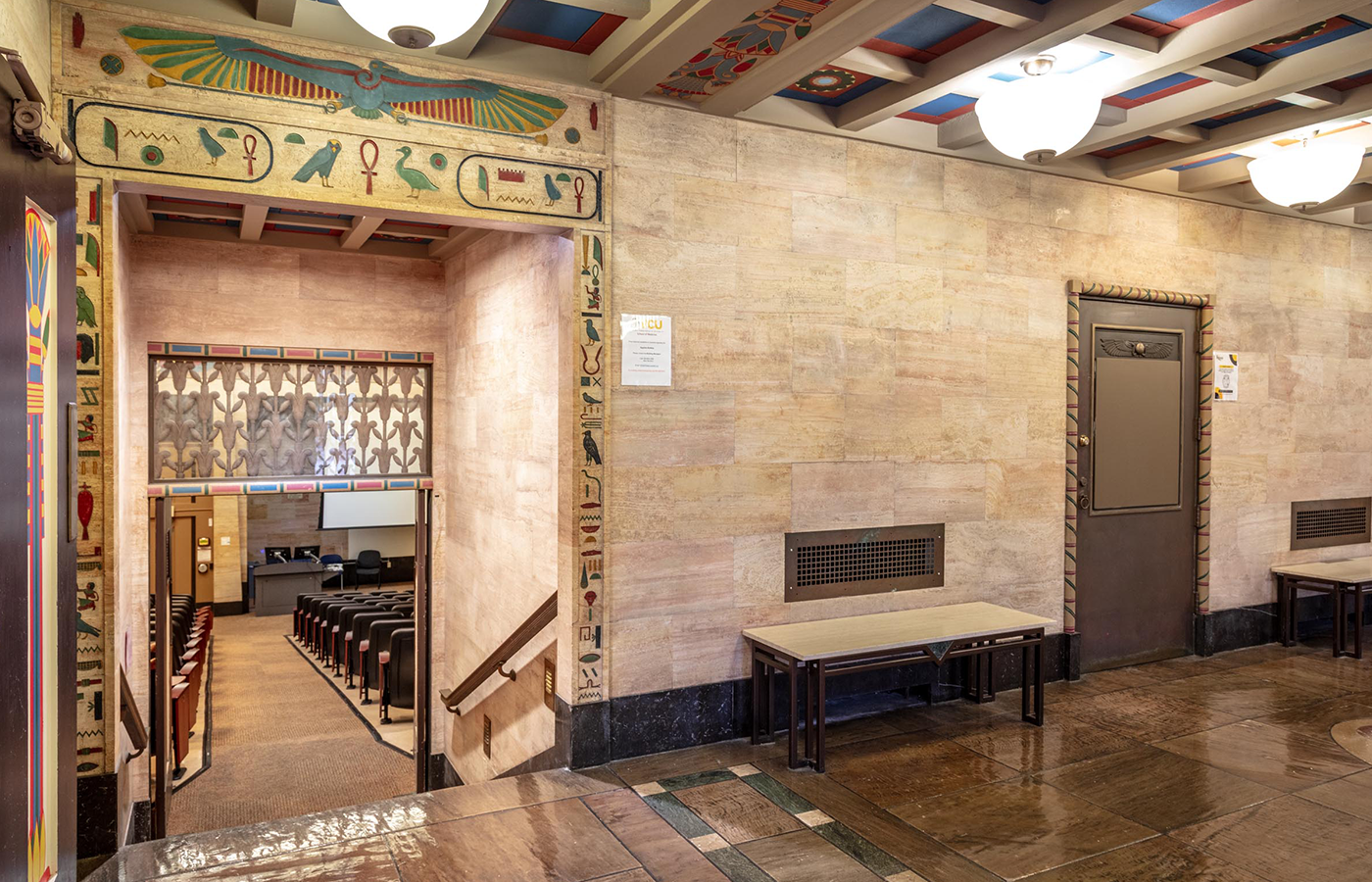
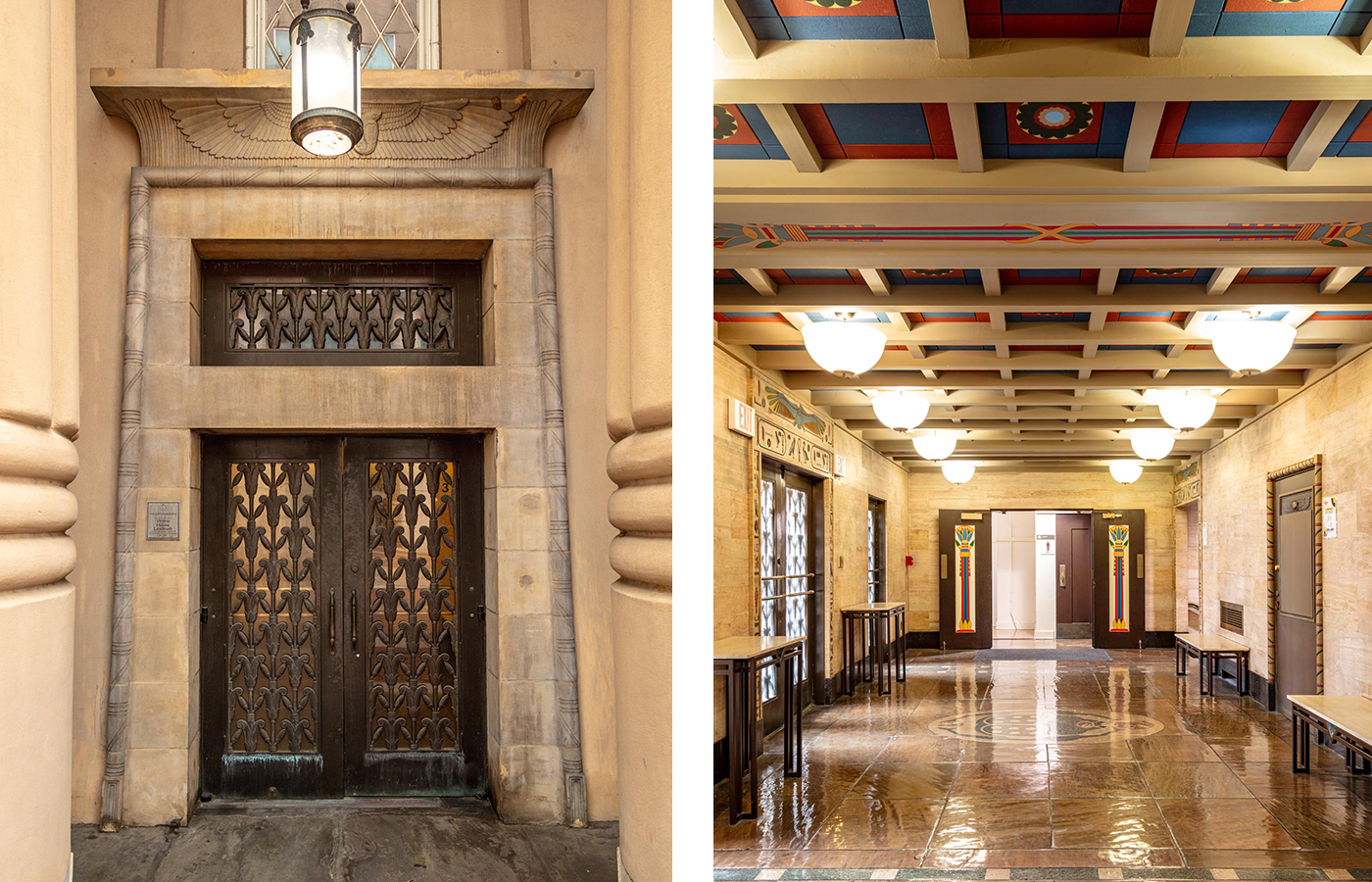
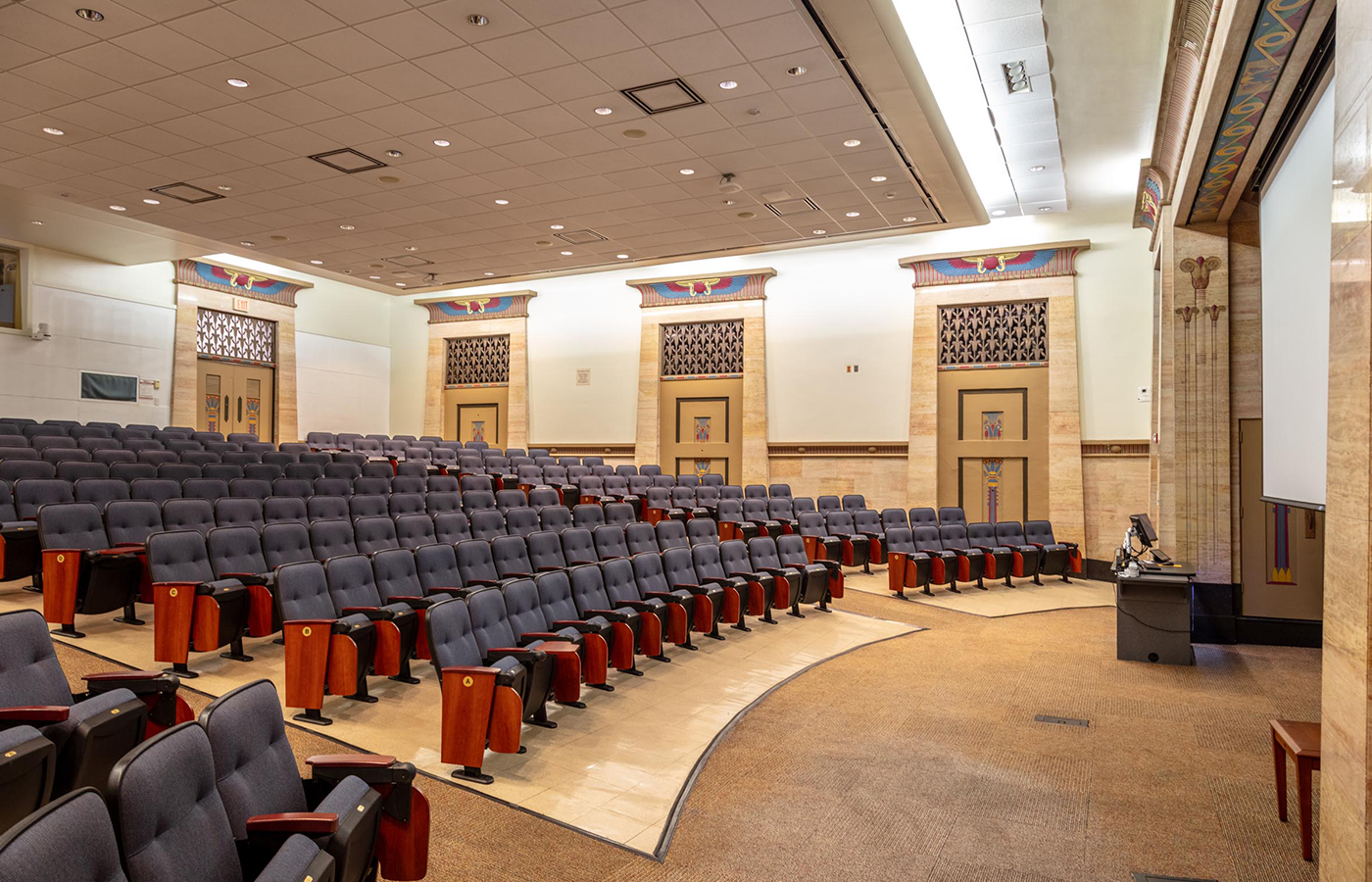
The Egyptian Building (1845)
In 1838, Hampden-Sydney College, located near Farmville, pioneered a medical school at the Union Hotel in Richmond’s Shockoe Valley. Four Richmond physicians had asked the nation’s 10th-oldest college to establish a school to address urban health issues. (The doctors were also concerned that too many Virginians were moving north for medical schooling.) By the mid-1840s, when the school had outgrown its first facilities, city, state and private funds were raised to purchase a lot on the promontory of Shockoe Hill for a new building.
The architect was Thomas W. Stewart of Philadelphia. In 1843, he had designed a church sanctuary in the Greek Revival style for Richmond’s St. Paul’s Episcopal across Ninth Street from Capitol Square. For the medical school, Stewart delivered a startling four-level adaptation of an Egyptian temple with colossal columns with palm-frond column capitals, battered (inward-sloping) walls and cavetto (curved) cornices. Though temple-like, it included classrooms, offices, labs, a lecture hall and hospital rooms, and today is the South’s oldest medical education building in continuous use.
Designers of the day had numerous revivalist options such as Roman, Greek and Gothic, as well as the Italianate style. So why did Stewart choose the Egyptian style?
Although the Egyptian style proved exotic for Western tastes, the motifs were available through widely distributed pattern books after Napoleon invaded Egypt in 1798. He embraced Egyptian antiquity as French patrimony and commissioned a 20-volume “Description of Egypt.” Written by scores of scholars, architects and artists, it included designs and illustrations of a range of sites and artifacts, including objects from Luxor, Dendera and the Valley of the Kings.
Published by 1829, this cultural achievement excited American architects. In addition to the publication’s influence in funerary design and Richmond’s Egyptian Building (designated a National Historic Landmark in 1971), “Description of Egypt” inspired equally worthy renditions at the Old Whalers’ Church in Sag Harbor, New York (1844), and the Downtown Presbyterian Church in Nashville, Tennessee (1851).
VCU’s architectural landmark, however, boasts something more. It might be the world’s only Egyptian revival building whose design reflects the only other time the style was in vogue. During the 1920s and ’30s, following the 1922 discovery of the tomb of King Tutankhamen, Egyptian-inspired architecture, fashion and motion pictures were the rage. In 1932, the influential American financier and international affairs adviser Bernard Baruch underwrote the interior renovation of the Egyptian Building as a memorial to his father, MCV alumnus Simon Baruch, who earned his M.D. there in 1862. The Richmond firm Baskervill & Son reworked and modernized the interior using an Art Deco palette you can still see today.
Slideshow
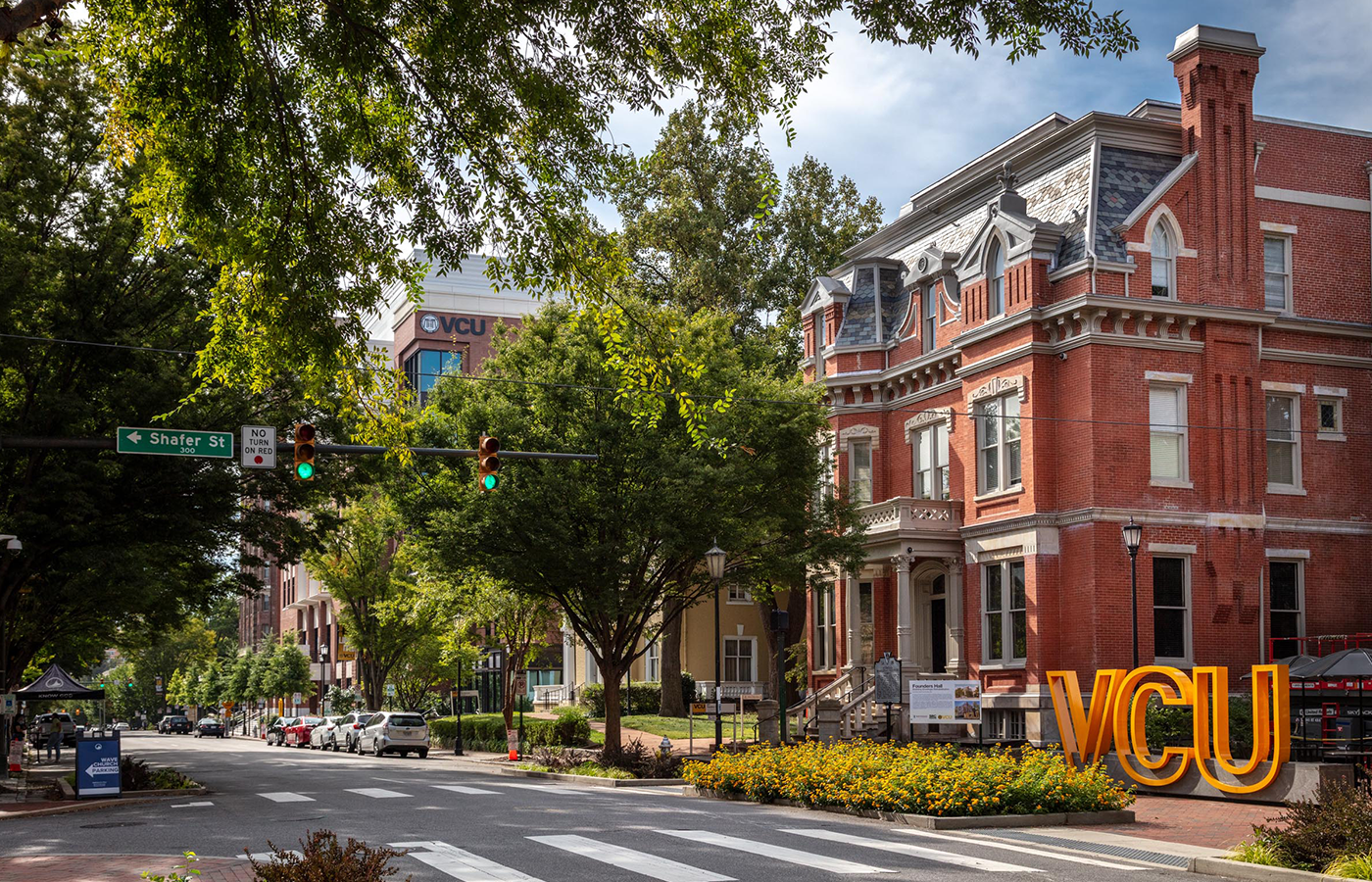
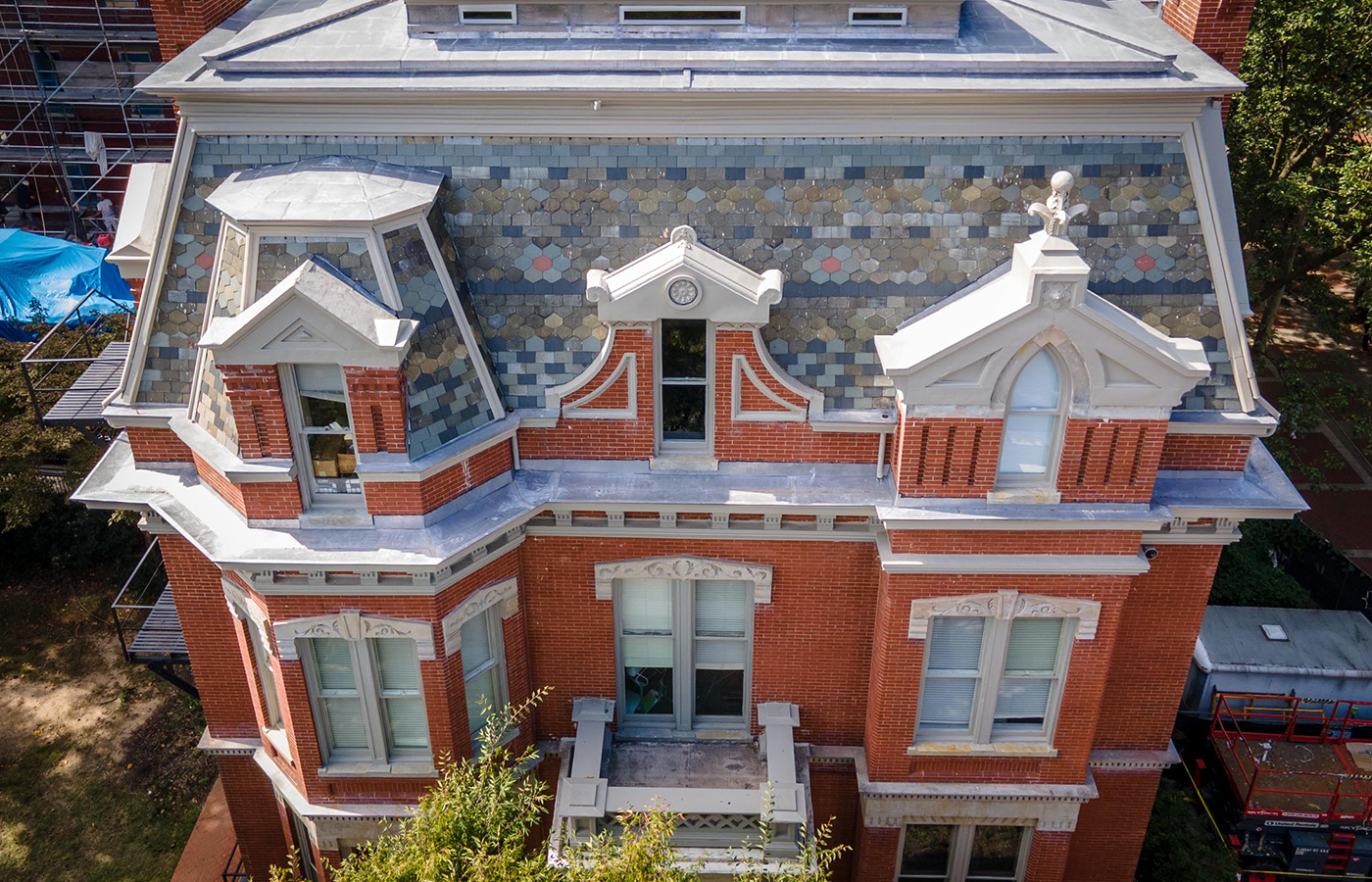
Founders Hall (1888)
The handsome Saunders-Willard House at the corner of West Franklin and Shafer streets was selected in 1925 by Henry H. Hibbs, Ph.D., the founder and head of RPI, to be its first permanent building. Hibbs had moved to Richmond in 1917, after earning his Ph.D. in sociology from Columbia University, to oversee what was then the Richmond School of Social Work and Public Health. The program had been initiated and nurtured at the First English Lutheran Church as part of its social gospel ministry.
With 52 full-time students (all women) and no budget, Hibbs was savvy in finding space in public buildings at little or no charge — the school held some classes in three small upstairs rooms at the Richmond Juvenile and Domestic Relations Court downtown and hosted assemblies in the courtroom itself. Saunders-Willard, an imposing Second Empire-style house, had been the home of a former tobacconist and later an ambassador to Spain. Hibbs called its location “a good, central neighborhood.”
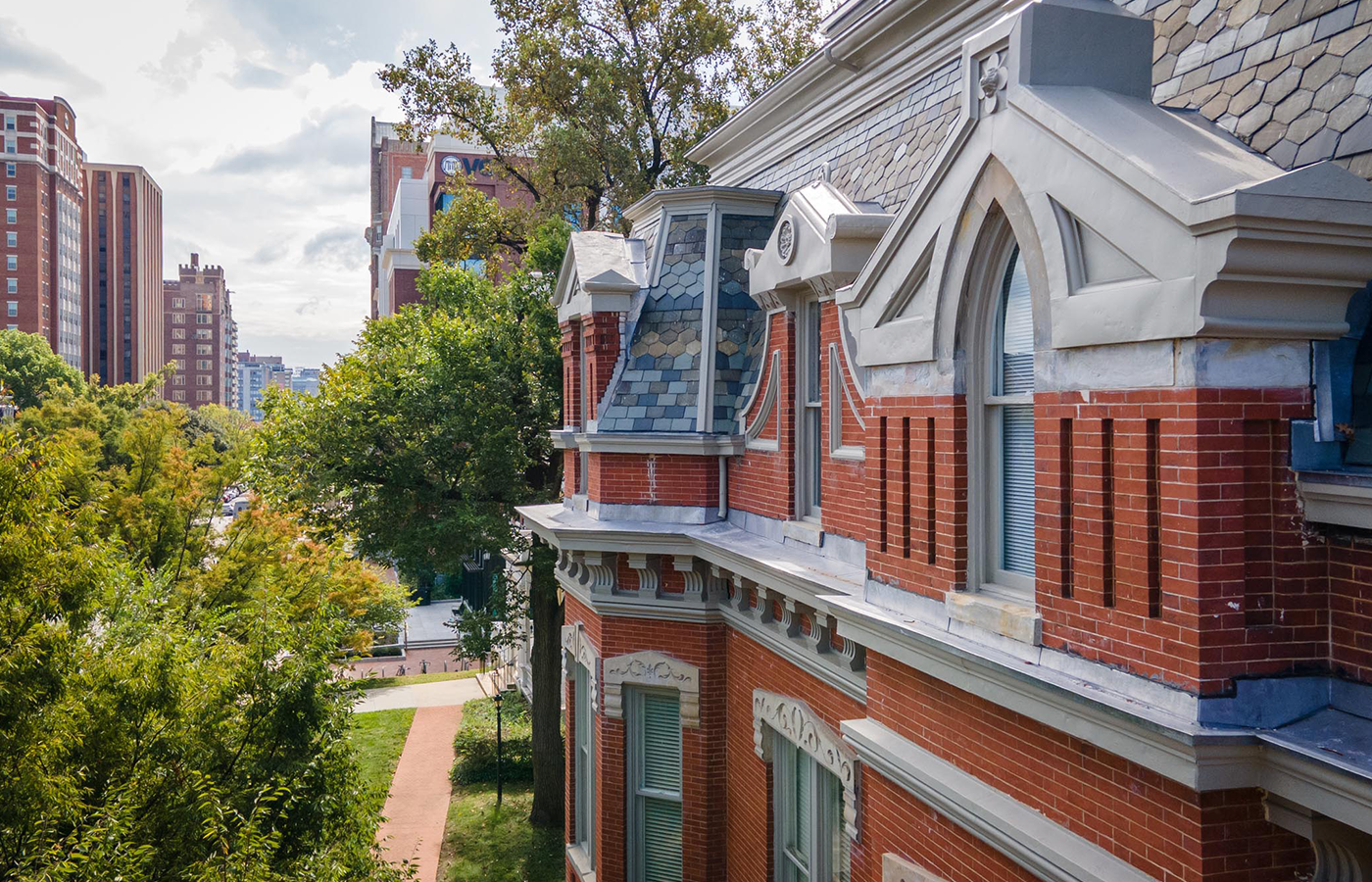
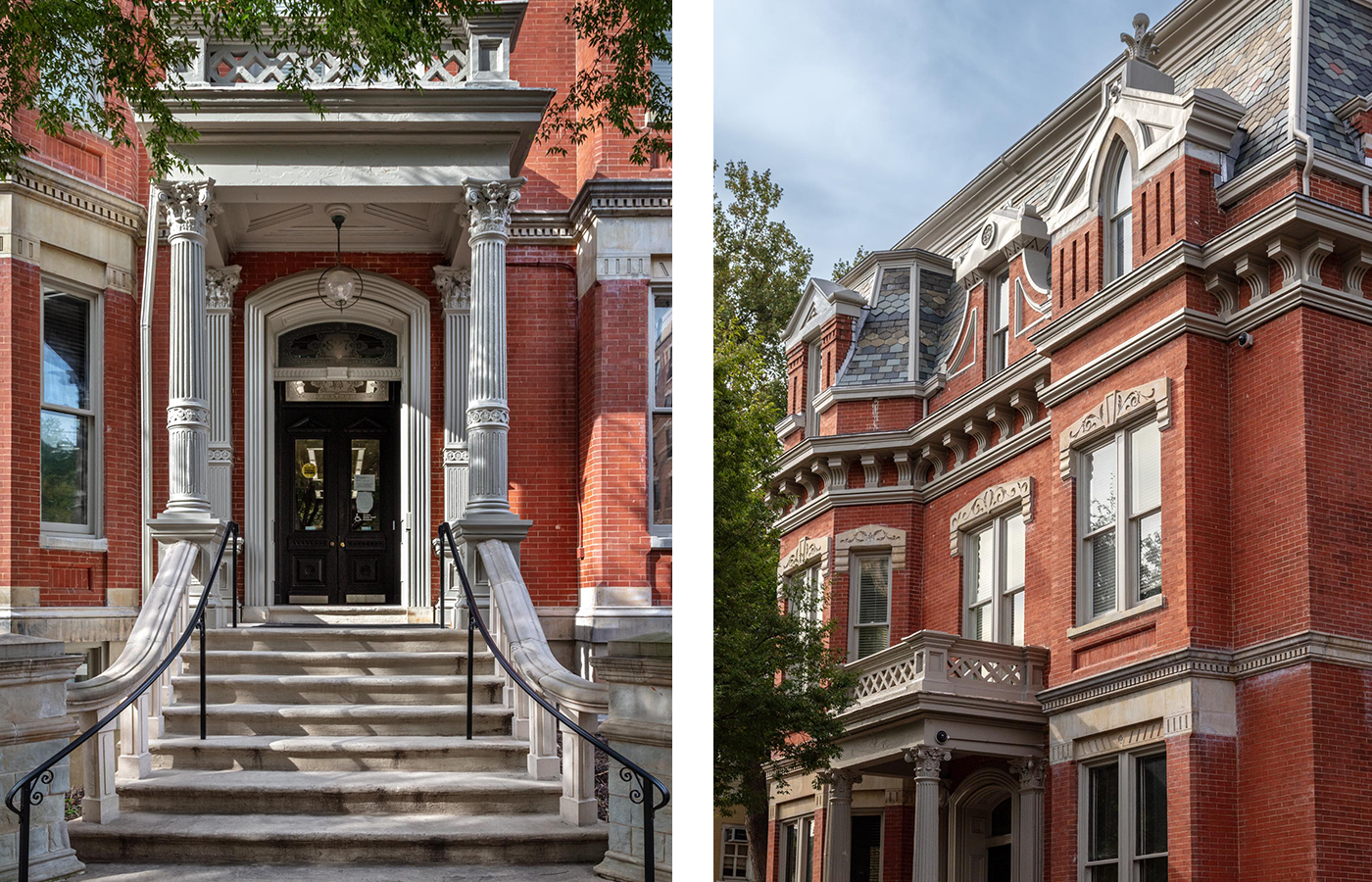
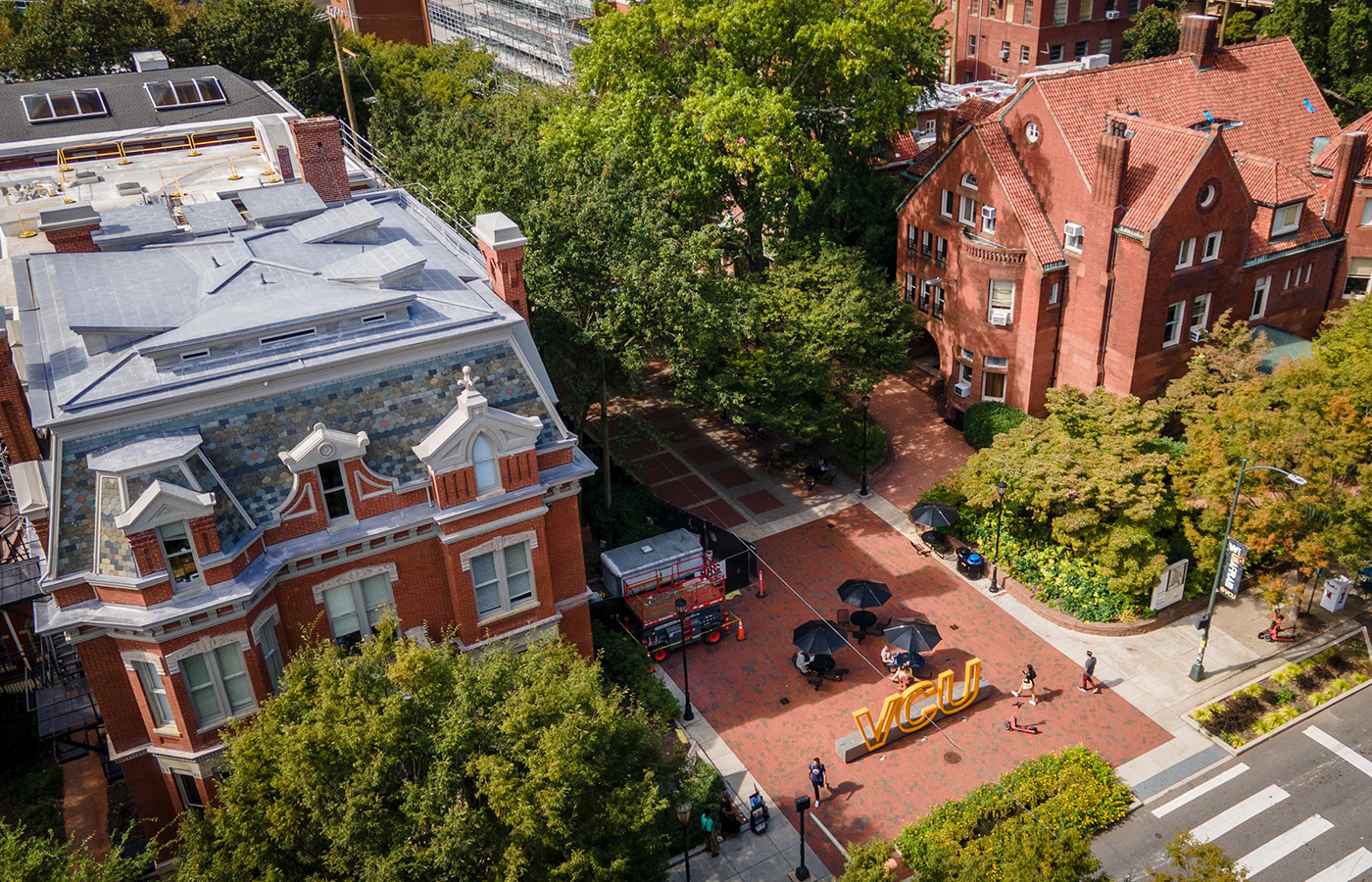
Like the Egyptian Building, the house exemplified the prevailing taste of its time, in this case, the architecturally eclectic post-Civil War decades. A mansard roof (steeply pitched) runs across the front of the house, from which project three quite different dormer windows — including a Gothic Revival portal. For some reason, the heavy, bracketed entablature at the roof line doesn’t extend across the front of the building. The porch columns are made of cast iron, a muscular touch during the Industrial Age.
Hibbs (who never took the title of president) saw to it that equal activity went on inside. On the first floor, the front parlors housed administrative offices, with classrooms in the rear. The kitchen and cafeteria were in the basement. Dorm rooms took up the second and third floors. The large, two-story stable in the rear was gutted and turned into a small gymnasium (it later became the Shafer Street Playhouse).
Hibbs’ adaptive reuse set the model for how he would acquire and use other houses and apartment buildings as they became available, including Millhiser House, Hunton House and Lafayette Hall, all within a block of Founders.
Slideshow
The Administration Building (1888)
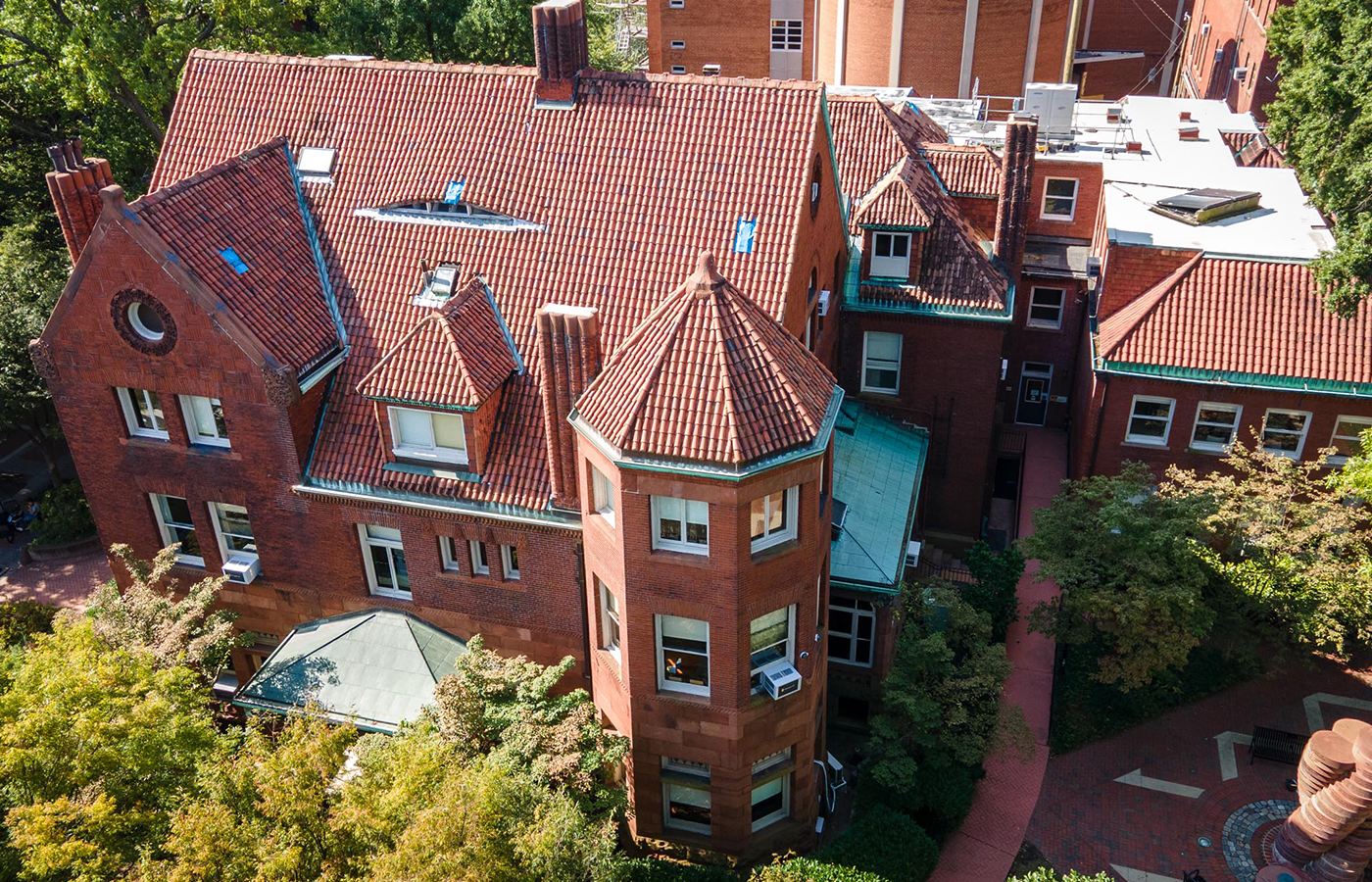
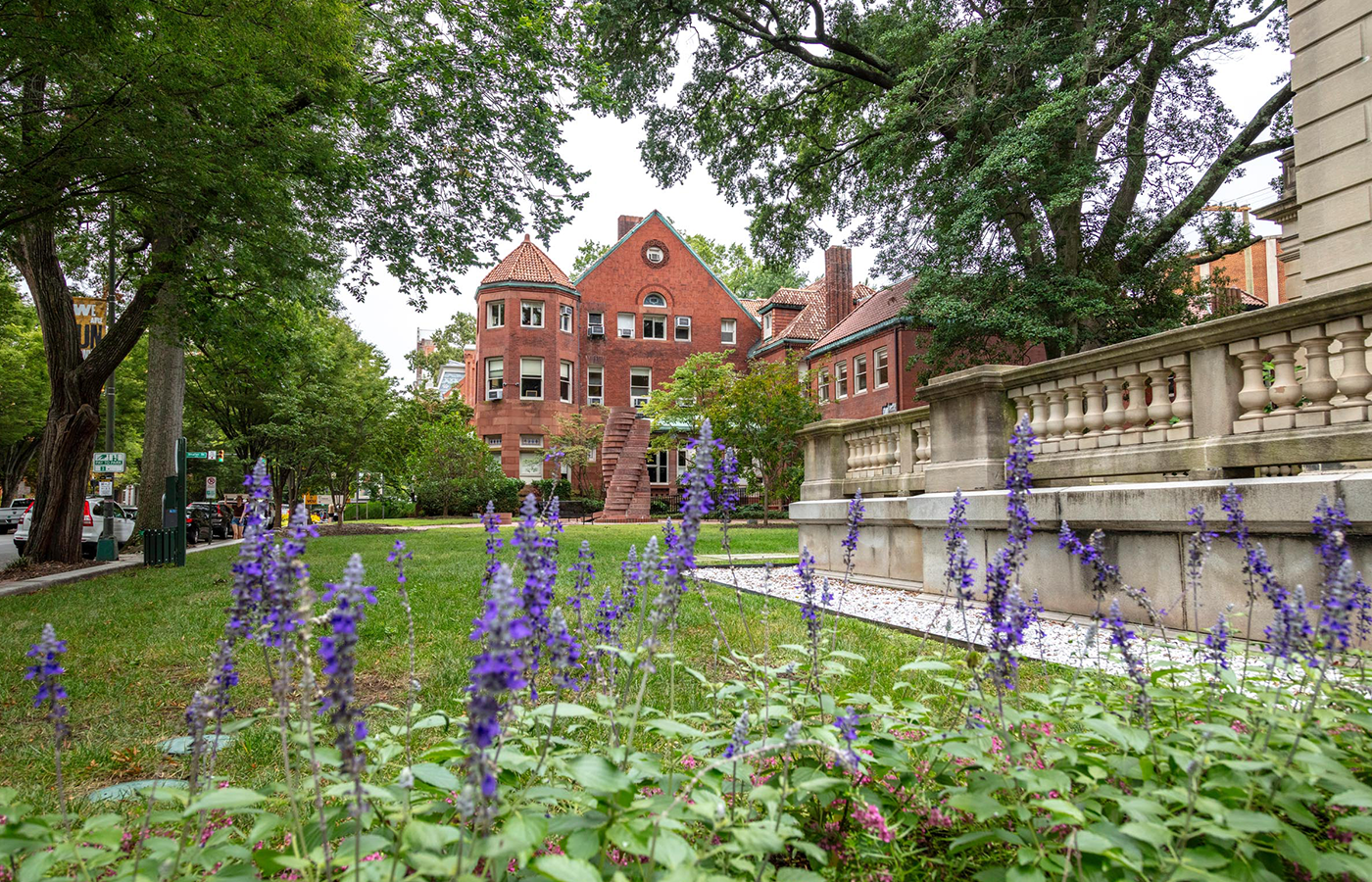
Hibbs’ decision to buy the Saunders-Willard House in 1925 was driven, in part, by the first Richmond municipal library, which opened the same year, right across the street. It was in the substantial former home of Lewis Ginter, a wealthy cigarette and cigar manufacturer, real estate developer and hotelier. Hibbs could now claim to have a two-building “campus.”
The arrangement lasted until 1930, when the library moved to Franklin and First streets. Hibbs then had RPI purchase the Ginter house as an administrative building — still its purpose today. Hibbs converted the carriage house behind it into an art gallery, and later RPI’s main library, a purpose it served for 40 years until VCU built James Branch Cabell Library in 1970.
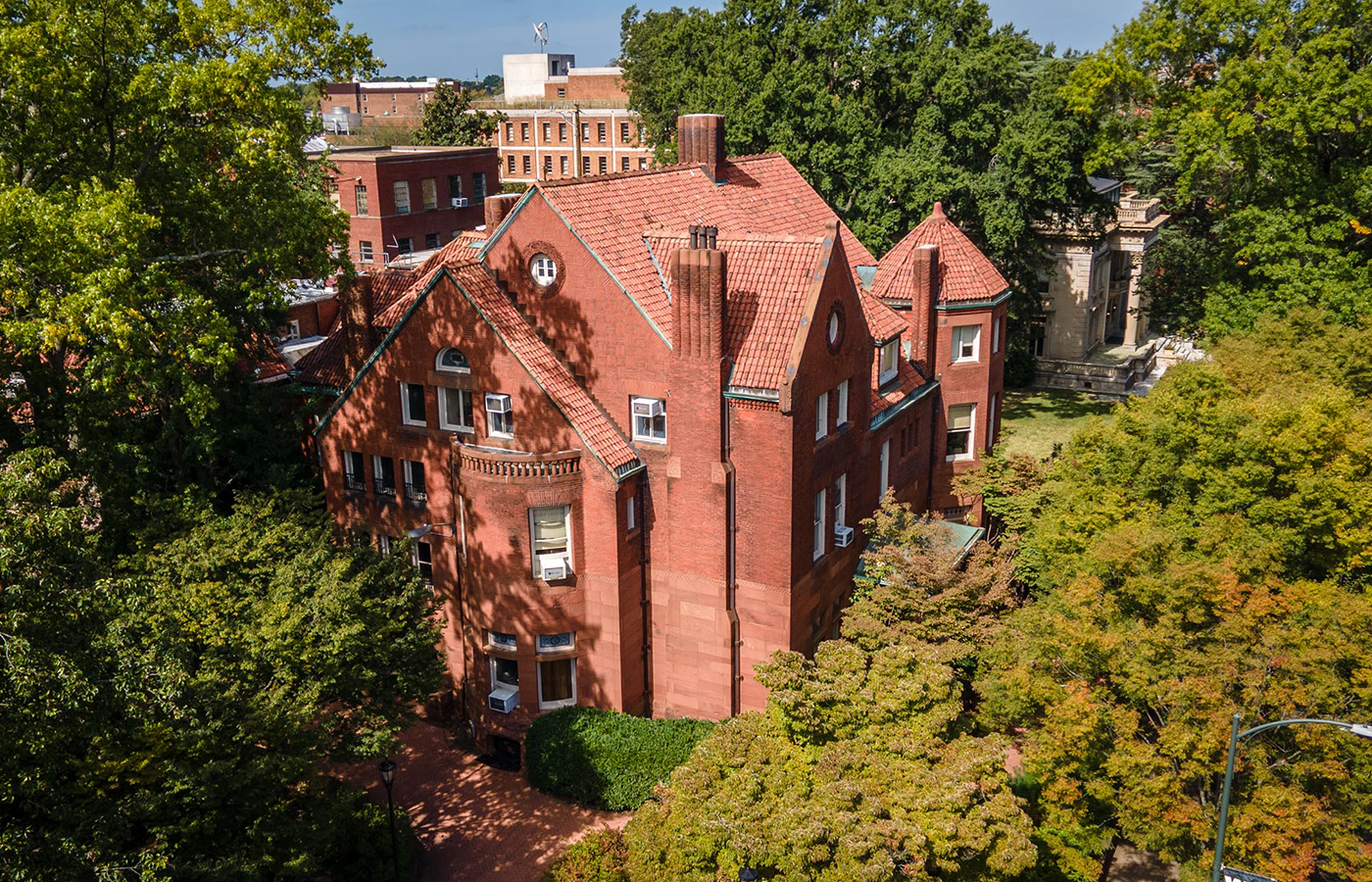
If Founders Hall is an amalgam of architectural styles, the Administration Building, designed by noted Washington, D.C., architect Harvey Page, is a clear expression of the Arts and Crafts Movement. Its stoic durability — a combination of strong massing, rounded arches and the elements of stone, brick, wood and metal — reflects the influence of the Boston architect Henry Hobson Richardson. Floral and plant motifs appear interwoven outside and inside the building.
And the former carriage house? It still serves as an art gallery, The Anderson, which features student work.
Slideshow
West Hospital (1940)
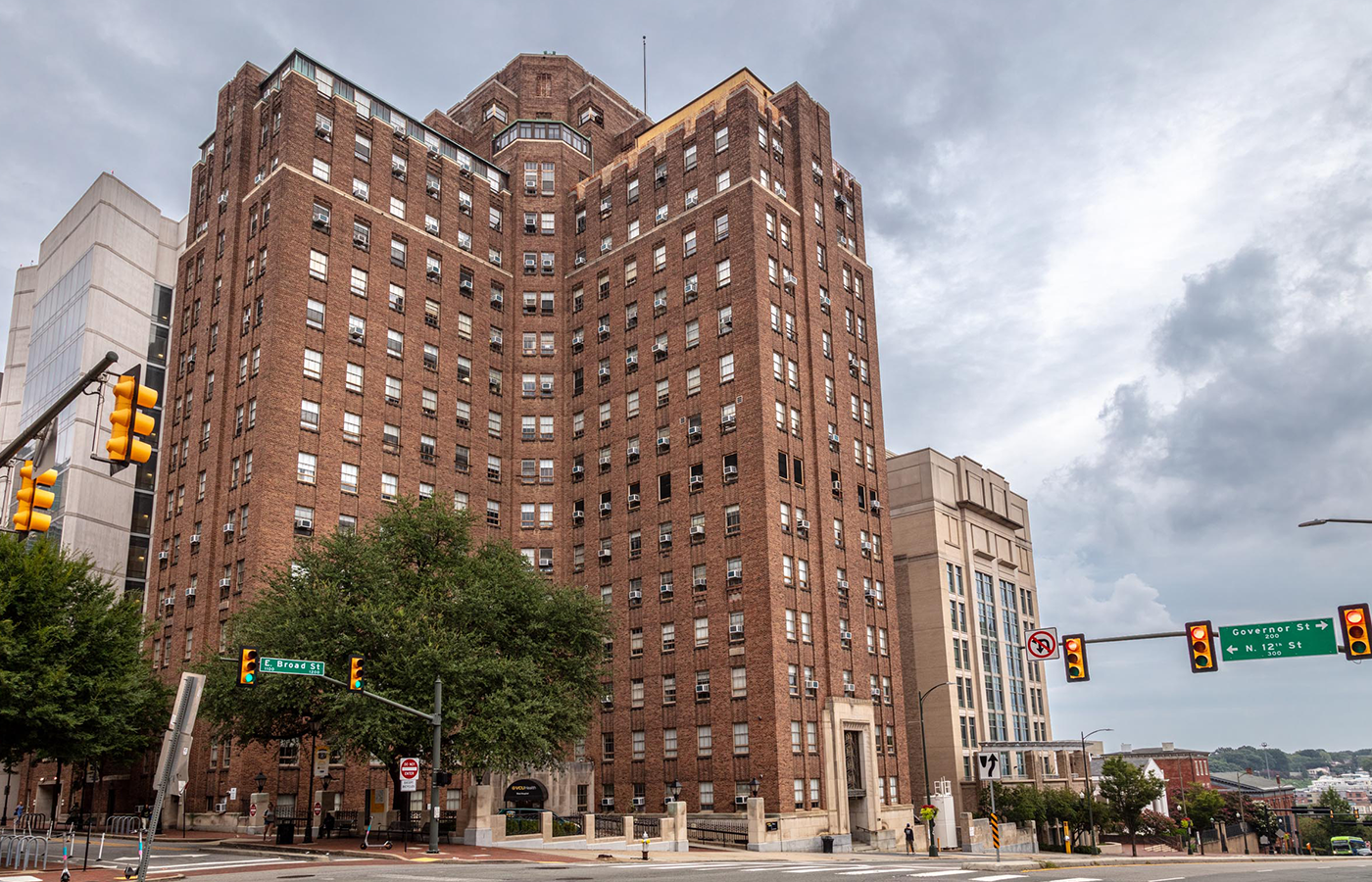
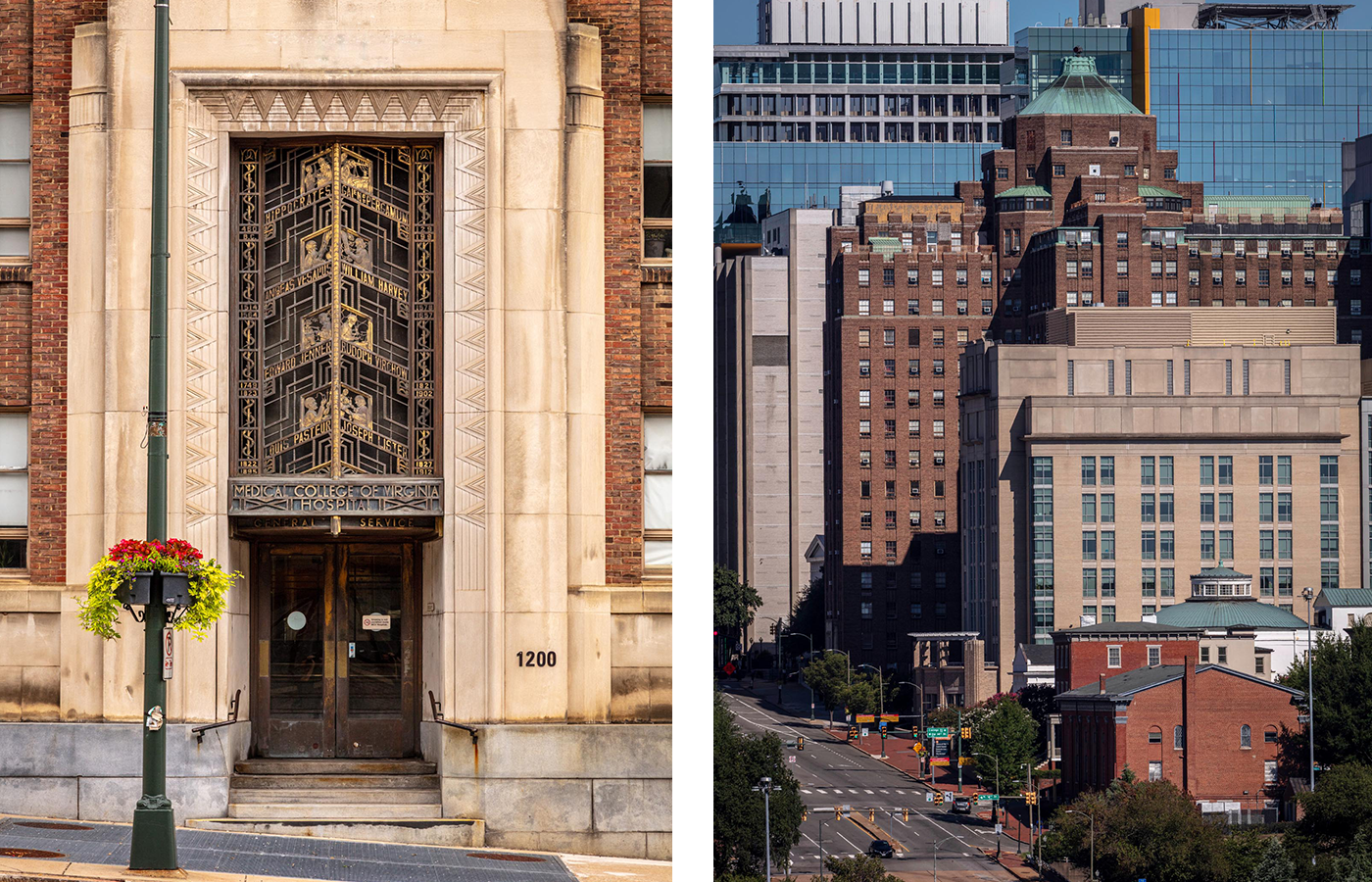
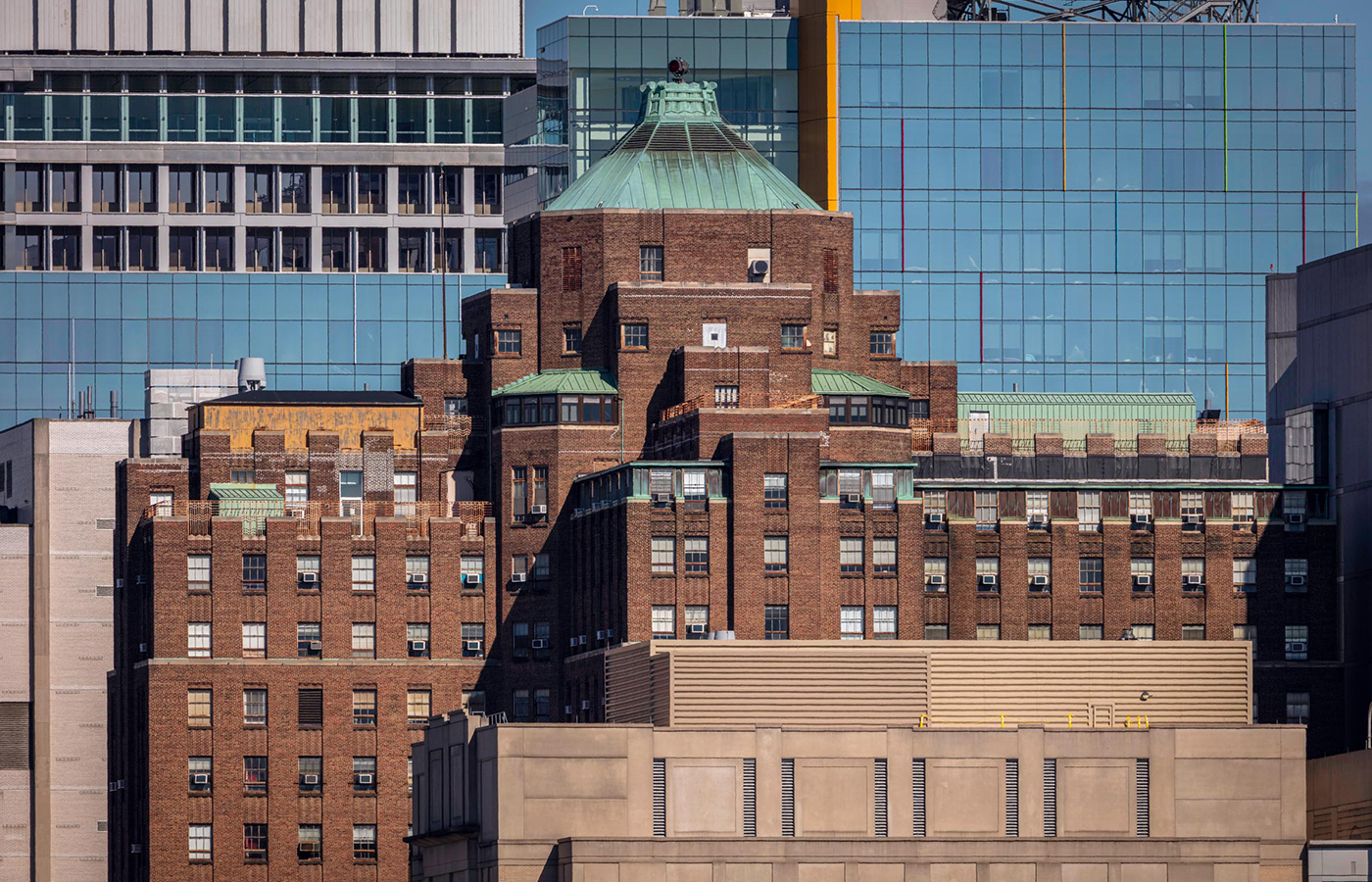
By the Great Depression, the Medical College of Virginia had outgrown its teaching facilities, labs and hospitals. It struggled periodically to meet professional and statewide standards for full accreditation, in part because of these limitations. Federal funding from President Franklin Roosevelt’s public works programs enabled MCV to initiate a multimillion-dollar expansion that included construction of an 18-story, 600-bed hospital on the hillside at East Broad and 12th streets.
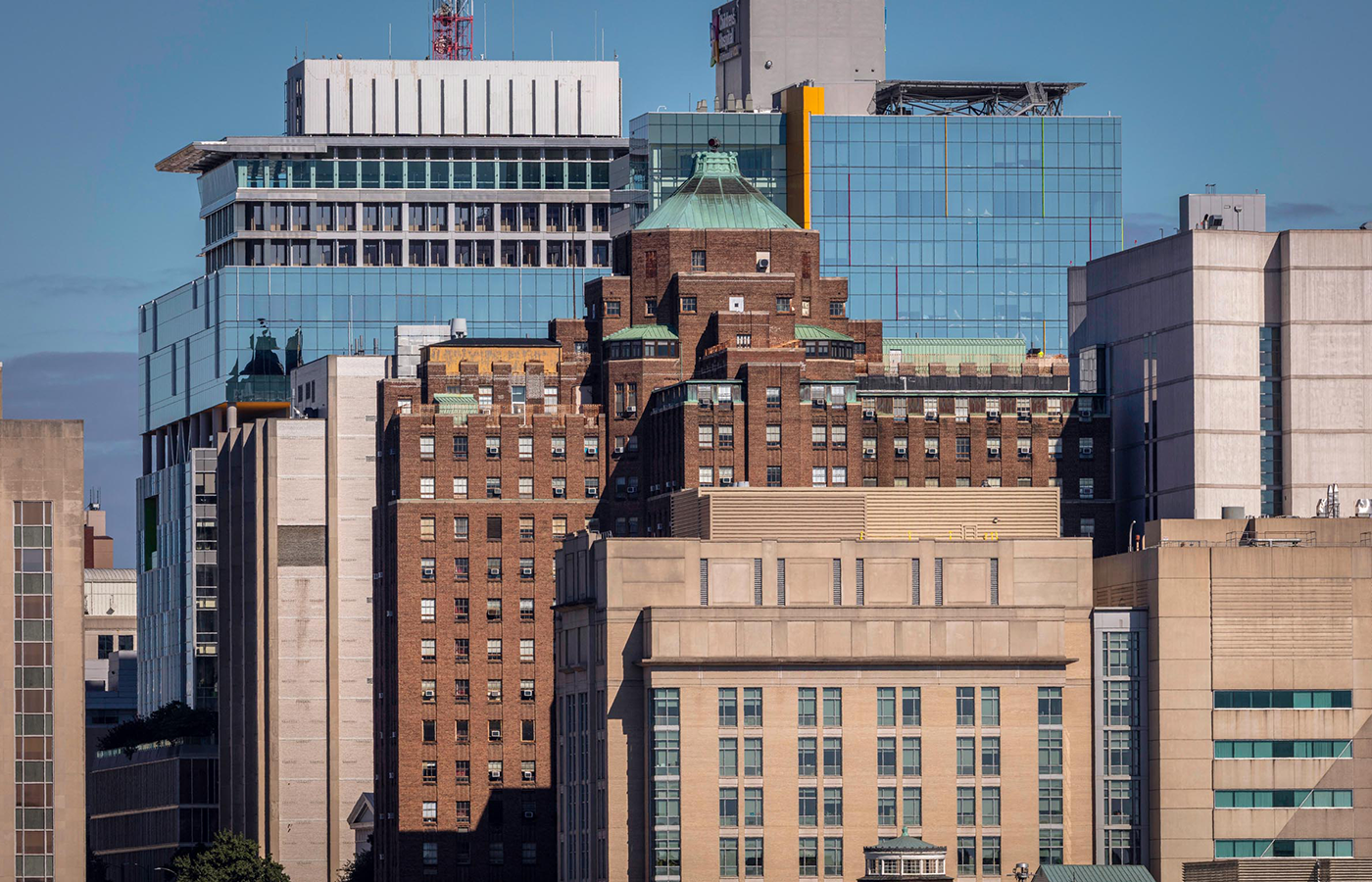
Baskervill & Son (of Egyptian Building renovation fame) designed the hospital. With its organizing cruciform floor plan — four wings radiating from a central core — the arrangement, from nurses stations to patient rooms, was state of the art. And there was ample natural light. The building suggests a pyramid as it reaches its top, forming an Art Deco masterwork, its decor limited only by financial restrictions. It was an instant landmark on the Richmond skyline and hailed nationally as an excellent teaching hospital.
A stunning artistic and decorative detail that did clear the construction budget was at the Broad Street entrance. This brass grille over the doorway featured relief images and the names of leading figures in research and medicine from ancient to modern times: Galen of Pergamum, William Harvey, Hippocrates, Edward Jenner, Joseph Lister, Louis Pasteur, Andreas Vesalius and Rudolf Virchow.
Slideshow
Hibbs Hall (1958)
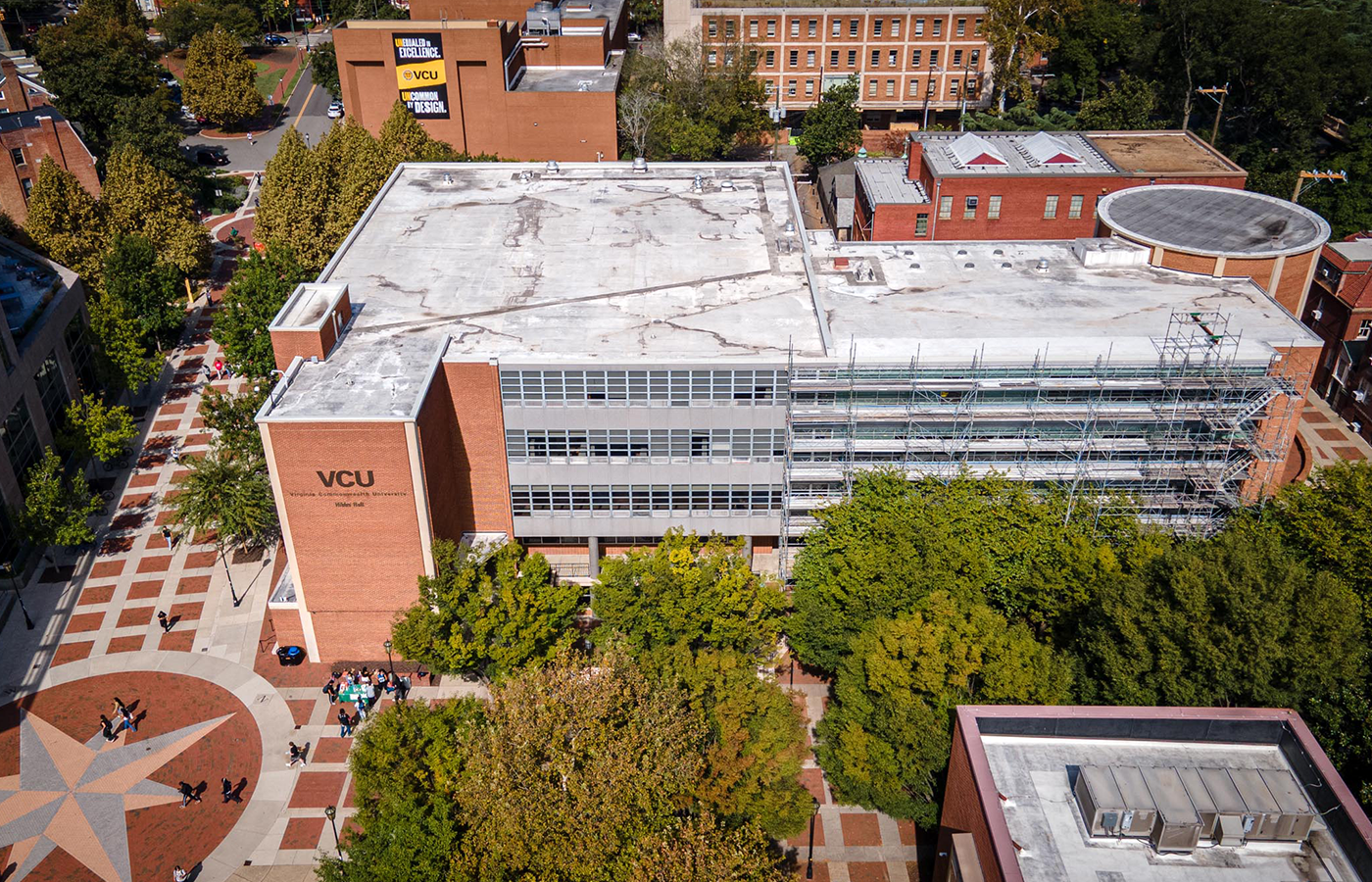
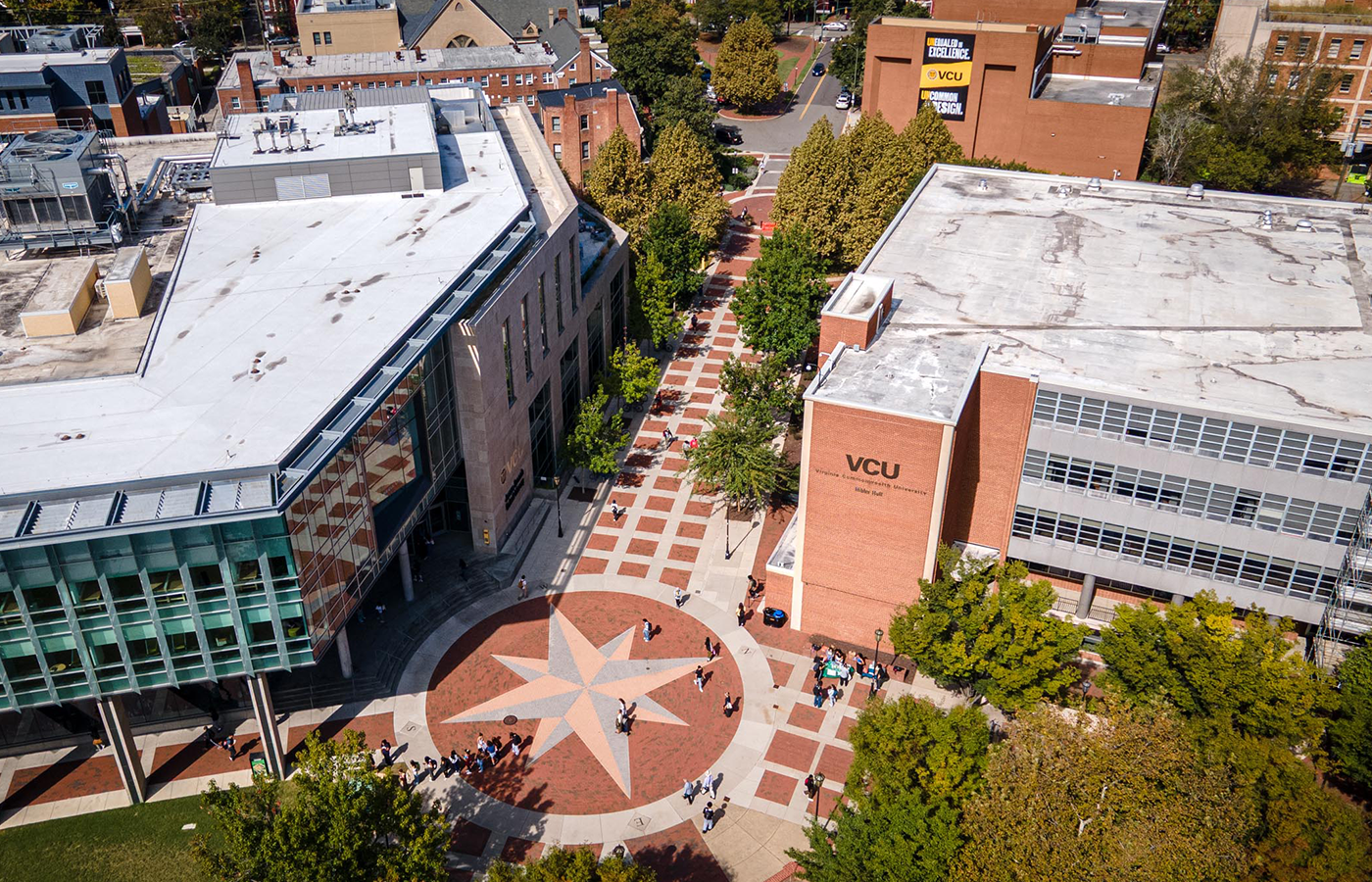
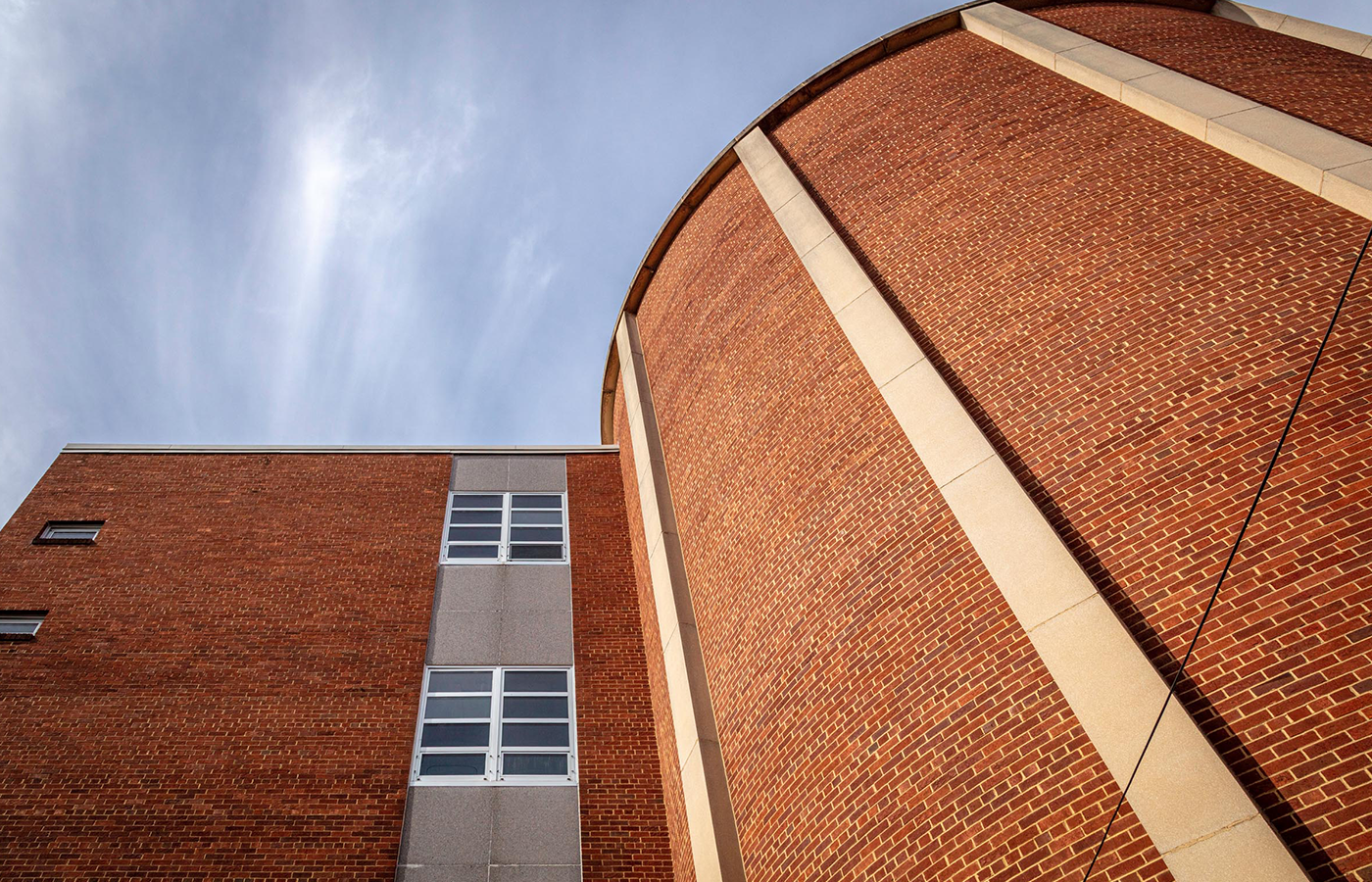
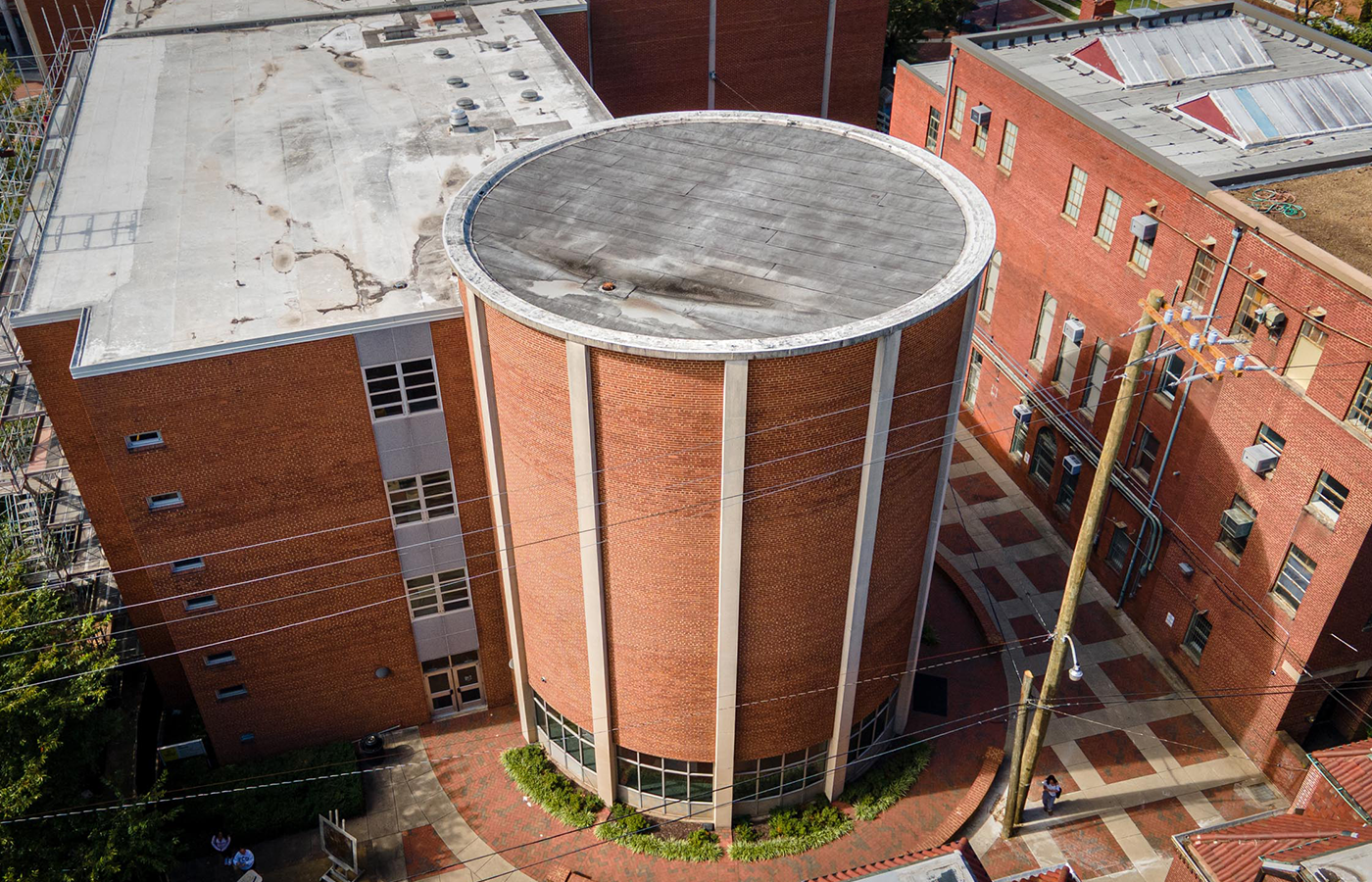
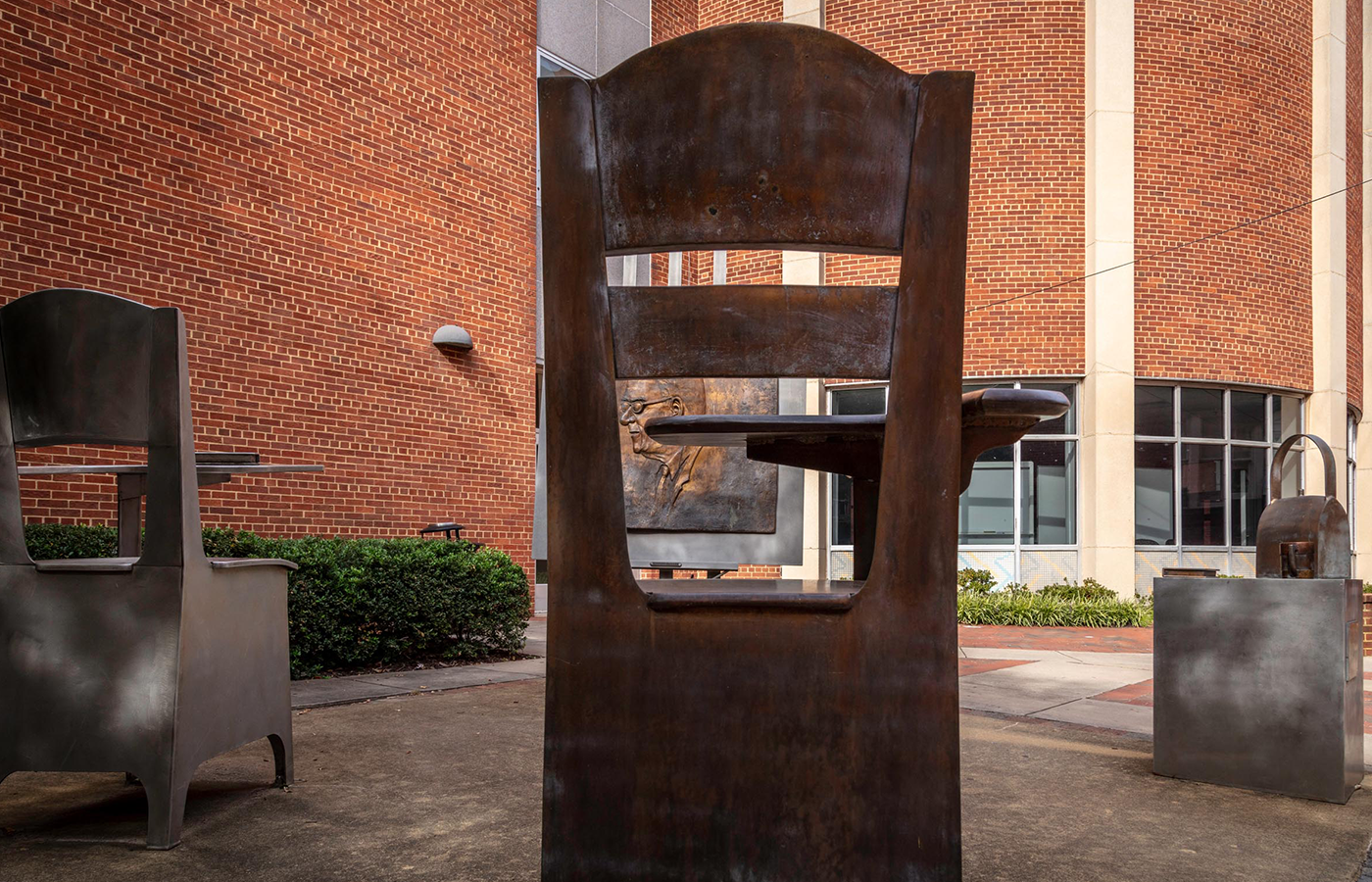
Henry Hibbs’ namesake building at The Compass (VCU’s pedestrian plaza at what was once the intersection of Shafer Street and Park Avenue), might, at first glance, seem underwhelming.
But take another look. It is a textbook example of the International Style, a movement popular with architects keen on serving the greatest number of people most efficiently. Their designs for hospitals, factories, railroad stations and schools were meant to be duplicated economically. This strand of modernism formed in Europe in the 1920s and ’30s, championed by architects like Le Corbusier, Ludwig Mies van der Rohe and Walter Gropius. It was promoted in the U.S. by Philip Johnson through a 1932 exhibit at New York’s Museum of Modern Art.
The mantra of “less is more” was exemplified by a total lack of ornament in addition to honesty in materials, distilling the building to its structural elements — concrete or brick, steel and glass. Geometry and form were stressed so it was possible to easily spot the various functional areas of a building. (At Hibbs, the north and south ends of windowless brick suggest the location of the staircases, elevators and utility closets, while the expanses of continuous ribbon windows on the three upper floors mark the classrooms and offices.) It is thrilling to see this unapologetically utilitarian building juxtaposed with the Administration Building, its Arts and Crafts neighbor to the north.
Designed and constructed in two phases by Walford and Wright Architects, Hibbs’ first and north end was completed in 1958 in the same style as the earlier Science Building and Franklin Street Gym. These were the first buildings on the Monroe Park Campus to be financed by the commonwealth of Virginia, built to absorb higher enrollment demands, including veterans using G.I. Bill benefits. Only Hibbs remains. (The Science Building was demolished to make way for Shafer Court Dining Center and Franklin Street Gym for the STEM Building.)
Hibbs’ second phase opened in 1965. The 98,000-square-foot building was restored in 2006. It has served multiple purposes over the decades — home of the English department and the College of Humanities and Sciences, a campus bookstore and a cafeteria. It now houses University College, the Campus Learning Center, and the Writing Center.
Slideshow
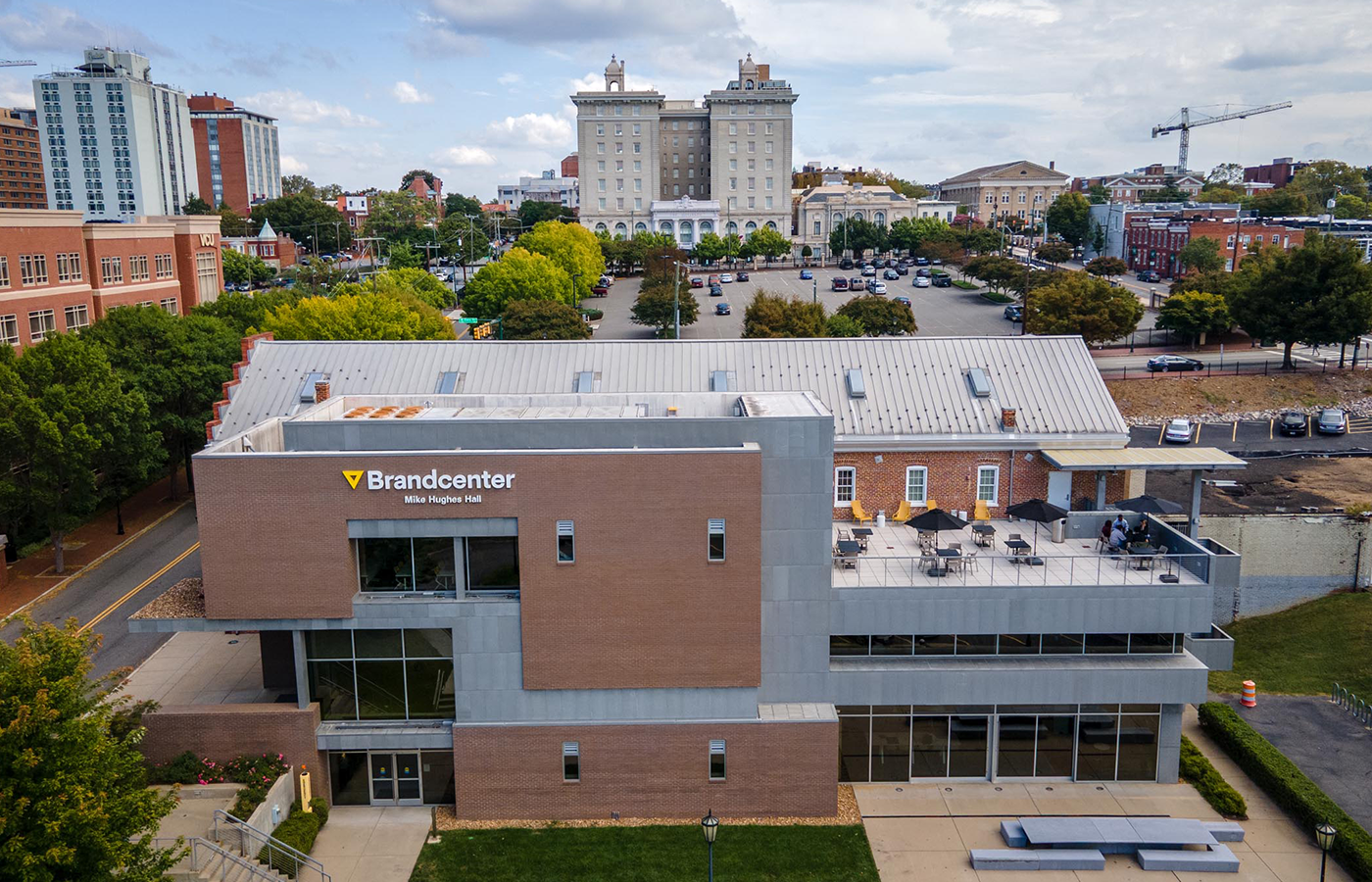
Mike Hughes Hall (2008)
The adaptive reuse of buildings, an approach Henry Hibbs had practiced out of necessity, became an expansion tool in the 21st century. Examples include the renovation of the former City Market/City Auditorium on West Cary Street into the Cary Street Gym and the elegant 2016 restoration and repurposing of the Richmond and Chesapeake Railway depot (1907) into an arts building at West Broad and Laurel streets.
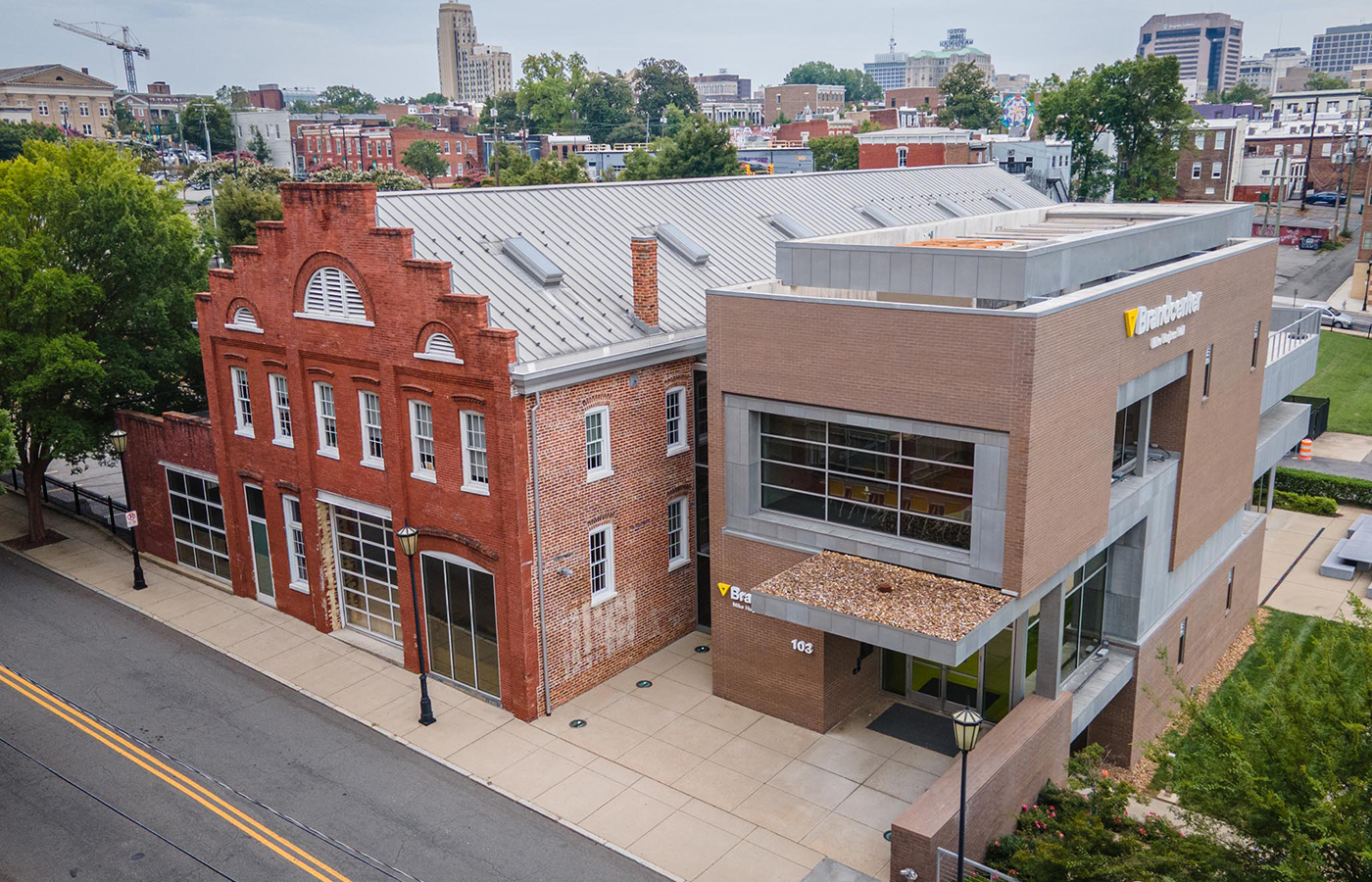
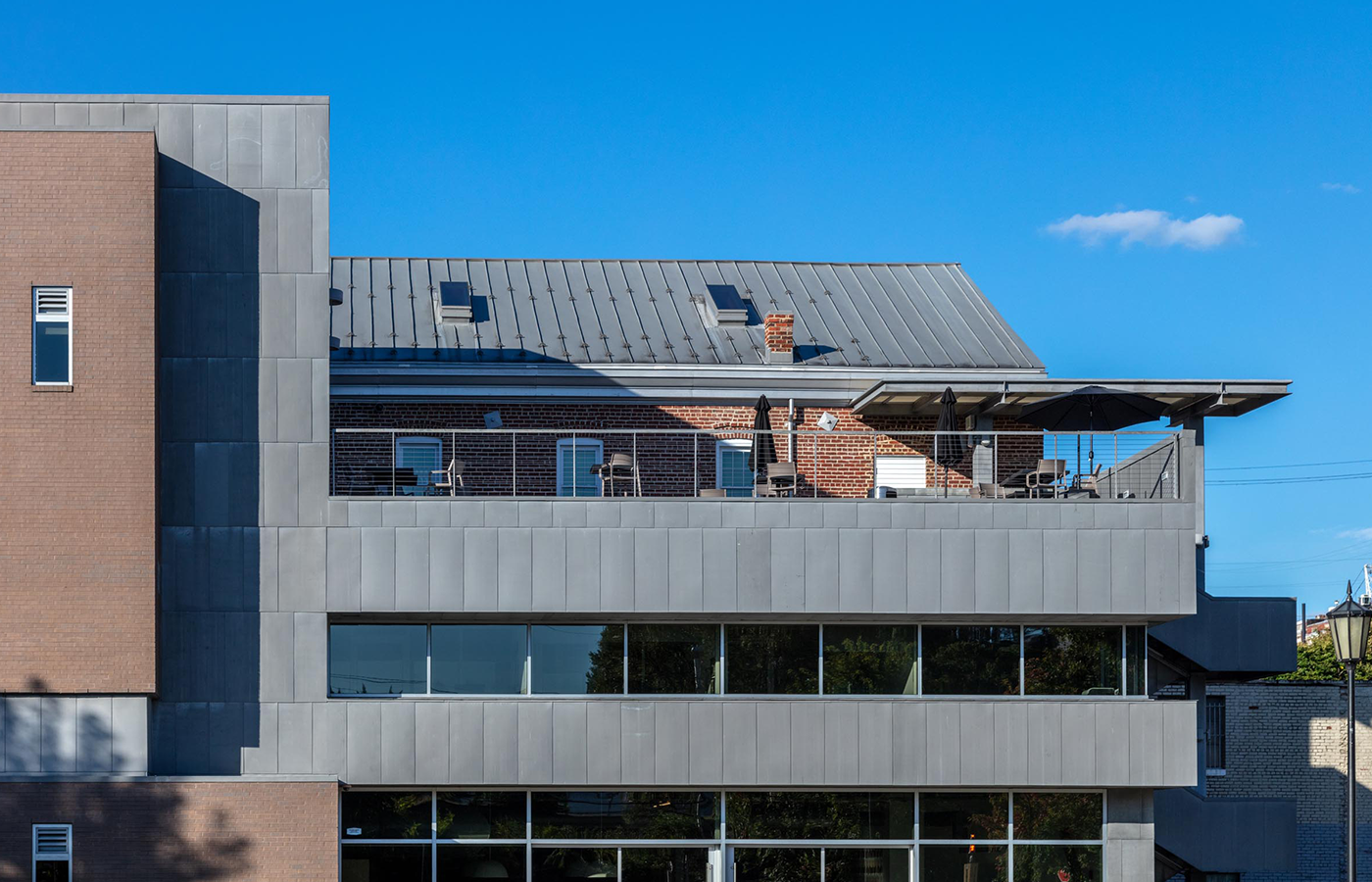
But the best illustration of this approach? The pairing of a commercial horse stable from 1897 with a renowned Los Angeles-based architect to create the dynamic quarters for the VCU Brandcenter.
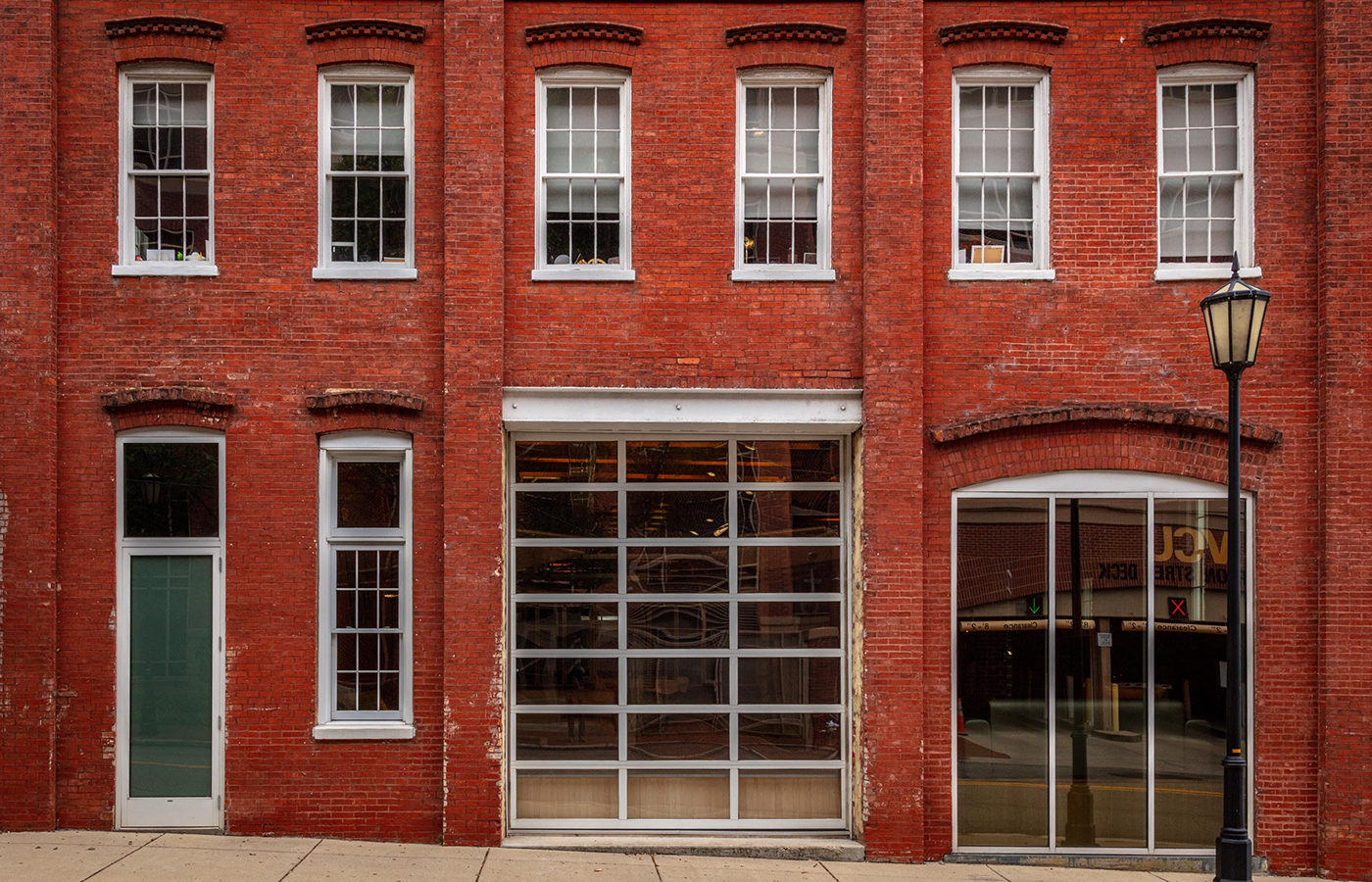
The handsome utilitarian brick building from the late 19th century at 103 S. Jefferson St. once housed the T.B. Hicks Delivery Stables. For a time it also served as the carriage house and horse stables for guests at the nearby Jefferson Hotel (1895).
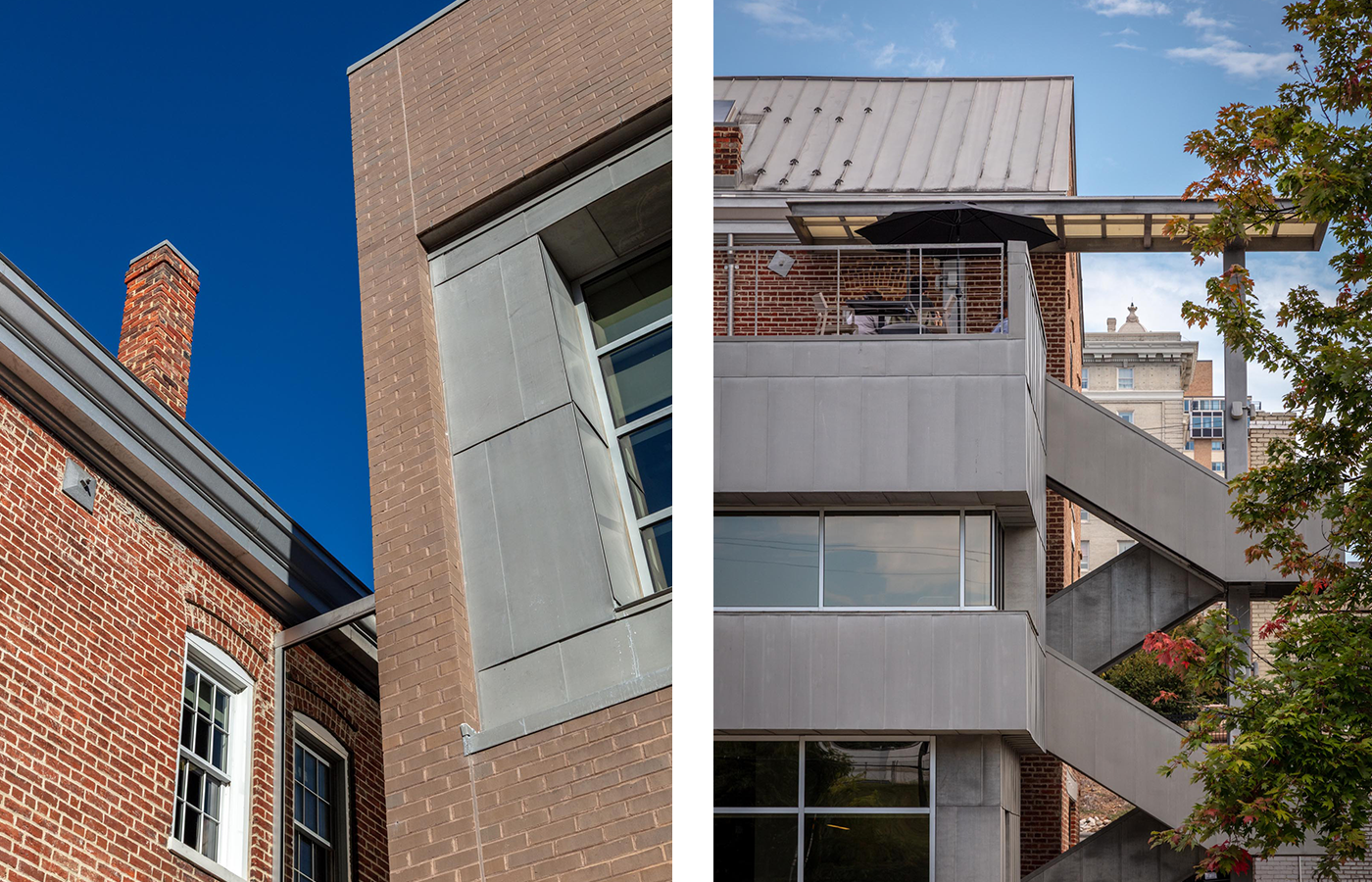
The California firm Clive Wilkinson and Architects, which designed Google’s Googleplex corporate headquarters, restored the stable and opened up the interior; its second floor is suspended with wires hanging from roof trusses, adding modularity and flexibility to the barnlike building. Then the architects more than doubled the space by attaching a new building to the south-facing wall of the stables. Its boxy, cubist forms complement the stepped gables of the older building.
Slideshow
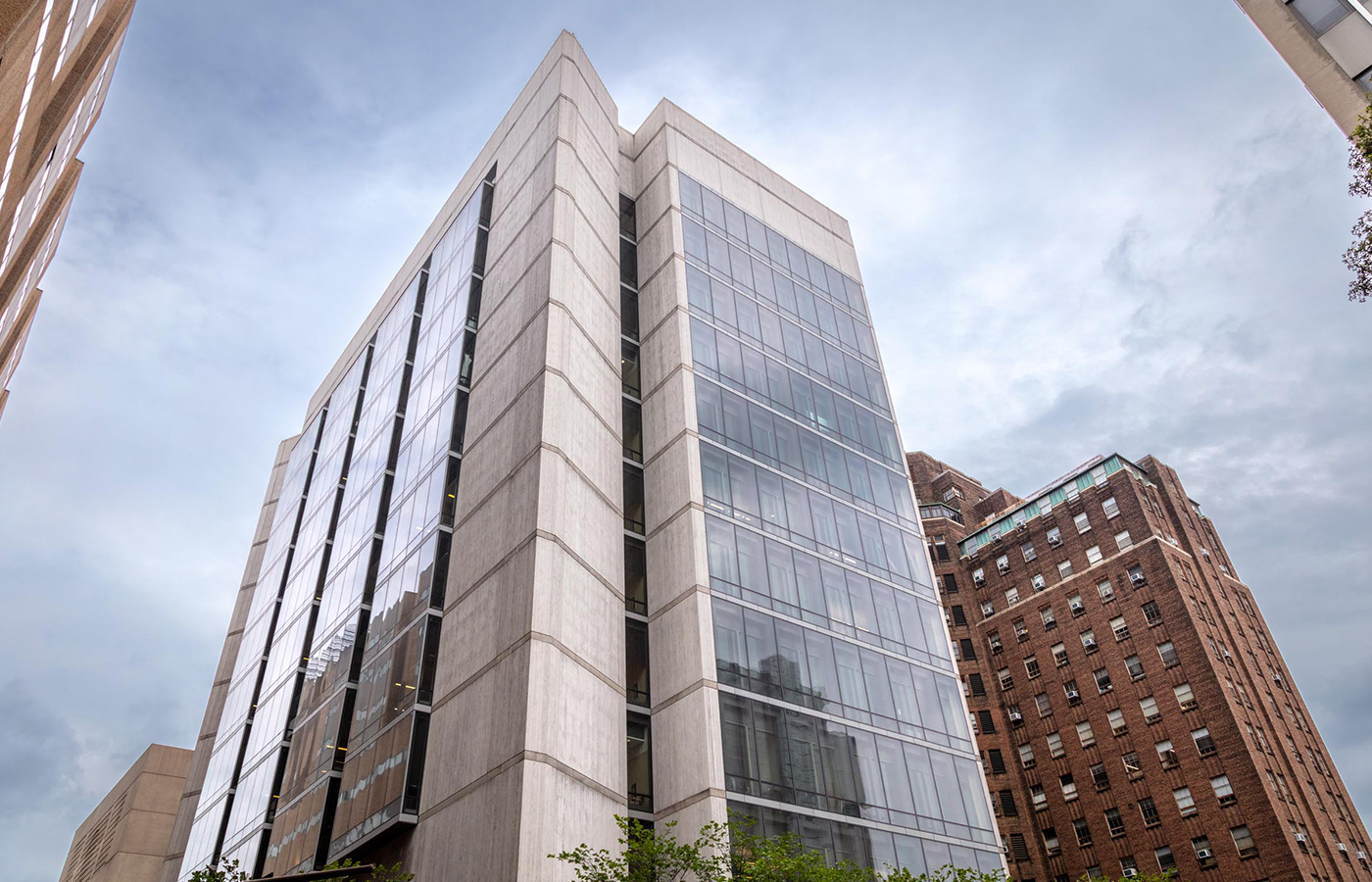
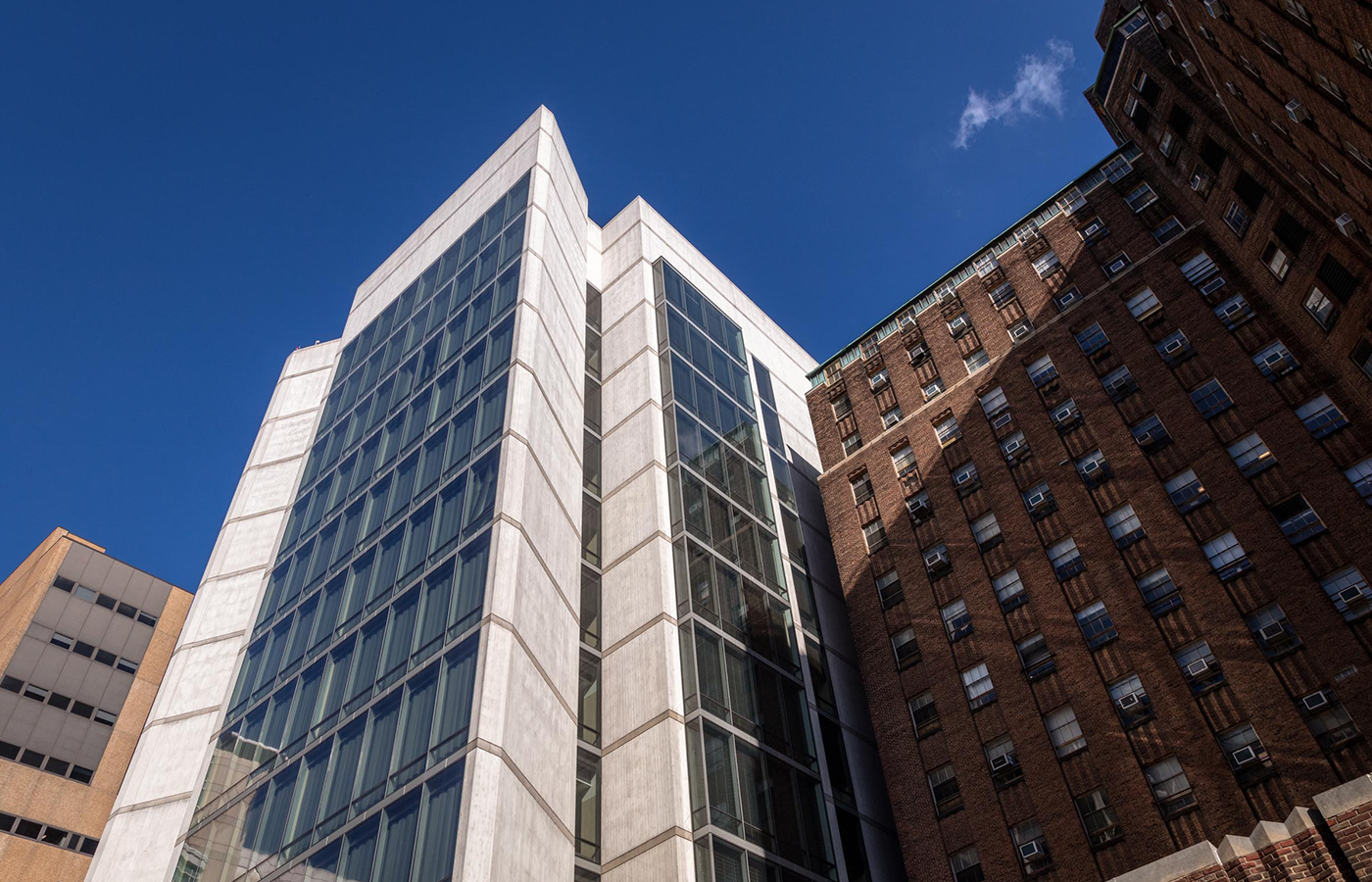
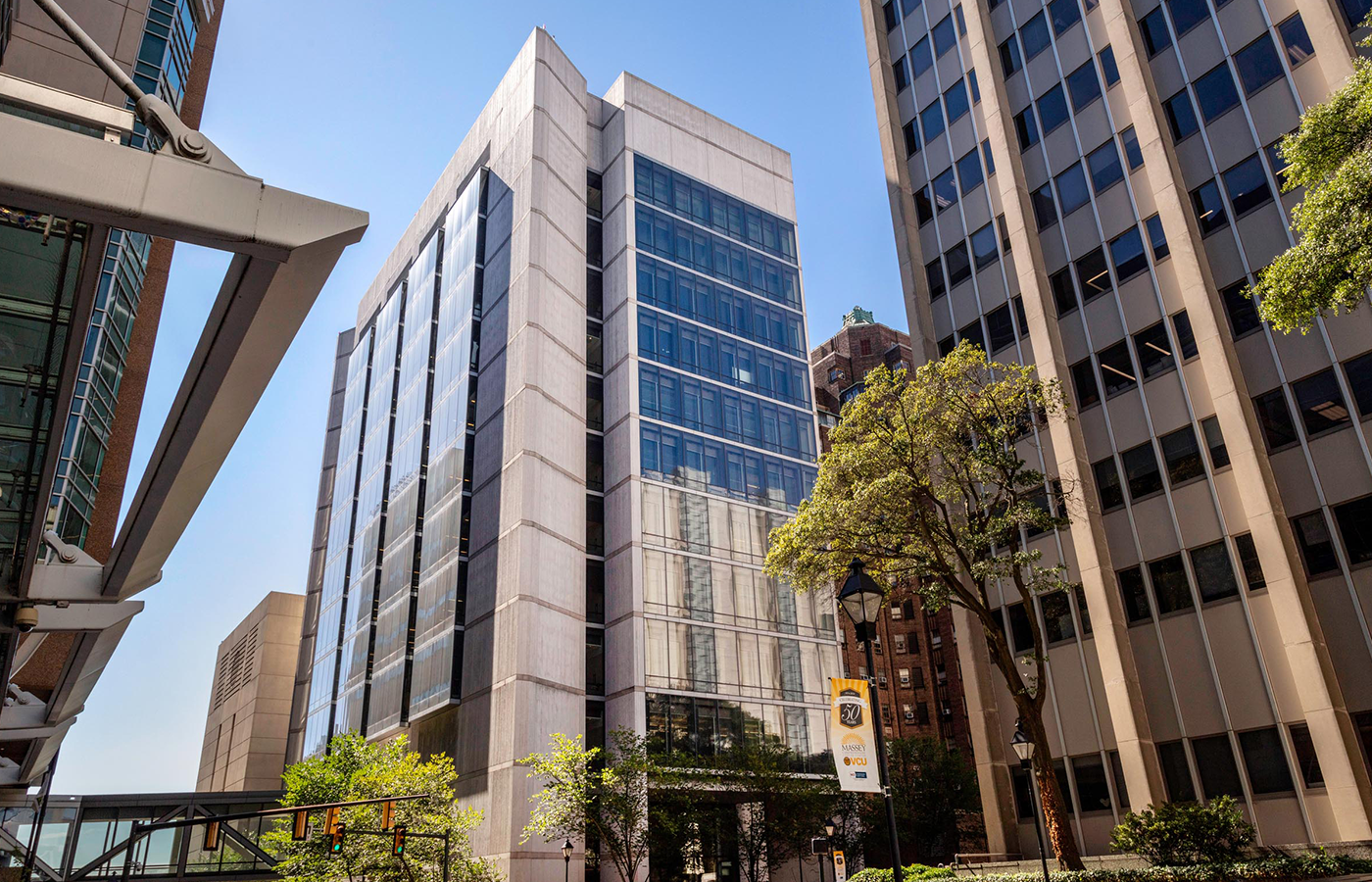
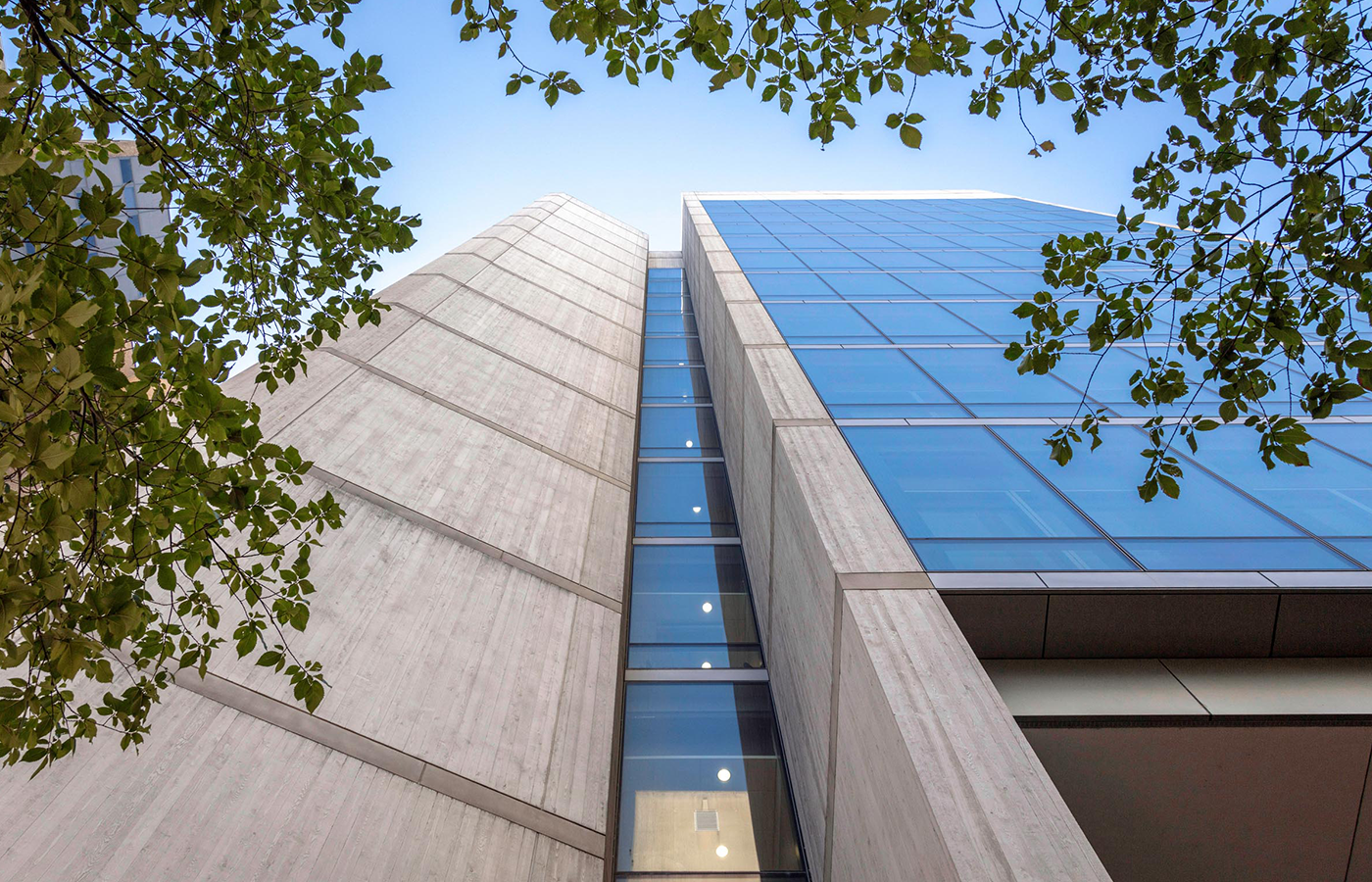
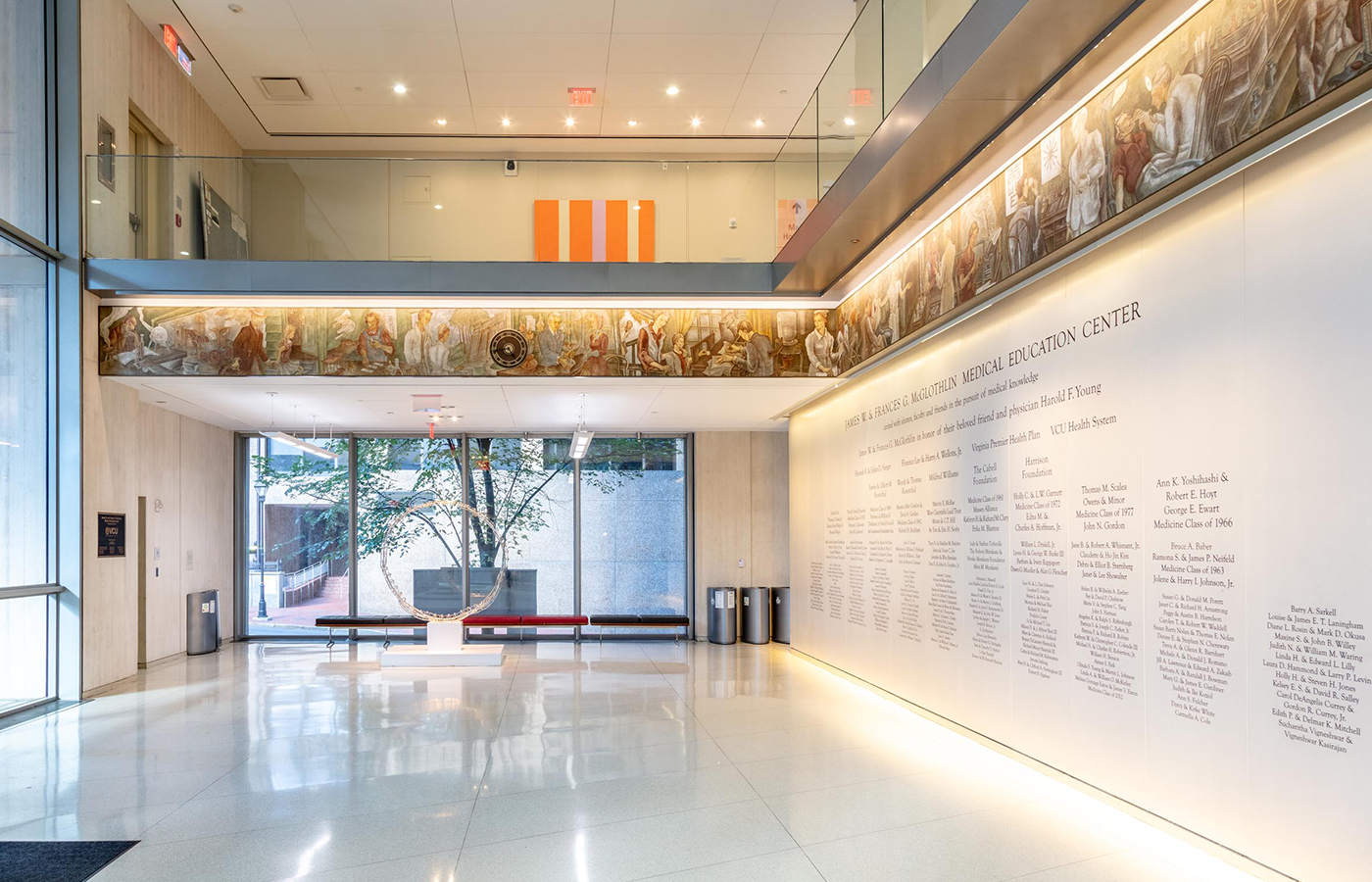
James W. and Frances C. McGlothlin Medical Education Center (2013)
If Thomas W. Stewart was a nationally acclaimed architect when he designed the Egyptian Building, 168 years later VCU hired an even more renowned architectural firm, Pei Cobb Freed and Partners, to design an achingly sleek 12-story tower on a relatively narrow lot at 1201 E. Marshall St. The firm is internationally known for its crisp, modernist structures of great clarity and refinement. Among its projects are the Louvre Pyramid in Paris, the National Gallery of Art’s East Wing in Washington, D.C., and the John F. Kennedy Presidential Library and the Christian Science Center in Boston.
What makes the McGlothlin building so successful at urban placemaking is how the seemingly lighter-than-air structure contrasts with dramatic and powerful effect with the stalwart dark red “brickness” of West Hospital next door. Both are prime examples of excellent high-rise design and technology of their time. And if West provided modernity for an architecturally moribund campus in the mid-20th century, the McGlothlin building delivers airy beauty to a densely built medical center where “value engineering” has often taken precedence over aesthetics.
The 205,000-square-foot building is named for the couple who provided a major gift for the building’s construction. (James McGlothlin died this past August at 85.) Their involvement is proof that architectural patronage matters. You can find another fine example of this on the Monroe Park Campus at the Institute for Contemporary Art, designed by Steven Holl Architects.
The McGlothlin building’s pleasing angularity starts at the sidewalk and flows under a portico, where a door through a clear glass wall welcomes students, faculty and staff into a double-story lobby. A curved staircase connects the lower and mezzanine levels. Nearby, elevators whisk folks to the administrative and faculty offices, research and simulation labs and cancer research facilities on the upper floors.
A striking feature in the lower lobby is a 100-foot mural that traces the history of the medical college from 1845 to 1947. The painting once adorned the lobby of the A.D. Williams clinic, a seven-story building designed in concert with West Hospital that was demolished to make way for McGlothlin. Richmond artist George Murrill began the work in 1937, went off to serve in World War II and returned to finish what he started.
Slideshow
James Branch Cabell Library (2016 renovation and expansion)
In 1968, when MCV and RPI were brought together to form VCU, a new library was at the top of the freshly hatched university’s lengthy to-do list. It was built in part with funds allocated in the 1966-68 Virginia biennium budget, which set aside $1.4 million for the library’s first phase and $1.9 million for a new fine arts building. Both Cabell Library and the Pollak Building (1970) reflect the era’s hard-edged Brutalist tendencies.
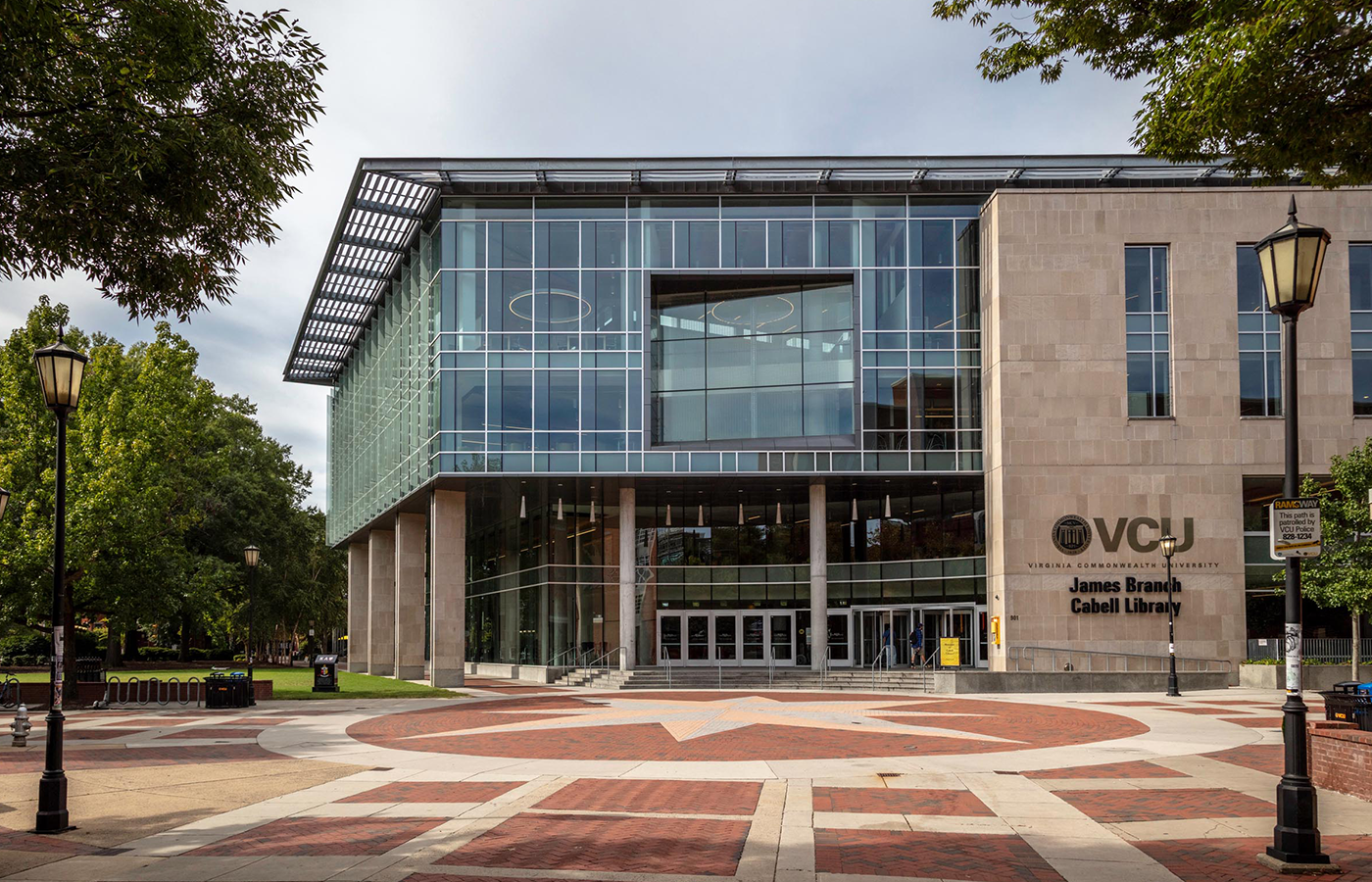
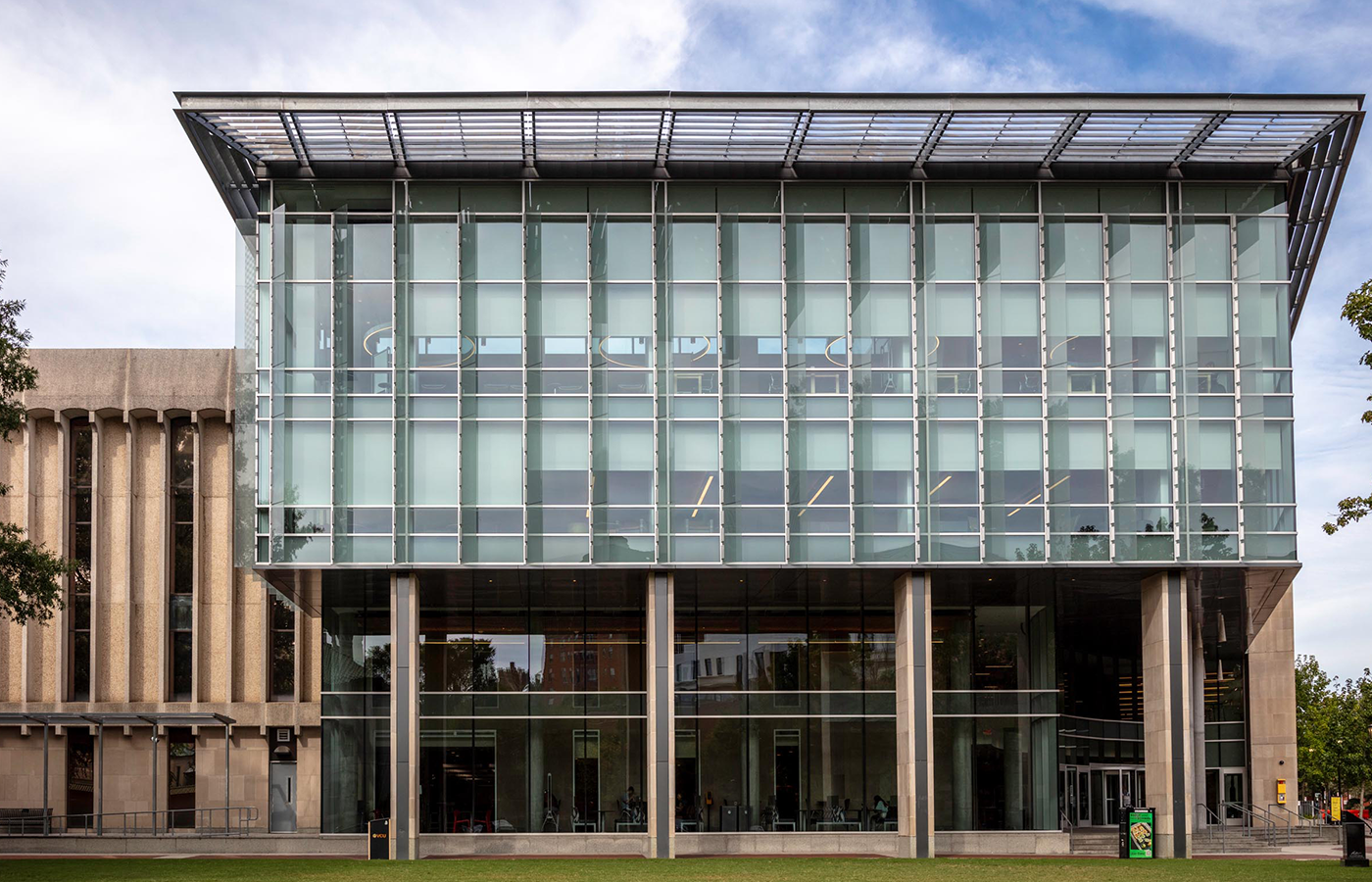
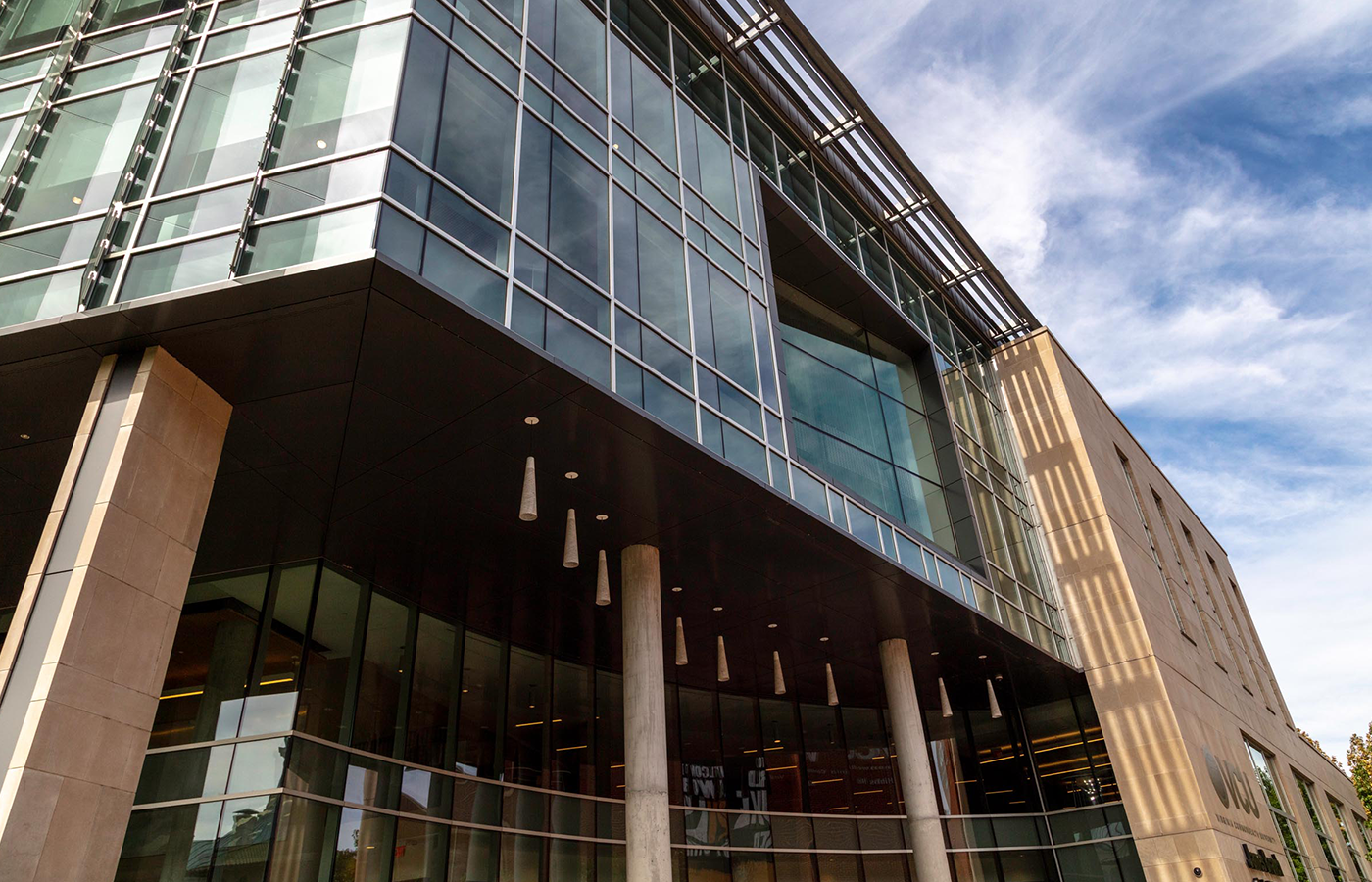
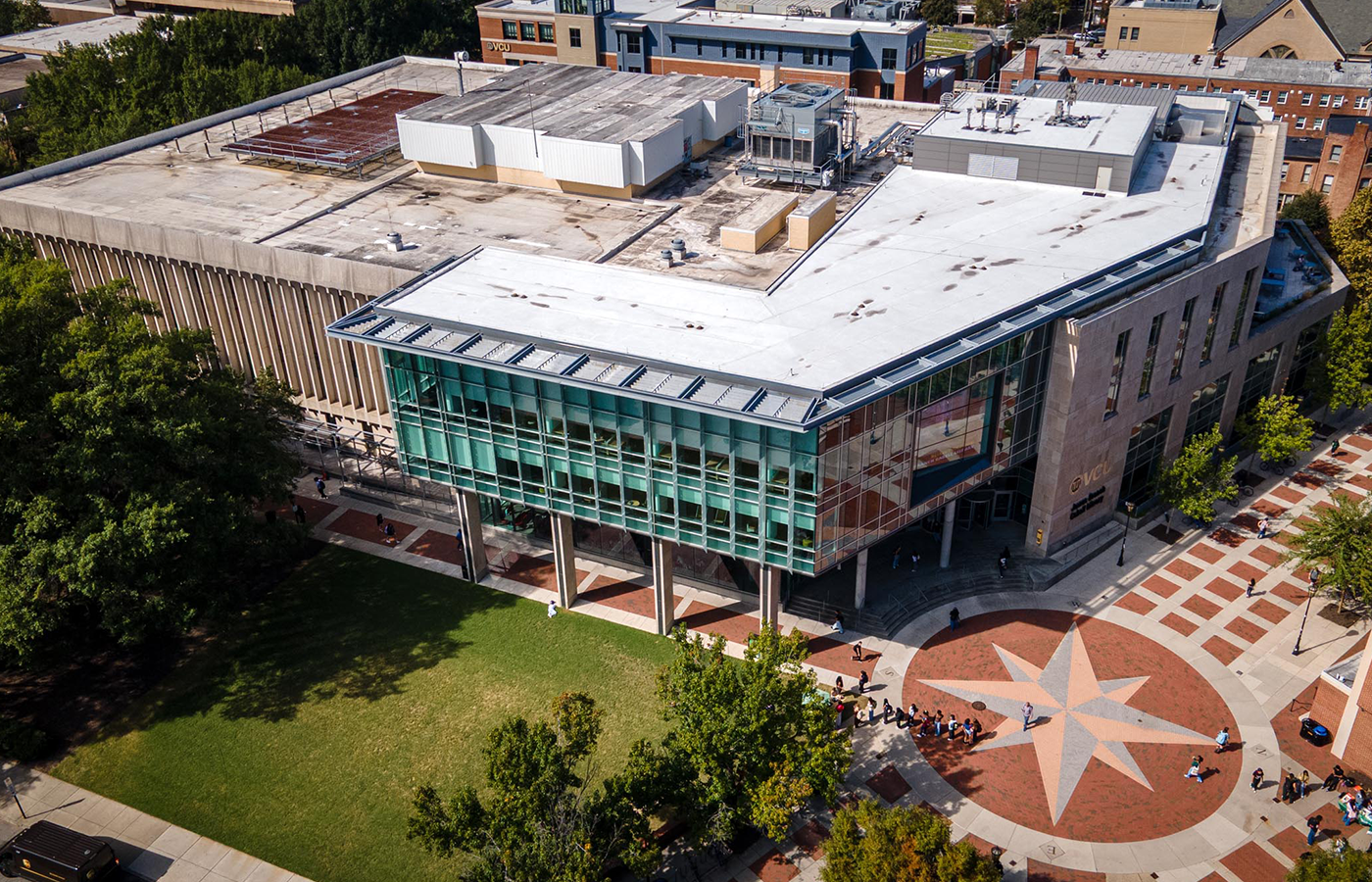
Two generations later, that 63,000-square-foot prefabricated box of a library was rejuvenated and elevated architecturally with a 93,000-square-foot addition.
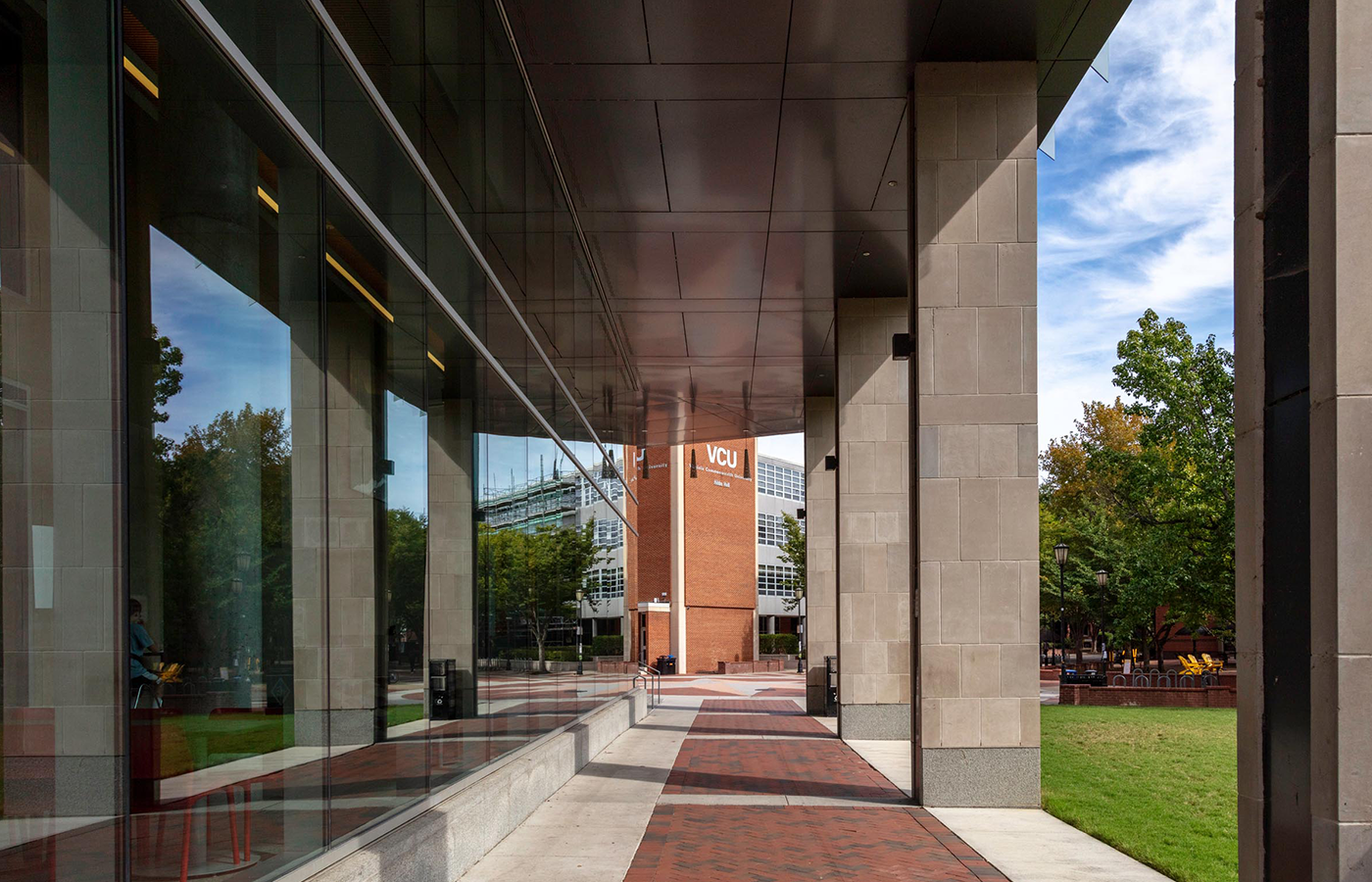
Designed by Shepley Bulfinch Architects of Boston and Moseley Architects of Richmond, the four-story L-shaped glass façade wraps around Cabell’s northeastern front and can be described as a huge, modernist lantern. It opens onto The Compass, about 50 feet south of Hibbs Hall — a lantern and a compass at the crossroads of a college campus.
