Research & Discovery
An Air of Mystery
Vapes and cannabis products have become ubiquitous. But many are wrapped in a fog that’s big on promised effects and light on details about the actual ingredients at play. Forensic toxicologist Michelle Peace, Ph.D., is finding answers and raising alarms.
The professor is working late tonight.
It’s early August, and although there’s plenty to compress the hours of VCU forensic toxicologist Michelle Peace, Ph.D. (Ph.D.’05) — a planned appearance before the Virginia General Assembly, a presentation to the American Chemical Society in Washington, D.C., the return of students to campus — what’s keeping her tonight is a meetup with a secret shopper who is delivering drugs.
These are readily available, over-the-counter drugs. But the chemicals at play inside them often are a mystery, either because they’re unlabeled or mislabeled. Even when the ingredients are identified by researchers, sometimes still the chemicals are relative unknowns.
Peace studies vapes and the cannabis miscellany that have stormed retail shelves in the past two decades, a public health crisis, she says, that has spread and gained malignancy in plain view. The ubiquity of these products tends to mask the fact that many are illegal to sell, while others exist legally without much in the way of regulation, having been born through a loophole.
For years they have overwhelmed and outrun both science and the law — a bitter, terrifying frustration for Peace that fuels her chase after them, racing to understand what’s inside these products and their probable track of evolution.
The animated 56-year-old professor in VCU’s forensic science department in the College of Humanities and Sciences often handles these secret-shopping forays herself, hanging up her lab coat and sunny tops for a more casual, nothing-to-see-here look of jeans, flannel and frayed denim baseball cap.
Tonight’s haul, however, comes from a secret shopper in southwest Virginia, one of a few people who help Peace keep tabs on smoke shop offerings across the state. In this jumble of cannabis vapes, edibles, drinks, concentrates and dried plant material, researchers back at the lab will find that some packages have no detail on ingredients or drug concentrations, and most of those that do are wrong, overpromising buzzy compounds by as much as 86%.
Some packaging will have no listed manufacturer, and some will be found to shelter mold or coliform bacteria, a harbinger of fecal contamination. Researchers will open a packaged brownie and see what appears to be a long gray, curly hair partially entombed in fudginess.
This kind of exploration, this unpacking of the macro and molecular, is half the job for Peace and her lab. The rest is telling the world about the first half. There’s the conventional publishing route, but her voice also has become a bullhorn for the ills of unregulated vape and cannabis products.
“It’s really unnatural for a scientist to be the tip of the spear,” she says. Still, her acutely informed, genial extroversion — a mix of warmth and nerve beneath the flag of a puckish, heathered gray pompadour — has made her an expert frequently sought by legislators, public health officials, scientific groups, law enforcement officers, advocates, parents and the media.
“The reason why I do this is to demonstrate how bad the problem is,” Peace says. “We have to get motivated to protect our communities. And if it means that I’ve got to educate from the bottom and [then] they punch up, that’s what I’m going to do.”
For nearly 15 years, this part of her work has felt like screaming into the wind, she says. Now, that seems to be changing.
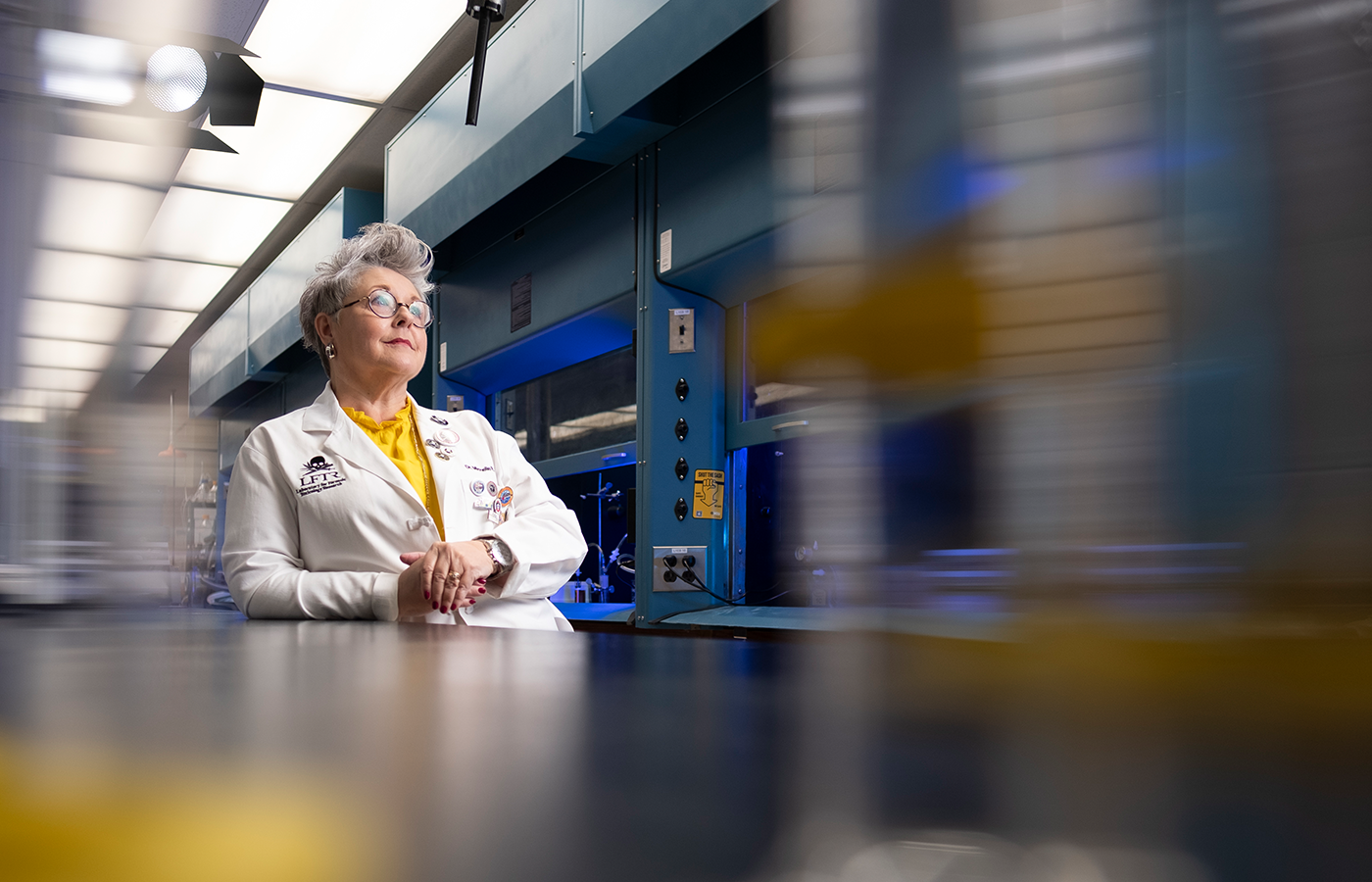
Michelle Peace, Ph.D. (Ph.D.’05), in her Laboratory for Forensic Toxicology Research at VCU (Nathan Hanger)
“Where there are gaps in policy and regulation and law,” Peace says, “there will be nefarious activity.” And the gaps began to tear open around the time she started this line of research, in 2012.
Vapes, or electronic cigarettes, of various forms date back a century or more in the U.S., including a handheld “electric vaporizer” for medicinal compounds patented in 1930 that claimed to be an improvement over existing models. But none took hold like the modern iteration, invented by Chinese pharmacist Hon Lik in 2003 and arriving in the U.S. about four years later. These battery-powered devices heat a nicotine-containing liquid until it’s aerosolized and can be inhaled. Vapes now range from disposable to refillable to those using replaceable cartridges, called pods. Some vapes aerosolize drops of liquid or concentrated solids.
Vapes came ashore at a time when the federal government was still struggling to assert broad regulatory control over the making and marketing of even traditional cigarettes and other tobacco products. That power would be given to the Food and Drug Administration in 2009, but it would take until 2016 to extend it over e-cigarettes — including a federal ban on sales to minors — and years more to give the industry a chance to apply for FDA authorization. While that played out, the array of available vape products burst into a fever dream of flavors and device types.
Thousands of vape products are available for purchase, though just 39 have been granted FDA authorization. It’s a decision made, in part, based on what the agency sees as a product’s potential benefit or risk, including evidence of getting smokers to quit traditional cigarettes. The FDA has turned aside millions of product applications and has tried to stem the flow of imports bypassing the system. In September, the government announced that in 2025 more than 6 million vapes had been stopped from entering the country, including one operation in Chicago that netted 4.7 million vapes, mostly from China, in what the FDA called “the largest-ever seizure of this kind.”
But gaps remain. In 2020, for instance, the FDA banned the sale of most flavors of vape-liquid pods in an attempt to curb teen use, only to see the market tilt toward disposable vapes, which were overlooked by the ban. By mid-2024, disposables accounted for nearly 60% of sales, most of them the kind of fruity and sweet flavors that had been targeted by the ban.
Through these holes, e-cigarettes have reigned as the nicotine product of choice for middle and high school smokers for the past decade. That trend peaked in 2019, when a federal tobacco-use questionnaire found 27.5% of high school students and 10.5% of middle school students had used a vape in the 30 days before the survey.
Numbers have since plummeted, owing possibly to a mix of factors, including: an outbreak of a vaping-related lung illness that spiked in August and September 2019, killing 68 people and hospitalizing more than 2,500 others before easing in early 2020; city, state and federal flavor bans; and stepped-up efforts to enforce laws and educate the public, including an FDA ad campaign that according to researchers prevented an estimated 444,000 youths from taking-up e-cigarettes between 2023 and 2024. In the most recent federal tobacco-use survey, from 2024, the figure among high school students had dropped to 7.8%, or an estimated 1.21 million students, and for middle school students to 3.5%, or 410,000.
Among adults, a separate federal survey showed that e-cigarette use rose to 6.5% in 2023, up from 4.5% in 2019.
Of course, nicotine is not all that people are putting in their vapes.
The arrival of nicotine vapes came in the years between the first state laws legalizing marijuana for medicinal purposes, in the mid-1990s, and those legalizing recreational use, starting in 2012. The issues quickly braided into the vaping of THC, or tetrahydrocannabinol, the main psychoactive compound in marijuana.
The loophole that keeps Peace’s secret-shopping program on its toes doesn’t involve marijuana, though — it’s hemp.
This is where things get a little complicated.
Hemp and marijuana both come from the Cannabis sativa plant; they produce many of the same compounds called cannabinoids, but to varying degrees. Both hemp and marijuana had been long classified by the federal government as controlled substances on par with drugs like heroin and LSD.
That’s still true for marijuana. But in 2018 Congress legalized hemp cultivation and all hemp derivatives, which opened the door to a raft of unregulated intoxicants.
The most well-known and plentiful hemp derivative is CBD, which is considered nonpsychoactive. But with the addition of a strong acid, CBD can be converted into intoxicants like Delta-8 THC, which occurs naturally in small concentrations and is similar to the high-inducing agent in marijuana, called Delta-9 THC.
Some of these hemp derivatives are even more potent than Delta-9 THC, Peace says, and some are entirely new and synthetic intoxicants that mimic THC’s high, like a compound called THC-O-acetate and the street drug known as Spice or K2. Though researchers know little about the effects or interactions of some of these compounds, Peace is finding them bundled together inside products, possibly because of messy chemistry or lax manufacturing in the absence of oversight.
“[T]he American public has become sort of a petri dish for these products,” she told a federal drug-testing advisory panel in late 2023. Manufacturers “don’t have to do an FDA-approved clinical study. They have the American public to do it in.”
This past November, Congress quietly moved to close the hemp loophole in the future. Included in legislation to rouse the government from its longest-ever shutdown was a measure banning cannabinoids that are synthesized or manufactured outside the hemp plant and that sharply limited the amount of THC and similarly intoxicating cannabinoids that can be in hemp plants and hemp-derived products. The rules, set to take effect in November 2026, triggered immediate pushback from the hemp industry, though. The U.S. Hemp Roundtable lobbying group said the limits as written would “wipe out 95% of the industry.”
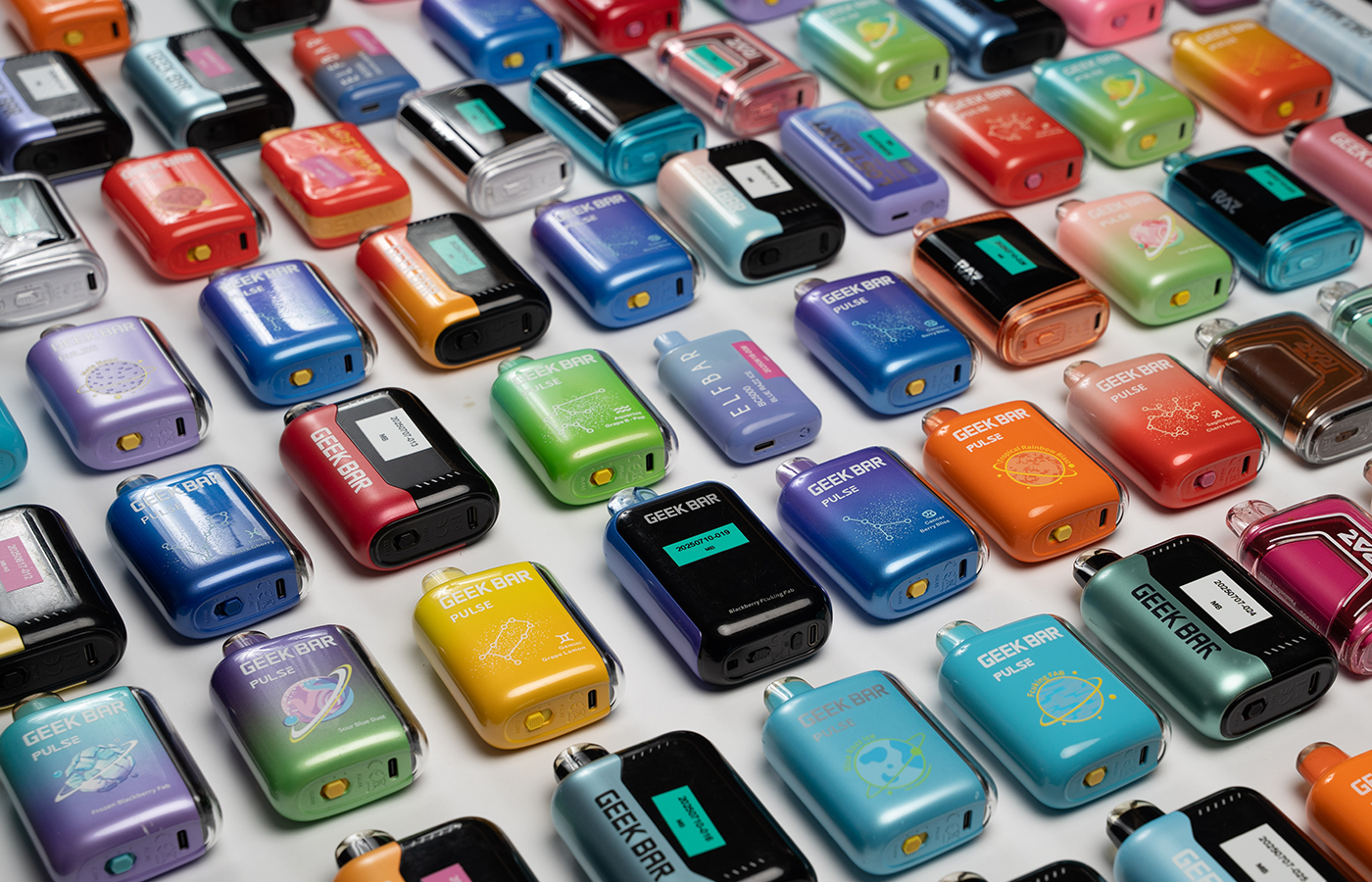
A sampling of the approximately 1,800 disposable vapes sent to Michelle Peace's forensic toxicology lab for analysis since 2023 (Jud Froelich)
“If you Google up my name and the term ‘maggot milkshake’ you’re going to find a news story about me,” Peace says. It’s neither a brag nor confession; it’s more like the headline for that particular straightaway stretch of life between a series of what felt like blind turns.
It’s the same way Peace notes that she earned three patents in her 20s for the chemical underpinnings of a more absorbent diaper, or that she hadn’t considered college — didn’t even know she was high school valedictorian — until the school guidance counselor asked what was next for her. “Oh, I guess college,” she answered. “Right?”
It seemed like something valedictorians do.
This was in Carlisle, Ohio, a city now grown to 5,500 people a half hour south of Dayton, noteworthy among Ohioans for the pair of conjoined, flying saucer-shaped homes that can be peeped between farm fields. Like many kids around her in the 1970s and ’80s, Peace says, her family had followed the new interstate there for factory work — in her dad’s case, the paper mill — leaving behind mountain towns in neighboring Kentucky.
In high school, she’d been enchanted by an assignment to count the water molecules on the surface of a petri dish and a sudden, rushing realization of an atomic architecture that underlies all of physical reality.
She carried that interest in chemistry through Wittenburg University, in Springfield, Ohio — an opportunity wrought by scholarship, a second mortgage, a school-year job and two or three jobs each summer — and then to George Washington University, in D.C., for a master’s degree in forensic science. At each, there had been a near-identical singular moment of illumination, two beats that Peace describes convincingly as “like the heavens parted and the angels sang.” The first was a student chemistry club tour of the police crime lab in Columbus, Ohio, and the second was when she laid eyes on the toxicology lab at Baltimore’s Office of the Chief Medical Examiner.
She’d been doing autopsies there as a grad student, and happily, until receiving back-to-back cases involving infants. A position at the tox lab was offered instead, and she felt that she’d found her place among the molecules of the world, despite a 6:30 a.m. start time and a 40-mile highway commute.
Peace went to VCU for her doctorate in forensic toxicology; the “maggot milkshake” was her dissertation work to figure out whether fly larvae that ate a dead body could reveal if a person had ingested drugs, in this case barbiturates and amphetamines. (Turns out, yes. Just grind up the maggots, chemically coax toxins to the slurry’s surface, isolate and analyze. “You are what you eat,” Peace told VCU News at the time.)
In the midst of her Ph.D. work, in 2002, she became the founding faculty member of VCU’s forensic science department. The field had only recently erupted into public consciousness with the 1995 murder trial of O.J. Simpson and the TV show “CSI: Crime Scene Investigation,” which started in 2000. In four semesters, Peace says, the program went from 10 students to 400.
At the start “she was basically the entire program,” aided by adjunct instructors from the state’s crime lab, says Mason Byrd (M.P.A.’02), who joined Peace shortly after, along with Tracey Dawson Green, Ph.D., the current department chair. “This department wouldn’t be successful if it had not been for her. She was teaching, she was creating the courses — she was doing everything while also working on her Ph.D. I mean, she was the department.”
Byrd, an adjunct professor, lawyer and former police officer, has spent more than two decades in Peace’s orbit and says she made a deep impression, instantly.
“There have been just a couple people in my life that, from day one, I felt absolute comfort being around them and absolute trust in them,” he says. “Having been a cop for about a dozen years — and I worked undercover buying crack in crack houses in Florida — I think I’m a pretty good judge of character and safety. From day one … that immediate feeling has never changed. And she’s proven it to be accurate time after time after time.”
Then, after earning a Ph.D. in 2005, Peace left the department she built and the university.
“I never wanted to be a teacher; I never wanted to be a professor,” she says. “So I left, because what I really wanted to do was run a lab.”
On paper, a two-year gap from 20 years ago can look brief enough to be difficult to spot. (Particularly when one’s incomplete curriculum vitae is 57 pages.) In Peace’s case, two years was long enough to savor the commercial lab experience she’d envisioned for herself and to realize that it would be short-lived.
She cared less about how to build the lab’s capacity and iron out inefficiencies than about its people — how to ensure they’re well-trained, and stay happy and interested, and feel mentored.
When the university came to get her back, she went.
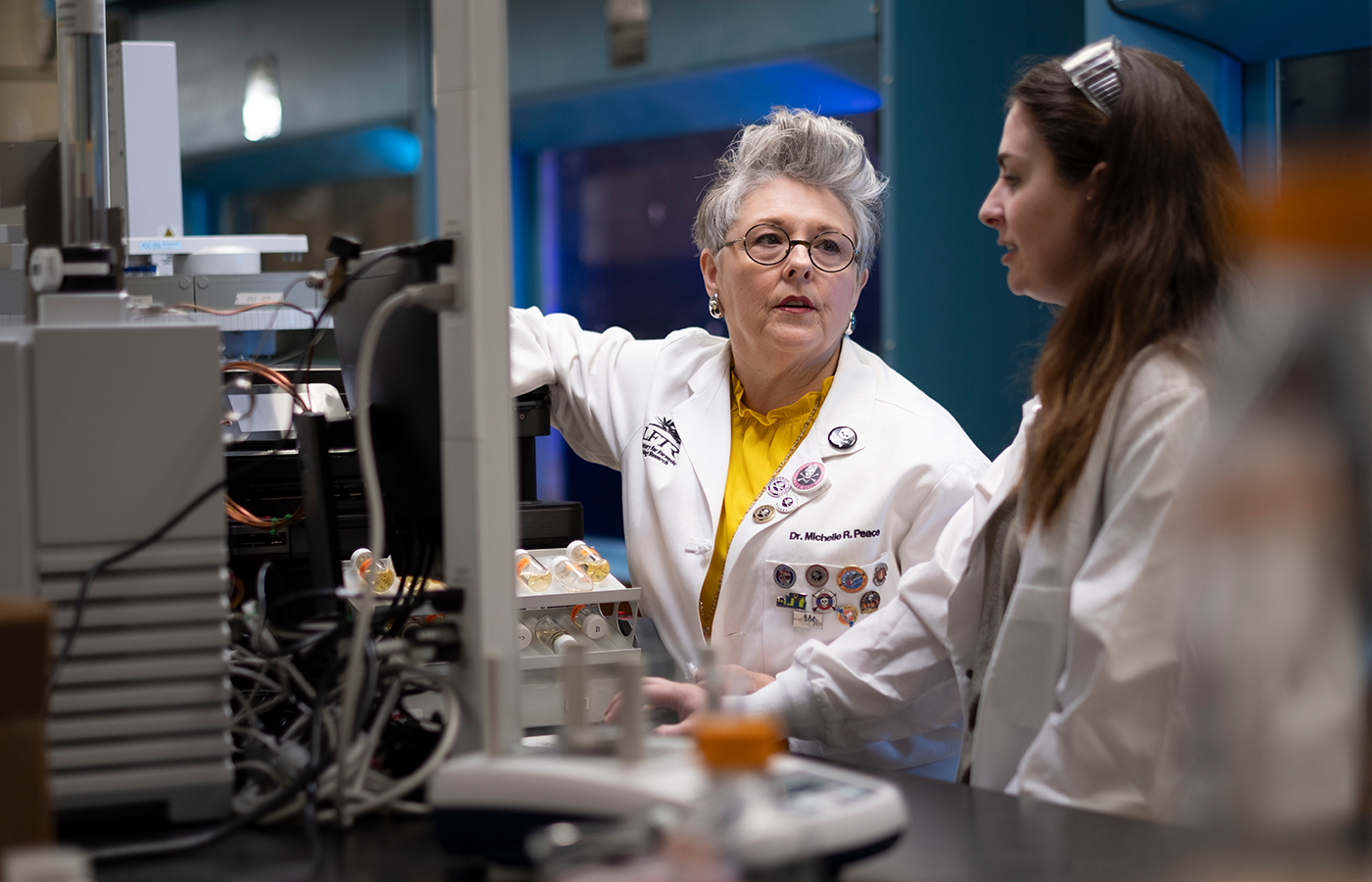
The American public has become a petri dish for vapes, Peace says. Manufacturers, “don’t have to do an FDA-approved clinical study. They have the American public to do it in.” (Nathan Hanger)
“Thank you, Dr. Peace, for a very frightening presentation,” state Sen. Adam P. Ebbin said this fall, after Peace presented the details of August’s secret-shopping haul to a bipartisan joint commission of the General Assembly.
“My pleasure,” Peace said with a laugh.
The commission aims to refine and keep alive a plan for a regulated retail market for marijuana, following a 2021 state law making it legal to grow and share marijuana but not to sell it. Former Gov. Glenn Youngkin vetoed past efforts that reached his desk, most recently in March 2025.
“Attempting to rectify the error of decriminalizing marijuana by establishing a safe and regulated marketplace is an unachievable goal,” he wrote in vetoing the bill. “The more prudent approach would be to revisit the issue of discrepancies in enforcement, not compounding the risks and endangering Virginians’ health and safety with greater market availability.”
For Peace, however, legal marijuana now seems the best way to protect consumers and starve the unregulated market.
Even with more law enforcement resources, officers “don’t necessarily know what they’re looking for when they go into these shops,” she told the commission, “because the unregulated market moves so quickly, and they’re also using a lot of language that makes it feel like it’s legal and makes it feel like it’s compliant. … When you walk into a shop, it’s wildly confusing because you’ve got cannabinoid products mixed with nicotine products mixed with paraphernalia that you don’t know what the paraphernalia is used for.”
Short of a retail market, she thinks the next best thing is to keep showing the public what’s out there, curly hairs and all.
Since 2014, much of Peace’s work analyzing cannabis products and vapes has been funded by nearly $3 million in grants from the National Institute of Justice, the research arm of the U.S. Justice Department.
A 2016 analysis of 27 nicotine vape liquids found that only one label had accurately listed the amount of nicotine inside. The following year, her team found ethanol — which is to say, grain alcohol — was an unlabeled ingredient in 52 out of 56 vape liquids gathered over the previous four years. Later the lab found that ethanol is getting aerosolized and inhaled with everything else, reaching the lungs’ deepest warrens and potentially causing inflammation. Under certain conditions, they found, vaped ethanol can even register on an alcohol breath test.
In 2024, the lab’s analysis of 69 samples from 55 cannabis products, most from the unregulated market, found that more than 75% had incorrectly labeled the drugs they contained. And the majority had inaccurately listed concentrations of cannabinoids, ranging from having none of the promised THC to a pill that had 8.5 times more than it should and 3.5 times the CBD.
Those kinds of discrepancies, in part, might stem from “pure laziness,” Peace says — but they also might be more calculated. “Care is not taken in the manufacturing of these products. They are reasonably easy to make, they don’t have the burden of quality-assurance oversight and that kind of expense, so why not give away some drug? … Why wouldn’t you want to make sure somebody has an experience that might set that product apart?”
As Peace’s work gained public exposure, consumers rattled by those unexpected experiences have turned to her lab for answers. Some are novices, like two septuagenarians who took CBD for pain and wound up hallucinating for days.
Another cannabis user sent a wax tube of honey he’d purchased, after consuming one left him hallucinating that his legs had been severed and his fingers broken. The product was supposed to have 45 milligrams of hemp-derived Delta-8 THC but actually contained 14 times that amount, plus 204 milligrams of Delta-9 THC and 953 milligrams of CBD. (For comparison, a single dose of medicinal THC in Virginia is limited to 10 milligrams.)
Another person reached out about hallucinating after smoking what he’d thought was CBD, which is supposed to be nonpsychoactive. Peace’s lab tested nine of the vape liquids from the same company, Diamond CBD, which all were claimed to be “100% natural CBD extracts,” according to the study, published in 2019. It found four of the samples contained a synthetic drug that mimics THC, called 5F-ADB, and one sample had dextromethorphan, a cough suppressant found in over-the-counter cough and cold medicines. It can cause dissociative hallucinations at high doses and has a noted potential for abuse.
Peace also has long-range research on vapes that monitors the issue from a unique vantage: far from the smoke shops, she’s seeing what actually makes it into kids’ hands.
She’s enlisting public elementary, middle and high schools across the state to send her their confiscated vapes. So far this school year, she’s received nearly 1,300 vapes, 3.5 times more than last year.
Initial results of the study, funded with $550,000 from the Virginia Foundation for Healthy Youth, were published in 2024. They offer a time-lapse glimpse into vaping habits in the years bookending the pandemic, covering four collection periods: fall 2019, early 2020, summer 2023 and fall 2023.
Most notably, perhaps, is the emergence of cannabinoids. In the combined samples from 2019 and 2020, just one of the 150 confiscated vapes contained trace amounts of cannabinoids, with nicotine in the rest. In summer and fall 2023, that jumped to 14% of 83 samples and 19% of 133 samples, respectively. However, Peace warns those figures likely underrepresent the issue, since vapes with cannabis might end up with law enforcement instead. Of those 37 devices that had cannabinoids, only five indicated it on the label.
The study also found that the controversial ingredient menthol, which creates a cooling sensation that can ease the body’s response to nicotine or smoke, peaked among the school-impounded vapes in fall 2019, when it was found in 91% of the samples (though only 3% included it on the label).
Menthol fell off from there — years in which a federal menthol ban was hotly debated but ultimately shelved — only to be replaced by synthetic coolants. They were found in 71% of the vape liquids by fall 2023, up from just 7% in 2019. Coolants have been associated with increased vaping frequency among youth, the researchers wrote, and the implications of inhaling synthetic versions are not well understood.
One of the biggest challenges now, though, is to enroll more schools, which would deepen the insights and, more importantly, give this research the kind of statistical sturdiness that could turn heads and foment change. Peace receives vapes from 30 schools, and she wants to add around 200 more. It hasn't been easy, she says. Administrators have had concerns over the possibility of results reflecting poorly on their schools and about the added work to participate in the study, and blowback from parents who might expect confiscated vapes will be returned, not donated to science.
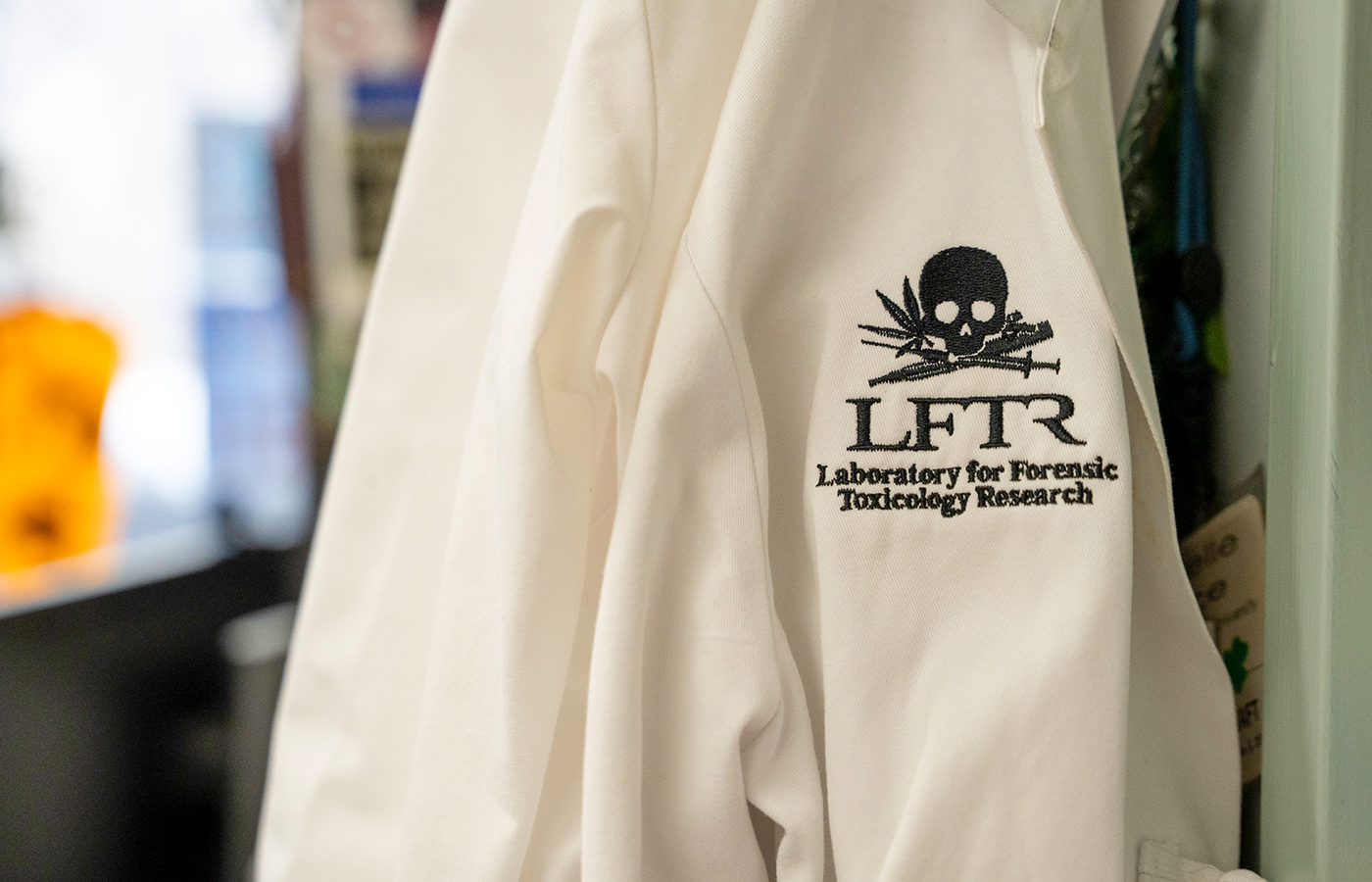
Peace hired a former student, Teresa DeCarmen (M.S.’13), to create a logo for her Laboratory for Forensic Toxicology Research. (Jud Froelich)
“I think a lot about sticky messages now, more than I ever had,” Peace says one day in August aboard a southbound train from Washington, D.C., where she was addressing the cannabis subgroup of the American Chemical Society.
She finds herself constantly recalibrating her approach. “There’s a lot of trial and error, there’s a lot of exercising of the message.”
That’s not to say it isn’t working. This past summer, Youngkin appointed Peace to the five-seat board of directors of the Cannabis Control Authority, which oversees the state’s medical cannabis program and advises the government.
Former state Del. Dawn M. Adams (Cert.’99), a nurse practitioner who served in the General Assembly from 2018 to 2024, says Peace’s research and a presentation on synthetic cannabinoids were influential in the passage of a 2023 state law aimed at tightening the slack left by Congress surrounding hemp. It specifies that all natural and synthetic forms of THC — not just hemp’s scant Delta-9 THC — now count toward hemp’s legal limit, a line in the sand of 0.3% THC that delineates hemp on one side and marijuana on the other.
“She brought some really good evidence that legislators really couldn’t afford to ignore,” Adams says.
At the end of last year, Virginia also limited which liquid nicotine and nicotine vape products can be sold, restricting retailers to only those products on a state-approved list.
The imperative Peace feels to communicate effectively and broadly jibes with a quality her friends describe as a sense of moral obligation that presses its shoulder into her work.
“I feel like she almost feels it’s her duty to make sure that the truth is out there, and that if somebody is distorting it or not saying it appropriately, she will step in and say, Hey, this is the truth, and here’s the evidence,” says Amy B. Cadwallader, Ph.D. (M.S.’03), the director of regulatory and public policy development for the nonprofit U.S. Pharmacopeia.
Peace, she says, could glide from a happy hour beer with cops to a formal dinner with the governor. “And in between those two, she will be sitting on a park bench talking to whoever is there about what she does and how it can help. She’s a chameleon and can be accessible to anybody who is willing to have a conversation.”
It’s an effort Peace wages on the visual front, too.
She hired her former student Teresa DeCarmen (M.S.’13) to create a logo for her Laboratory for Forensic Toxicology Research — a skull-and-crossbones design, but this skull looms over a crossed vape and hypodermic needle; a marijuana leaf floats to the left, a couple pills to the right.
The logo appears on PowerPoint slides and research posters, it’s been made into stickers and embroidered onto sweatshirts and hats. The lab’s name, LFTR for short, is stamped in metal on Peace’s license plate. And it’s sewn onto the back of one shoe in a pair of bright yellow Chuck Taylor All-Star sneakers that she wears sometimes. The other shoe’s back reads “4N6TX,” shorthand for “forensic tox.”
People like branding, she says. Hers aims to give just enough of a wink and a smile to get those yellow Chucks through the door; to telegraph to students, teachers, legislators that “you can come up and talk to me,” Peace says. “I’m going to meet you on your level. I’m not going to be that ivory-tower kind of scientist that’s hard to talk to.”
She knows it’s a little gimmicky. But gimmicks done well can work wonders.
