
Campus & Community
Jerry Dipoto’s endless summer
The former VCU star pitcher has spent 38 years in professional baseball as a player, scout and now president of the Seattle Mariners. Last season, his club fell eight outs short of the World Series. But if Dipoto’s learned anything from a life in the national pastime, it’s that today is a fine day to try again.
When it was over, and the Seattle Mariners had fallen eight outs short of the World Series, Jerry Dipoto exited the skybox suite he had occupied for the previous three hours, stepped into the delirious celebration of Toronto’s Rogers Centre and began walking to the visiting team clubhouse.
His Mariners had lost Game 7 of the 2025 American League Championship Series to the home Blue Jays in heart-bruising fashion, a late 3-1 lead evaporating into a 4-3 loss, the game flipping on one swing, a three-run home run surrendered by relief pitcher Eduard Bazardo.
Dipoto, Seattle’s president of baseball operations, oversees scouting, player development, trades, signings and draft selections for the Mariners and their tiered network of minor league teams. When he started in 2015, the club was in the middle of a 21-year playoff drought. The rare ex-Major League Baseball player to ascend to the top of a modern-day franchise C-suite, Dipoto spent the next decade tearing the organization down to the studs and rebuilding it, making more trades (190) than anyone in the sport — blockbusters and footnotes; flops and brilliant strokes. The baseball world began calling him “Trader Jerry.”
Bazardo was part of that flurry, acquired in a small deal in 2023. Thirty and from Venezuela, he spent nine years toiling in the minors and majors after signing with the Boston Red Sox as a teenager. He’s a power pitcher who mostly throws fastballs and curveballs (the latter, out of Bazardo’s right hand, sweeps down and away from right-handed batters).
The Mariners wanted Bazardo to change his arsenal. He technically had two fastballs: a four-seamer that tailed slightly up and in toward a right-handed batter and a sinker that featured a sharper rightward veer. Both clocked in at about 94 mph. Before he came to Seattle, Bazardo threw his four-seam fastball about twice as often as his sinker.
The Mariners believed the sinker was the more valuable pitch and wanted to reverse this ratio. They explained to Bazardo that if he altered the way he held the ball and tweaked his release point, he could throw harder and with more movement.
The adjustments transformed Bazardo’s career. On his third team in four years, he put it all together in 2025, leading Seattle relievers in innings pitched, his sinker chewing through bats at up to 97 mph. For long stretches, he was the Mariners’ most valuable reliever.
Tonight, though, he failed. Summoned in the seventh inning with a lead and two runners on base, his sinker was a few inches too high, a few inches too far over home plate, and George Springer, a four-time All-Star, launched it deep into the October night. And now Jerry Dipoto — the Mariners’ chief architect, ace of Virginia Commonwealth University’s first NCAA Tournament team and a former major league relief pitcher who knows what it’s like to be on the mound when everything crumbles — was looking for Eduard Bazardo.
“[He was] one of the first guys I got to in the clubhouse,” Dipoto says, “and the first thing I said was, ‘We don’t get here without you.’ I just wanted him to hear that. And he’s such a lighthearted, resilient guy, and you could see he was down. It’s the burden you carry as a late-inning reliever, that sometimes on your bad day you wind up ruining the work everybody else put in. You feel like you let the group down.
“If you look at the season ’Zardo had, he had a phenomenal year. And then the game was cruel, and it dropped him off the cliff.”
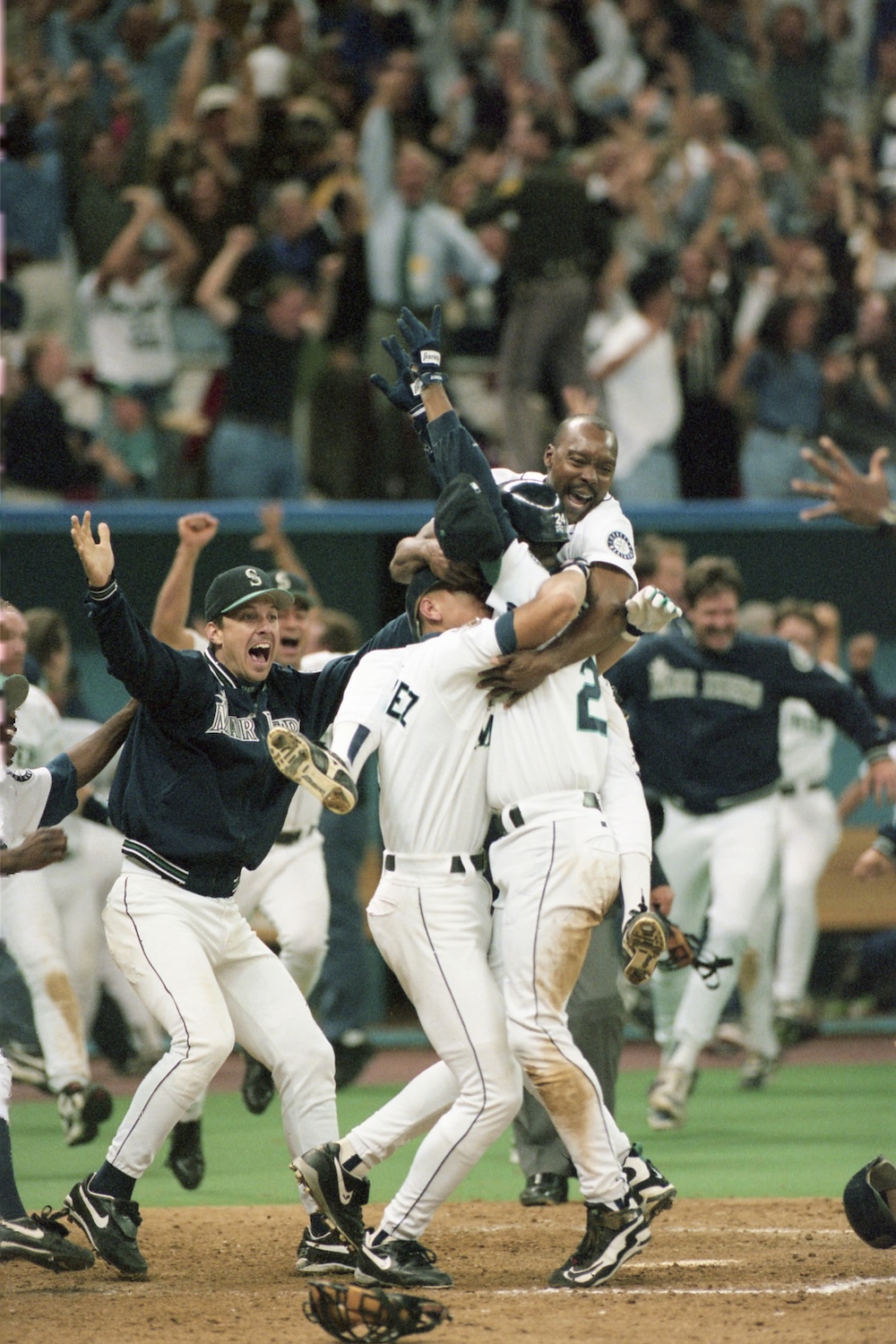
Ken Griffey Jr. is mobbed at the plate after scoring the winning run for the Seattle Mariners in Game 5 of the 1995 American League Division Series against the New York Yankees. That Mariners team “saved baseball in the Pacific Northwest,” says Rick Rizzs, a longtime broadcaster in his 41st and final season calling Mariner games. (Ben VanHouten)
“It breaks your heart. It is designed to break your heart,” the English literature professor and Major League Baseball commissioner A. Bartlett Giamatti once wrote about the sport he loved. “The game begins in the spring, when everything else begins again, and it blossoms in the summer, filling the afternoons and evenings, and then as soon as the chill rains come, it stops and leaves you to face the fall alone.”
“The Green Fields of the Mind” first published in 1977 in Yale Alumni Magazine (Giamatti was an alumnus and later Yale’s president). He was writing about his beloved Red Sox and one of their many near misses in the years after they sold Babe Ruth to the New York Yankees.
The essay is a bittersweet ode to a game unable to deliver its promise of everlasting summer. Baseball, played daily from April through October, teases this possibility. It’s an illusion. “Dame Mutability never loses,” Giamatti wrote. She uses baseball, “our best invention to stay change, to bring change on.”
The Seattle Mariners were born the spring before Giamatti penned “The Green Fields of the Mind” and are the only Major League Baseball team to never reach the World Series. (Four others — the Colorado Rockies, Milwaukee Brewers, San Diego Padres and Tampa Bay Rays — have played in at least one Fall Classic but have never won it.) Across their 49 years, the Mariners have endured some of mutability’s cruelest endings, and in this way, they are like many teams: periods of struggle and success, moments of elation and despair. How Seattle differs is in the intensity.
The franchise did not play a postseason game until its 19th season and nearly left Seattle twice because of attendance, stadium and money woes. It suffered a longer playoff wait after the millennium. In between, though, the Mariners came achingly close to winning the American League four times — in 1995, 1997, 2000 and 2001 — and employed baseball’s brightest stars: Ken Griffey Jr., Randy Johnson, Ichiro Suzuki, a young Alex Rodriguez. In the final year of that run the Mariners won 116 games, the most in a season in baseball history. They lost the pennant to the Yankees.
“The Mariners story, I think, is one of resiliency,” says Rick Rizzs, a longtime broadcaster in his 41st and final season calling Mariner games. “It’s an organization that has battled to hang in there. In 1969, we had the Seattle Pilots and they lasted only one season and then they were gone.” (The Pilots moved to Wisconsin and became the Brewers.) “[But] the city hung in there and got the Mariners. And in 1995, they were 13 games out of first place with just two months left to play. And that was the ballclub that saved baseball in the Pacific Northwest because it proved that baseball could not only survive but thrive here.
“I mean, they were getting ready to move to Tampa Bay. [People] were selling Tampa Bay Mariners T-shirts. But it’s a team, an organization and a city that just doesn’t give up.”
For a long time after 2001, though, the franchise was on a treadmill. In Major League Baseball’s 162-game season, 90 wins is usually enough to make the playoffs. Beginning in 2004, the Mariners won between 75 and 88 games in six of the next 12 years. The other six were worse.
“It always felt like they were kind of stuck in slow motion,” says Ryan Divish, a reporter at The Seattle Times who has covered the Mariners since 2006. “They’d always say they wanted to win, but they’d only green-light enough stuff to patch it together. They never made a hard decision about winning, whether it was rebuilding or going all in. They just stayed in the middle.”
The man they hired in 2015 would help them become more decisive.

Jerry Dipoto led the Seattle Mariners to their deepest playoff run ever in 2025. He’s Baseball America’s reigning executive of the year.
Jerry Dipoto’s playing career ended prematurely, on a practice field pitcher’s mound in Tucson, Arizona, in 2001.
The previous season, pitching for the Rockies, and after stints with the New York Mets and Cleveland, he suffered a herniated disc in his neck between the C5 and C6 vertebrae. Dipoto got a cortisone injection and pitched that April. But he couldn’t feel the baseball in his hand. Facing the Expos in Montreal, he spiked a fastball halfway to home plate.
This was scary. But Dipoto remained level. He had beaten worse.
Six years earlier, while in Cleveland, he’d been diagnosed with thyroid cancer, vanquishing it with radiation and surgeries that cost him his thyroid and one of his adrenal glands. Three years after that, he survived a blood clot in his right shoulder and a reaction to anticlotting medication that stopped his heart and put him in the hospital for three weeks.
Fighting a balky disc and nerve problems, Dipoto had surgery to fuse the vertebrae together with a metal plate. He rehabbed and returned for the season’s final month.
The following spring training, though, he threw a pitch and collapsed to the ground. Doctors discovered another bulging disc, just above the first, and two broken bones, above and below the plate.
Jerry Dipoto was 32 years old. He sat in the team training room. He thought about his wife, Tamie, and their three kids. He cried.
And then Dan O’Dowd offered him a job.
O’Dowd was Colorado’s general manager from 1999-2014. He’d been in Cleveland when the club drafted Dipoto a decade earlier and, as assistant GM, helped turn the team from perennial losers into American League champions in 1995 and 1997. Recovering post-surgery in 2000, Dipoto attended Colorado’s front office meetings during the Major League Baseball draft. O’Dowd liked his curiosity.
“My career was over,” Dipoto says. “And I met with Dan, and he talked to me about coming over to the [front office]. All of this was in about six days — coming back to spring training in late February, throwing and falling down on the mound, and by the start of March, I was done. It was as abrupt as it could possibly be.”
But Dipoto, now a senior decision-maker for a $2 billion sports franchise, is the kind of person who mulls, leaps and then shreds the receipt.
“Thyroid cancer, blood clots, the neck issues, spinal fusion. In none of those instances — and I think this is just the lesson that baseball teaches you — did I ever, in a moment, take a step back,” he says. “You just played the next inning. And it never dawned on me that the next inning wouldn’t be played or that tomorrow there wouldn’t be a game. And if you’ve lived that all your life, it affects your outlook on the rest of your life. When I went to work in the front office, I didn’t know where it would lead. I think the thing that I said then — and I believe it to be true — is you just start walking and the game will tell you how far you go.”
Dipoto retired on March 7, 2001. Days later, he started as Dan O’Dowd’s special assistant, and on opening day, he watched his teammates beat the St. Louis Cardinals from the baseball operations suite at Coors Field in Denver. When the national anthem began, Dipoto choked up and left the room.

The Dipotos pose for a family photo in the late 1990s outside Jerry Dipoto Field at St. Mary’s Catholic School in Littleton, Colorado. Dipoto and the Colorado Rockies built the field as part of the club’s “Field of Dreams” program. (Courtesy of Jerry Dipoto)
Jerry Dipoto was considered a good hire in Seattle in September 2015. A president of baseball operations or general manager has three primary responsibilities: Assemble a competitive major league roster, construct a talent-rich minor league farm system and set a franchise’s long-term strategy. Dipoto, by now, had a lengthy front office résumé: scout for the Boston Red Sox; director of player personnel for the Rockies; a trio of executive roles, including as interim GM, for the Arizona Diamondbacks; GM of the Los Angeles Angels; Red Sox special assistant.
There were blips, though. He’d resigned as Angels GM two months earlier, midseason and only three years into the job, because of a power struggle with manager Mike Scioscia, a World Series winner and baseball’s then-longest tenured field manager. The rift was over Scioscia not using research produced by Dipoto’s front office to make in-game decisions. Angels’ ownership backed Scioscia, so Dipoto quit.
Dipoto was also a former player. And teams, increasingly, weren’t hiring ex-players as franchise showrunners.
Historically, most baseball team presidents and GMs fit into one of two archetypes: non-player business executives and ex-players with backgrounds in scouting and player development. In 2002, the math-savvy Oakland Athletics — employing a strategy known today as “Moneyball” — introduced another archetype, the non-baseball analyst, downplaying qualitative scouting and a ballplayer’s physical “tools” and instead using performance data to find hidden gems.
By 2015, the analyst was baseball’s dominant executive model. When the Mariners hired Dipoto he was one of only four ex-players running a Major League Baseball franchise. Today, he’s one of five.
But Jerry Dipoto also doesn’t neatly fit into an archetype.
He played eight seasons in the majors, receiving a Rookie of the Year vote in 1993 and saving 19 games for the Rockies in 1998. He was the rare big leaguer with an active membership in the scholarship-producing Society for American Baseball Research. He can break down the spin rate of Eduard Bazardo’s fastball and opine on the writings of Marcus Aurelius.
“His background had a little bit more variety,” says Ryan Divish, The Seattle Times reporter. “I think he’s become a very high example for being able to blend the analytical new school [and] still having the old-school scouting, too. I think anytime you lean hard to one direction you have inefficiencies. And I think Jerry figured out very quickly that that’s not who he is. He’s gregarious. He’s a baseball nerd at heart.”
Dipoto, 58, grew up in Toms River, New Jersey, collecting baseball cards, tacking Sports Illustrated posters to his bedroom walls and worshiping New York Mets ace Tom Seaver. As a kid, he wrote letters to players asking for autographs, and when he was a young pro player, he wrote letters to retired players thanking them for being part of the game’s long history. Many wrote back. The Hall of Famer Bob Feller once insisted on giving a 23-year-old Dipoto an unofficial mid-game bullpen lesson, and when Dipoto’s pitching coach, Rick Adair, raced over to admonish Feller, Dipoto told Adair that he should be nicer to Bob Feller.
“He loves baseball,” Divish says. “Like, I love baseball. I don’t love it as much as Jerry Dipoto. He loves spring training and the joy of being around all the players. He still sometimes sits down with scouts during games.”
Slideshow

Dipoto, sitting in his T-Mobile Park office, attends the 2020 Major League Baseball draft, which was held remotely during the pandemic.

At T-Mobile Park in April 2026.

Chatting with shortstop J.P. Crawford at the batting practice cage in 2024.

Rick Rizzs, left, and Dipoto at a preseason Mariners fan event in March 2024.
The franchise Dipoto inherited in 2015 needed this enthusiasm. The Mariners had a shallow farm system, a history of bad draft selections, a roster that lacked athleticism and a league-average payroll (Seattle spent $145 million on player salaries in 2016, 12th of Major League Baseball’s 30 teams and $100-plus million less than the Los Angeles Dodgers). A handful of expensive stars commanded the majority of the budget.
“He was kind of hamstrung and had to go about working on the fringes, trying to improve the team through trades,” Divish says. “He put a value on run prevention and pitching and athletes. He put a premium on the MLB draft. He really put a focus on [the] need to build talent from within.
“But I think, really, what turned this franchise around was he came up with a plan to rebuild the big league roster and reset the farm system. The Mariners in the past had been hesitant to rebuild. And Jerry, after the 2018 season” — the Mariners won 89 games, overachieving but missing the playoffs again, and Dipoto had seen enough — “he went to [ownership] and said this team isn’t good enough to consistently win. We need to [fully] rebuild. And, you know, you go into an owner’s office and say this isn’t working. … I mean, he managed to sell them on [it].”
That offseason, in a span of 44 days, Jerry Dipoto traded away two outfielders, his top starting pitcher, four relief pitchers and his starting second baseman, shortstop and catcher. He created payroll space, began replenishing the farm system and acquired a shortstop, J.P. Crawford, from the Philadelphia Phillies. Crawford is now Seattle’s longest-tenured player.
Rick Rizzs, the longtime broadcaster, calls Dipoto “the everything-thinking type of guy.” Among his Seattle hires: two first-time managers (Scott Servais and Dan Wilson) who played a combined 25 years in the majors; a pitching strategist (Trent Blank) who is a biomechanics expert; and a player development director (Andy McKay) with a background in organizational leadership. In 2017, Dipoto used a 34th-round draft pick on Massachusetts Institute of Technology pitcher (and analytics whiz) David Hesslink, planning all along to offer Hesslink a front office job when his playing career ended.
A good illustration of this blended approach is a computer program Hesslink built in 2018. It works by combining a large volume of dork-level baseball data for every moment in every game — like the velocity, location and movement of a thrown pitch and the arc, speed, contact rate and contact quality of a swung bat — to generate a “game score” for every Mariner.
The score separates the things players can control (the pitch they throw or swing at; the quality of that pitch or swing) from the things they can’t (whether a batted ball is a hit or an out). Julio Rodriguez, Seattle’s superstar center fielder, can now analyze the four line drives he hit last night without agonizing over all of them being caught.
Every team today taps into human kinetics, sports psychology and performance data. But in the past five seasons, the Mariners have the third-most wins in the American League. Seattle’s four minor league affiliates have won five league championships since 2021.
“It takes the village,” Dipoto says. “And that’s going to be contributions from your scouting people, your analysts, your development people, your coaches, your players. In the postseason [last year], we had a break and we [had] our fans come to the ballpark for practice games to recreate a major league atmosphere instead of just having music on and taking batting practice.
“You have to be able to rely on the people who do that thing, let them do that thing, and then leave the result to chance, believing that your process prepared you. We’ve never wavered from a commitment to that, to relying on one another, to being open-minded. That’s the lesson learned over time. If you get too locked in and believe that you have the template, you’re probably wrong. Some gray area is the right answer to almost everything.”
In 2022, the Mariners made the playoffs for the first time in 21 seasons. Last year, they were eight outs from the World Series. Dipoto is Baseball America’s reigning executive of the year.
“I grew up on the South Side of Chicago, and the one thing we had was faith,” Rizzs says. “The Cubs were our team and we loved our team no matter what. It’s the same thing, I think, in Seattle now. The Mariners are their guys, and when the Mariners win a World Series, it will be a rock into the ocean that will ripple all the way back to Diego Segui’s first pitch in 1977. It will connect season to season, decade to decade, because where you’re going depends on what you did in the past. Baseball is generational.”
Slideshow

Jerry Dipoto in 1968 with his father, Jerry Sr., at Doubleday Field at the National Baseball Hall of Fame and Museum in Cooperstown, New York. (Courtesy of Jerry Dipoto)

Dipoto led the Rams to their first NCAA Tournament appearance. He was inducted into the VCU Athletics Hall of Fame in 1997. (Courtesy of VCU Athletics and Jerry Dipoto)

With baseball strikeout king Nolan Ryan (Courtesy of Jerry Dipoto)

Dipoto pitched eight seasons in the Majors, including stints with the Colorado Rockies and his boyhood team, the New York Mets. (Courtesy of Jerry Dipoto)

With former Negro League players Buck O’Neil and Byron Johnson (Courtesy of Jerry Dipoto)
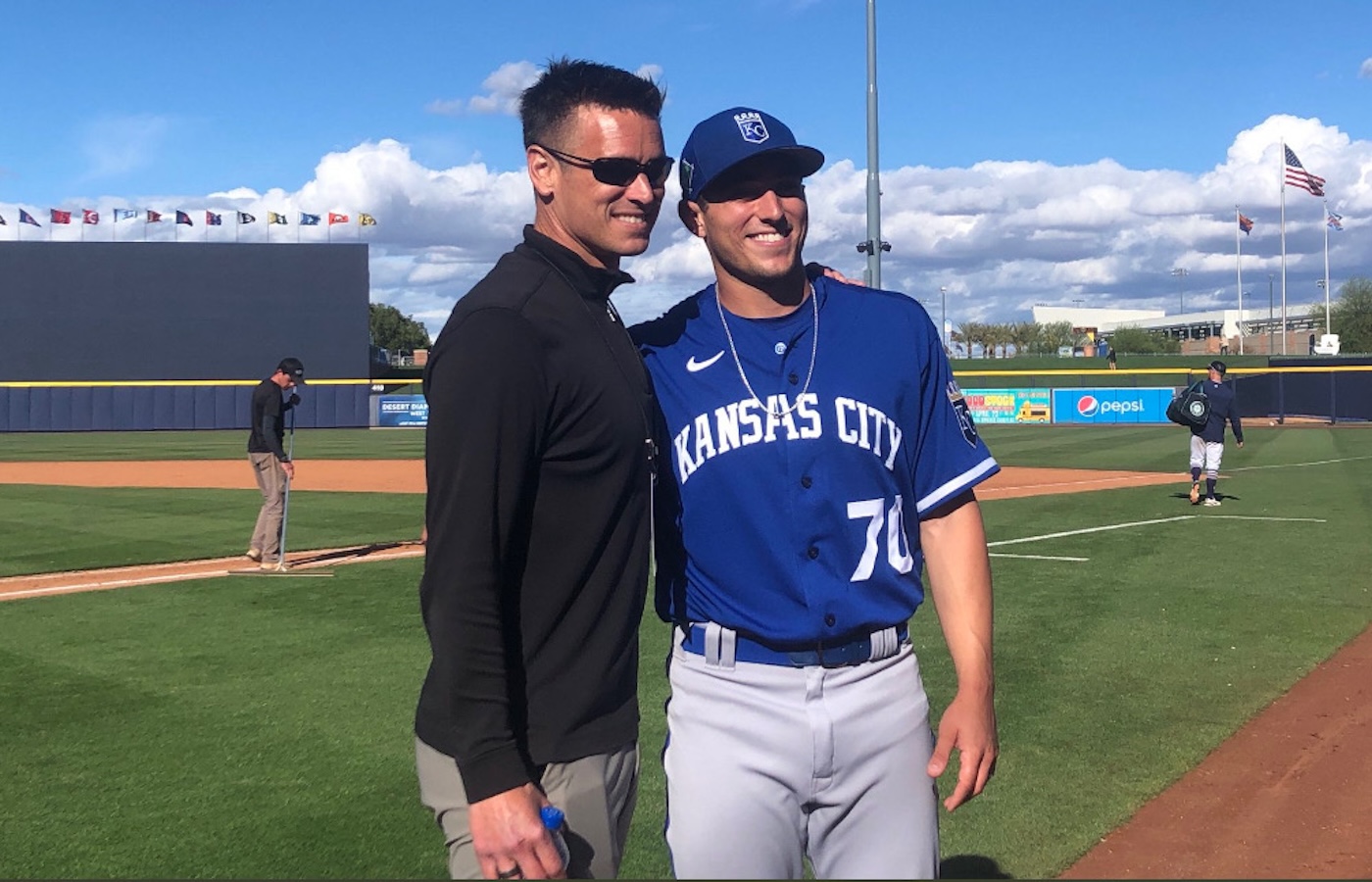
Jerry and Jonah Dipoto in Arizona in 2022, after Jonah, a spring training invitee with the Kansas City Royals, pitched a scoreless inning against Jerry's Mariners. “Thrill of a lifetime,” Jerry later said. (Courtesy of Jerry Dipoto)
It’s late January, and Jerry Dipoto is recalling a story from when he was 15.
He had become a pitcher, like his idol Tom Seaver. The Sports Illustrated posters were coming down and the Bruce Springsteen posters were going up. Dipoto started throwing against college-age players in a local men’s league that summer.
“I got invited to Virginia to this camp,” he says, the flashback shaking loose in his mind and wandering into conversation. “They invited the top 100 high school prospects from the Eastern Seaboard. Probably 10 players at that camp were ultimately drafted in the first round. The instructors were college coaches. On the first day, they ran you through a skills presentation, like a tryout. And then four coaches drafted teams. And I was drafted to play on Coach G’s team.”
The camp was at Old Dominion University. “G” was Tony Guzzo, VCU’s baseball coach from 1983-1994.
“For a week, I spent almost every hour with him and a small coaching staff,” Dipoto says. “And unknown to us, we were also being evaluated by scouts and schools. I wound up getting invited back to that camp three times, and all three times I got drafted to play on Coach G’s team.
“I was mostly thinking about going to SEC schools” — Georgia, Alabama and Auburn each recruited Dipoto — “and then Coach G offered me a scholarship. VCU wasn’t really on my radar. [But] I loved him so much and he said, ‘Trust me, we’re building something great.’”
In 1986, VCU’s baseball program was in the middle of a 12th-straight losing season. Guzzo, though, did have some talent, including a quartet of future pro draftees: infielder/pitcher Jim Austin, outfielder Scott Banton and pitchers Craig Lopez (B.S.’91) and Chris Pinder (B.G.S.’87).
“Eighty-five we’re not really good. Eighty-six we started to show some promise. James and Lopez get drafted really high, and we’re sort of like, Hey, we got something going here,” Pinder says. “And then comes the class of ’87.”
That’s Dipoto’s class. He arrived in Richmond in August 1986, then watched from his room in Gladding Residence Center as his Mets beat the Red Sox in one of the greatest World Series ever played. The following spring, he paired with Pinder atop VCU’s pitching staff and helped the Rams finish 25-22.
“I remember the first game, I look behind me at my infield and I think they were all freshmen,” Pinder says. “I was like, ‘This could be really good or really bad.’ I think Guzzo probably was at a point where [he thought], ‘OK, let me just see if I can flip things with some young bucks.’ And that’s what he did. You change the environment, change the mindset. And we did it with energy and young kids that had no clue of the losing seasons. And Jerry was in the middle of it.
“He was just different. Driven, a competitor. And loose. Grinning ear to ear. He squints his eyes real tight when he smiles and laughs. My nickname was ‘Pinge.’ And he was [always] saying, ‘Hey, Pinge’ — I can hear that Jersey accent — ‘Pinge, what are you doing? How many [strikeouts] you got, Pinge?’”
In 1988, the Rams won 45 games — still the second most in school history — and reached the NCAA regional. Dipoto led the team in strikeouts, complete games and innings pitched. He did it again in 1989.
VCU went to 10 NCAA tournaments from 1988-2010. In June 1989, Cleveland selected Jerry Dipoto in the third round of Major League Baseball’s amateur draft. He went No. 71 overall, ahead of future Hall of Famers Jeff Bagwell, Jim Thome, Trevor Hoffman and Jeff Kent. Within four years he was in the majors.

Dipoto, right, celebrates with general manager Justin Hollander in a champagne-soaked clubhouse after the Mariners clinched a playoff spot in 2025.
“If you love baseball, baseball will love you back,” Jerry Dipoto says. It’s Feb. 6, 109 days since George Springer ended summer in the Pacific Northwest. Dipoto is speaking on Zoom. He has hazel-green eyes and a youthful face. He’s wearing a blue Mariners sweatshirt and is sitting in an upstairs study in his house on Mercer Island, seven miles from his T-Mobile Park office.
Days earlier, he and his general manager, Justin Hollander, completed the last major trade of a busy offseason — a deal for infielder/outfielder Brendan Donovan — while visiting the Washington State Capitol (the Mariners were being celebrated with a resolution on the House floor). Now, though, there’s less work. Dipoto spent the early morning playing hide-and-seek with his 15-month-old grandson, Cal. The moving trucks hauling equipment to the Mariners’ Arizona spring training complex left town a few hours ago. Team workouts begin next week.
“One of the most peaceful feelings that I’ve experienced in my life [is] sitting in the outfield grass on a Sunday morning, before the gates are open, when the tractor’s mowing the grass and you can smell the cut grass in the outfield,” Dipoto says. “If you can’t feel peace and the love of the game loving you back, on the days [when] you just need to decompress and get it out, it gives you the space.”
After VCU, Jerry Dipoto embarked on baseball’s nomadic rite of passage: the minor leagues. He spent most of 1989-1993 bouncing around America: Watertown, New York. Canton, Ohio. Kinston, North Carolina. Charlotte. Colorado Springs. The settings of “Bull Durham” wrapped in the franchise from “Major League.”
This is also when he met Tamie Nothnagel. Her aunt, Arleta Johnson, owned a suburban Kansas City baseball card shop (Dipoto’s parents moved to Kansas City when he was in college) and set Jerry and Tamie up on a blind date in 1989, in a sliver of late spring between the end of Dipoto’s third year at VCU and the draft.
Minor league baseball is a grind. Small ballparks, bumpy bus rides, players promoted and demoted daily. In 1990, in Kinston, Dipoto was reunited with Chris Pinder, and for a summer they lived something almost lifted from “Bull Durham” itself, pitching and rooming together on the road all the way to the Carolina League championship series. That team finished 88-47 and of the 45 players who appeared in at least one game, 12 reached the majors.
Pinder was not one of them. That season was his last in pro baseball. Four of the five minor league teams Dipoto played for no longer exist. The club that drafted him is now called the Guardians. They traded him to the Mets and the Mets traded him to the Rockies. A lot of this happened while he and Tamie raised their kids.
He’s happy to be settled. He also truly enjoyed getting here. Jerry Dipoto is an optimist.
“[In] 1993, I’m a rookie in the major leagues, and we went to Yankee Stadium in September,” he says. “A lot of my family made the trip up — my grandparents, people I went to high school with. I’m out there before Game 1 and Tom Seaver is standing at the batting practice [cage].
“He was doing color for WPIX, Yankees Channel 11. And he was just chatting it up with the guys. One of my teammates was a guy named Eric Plunk. And I’m sitting there gawking at Tom Seaver. And Plunky hit me on the arm and said — he’s from Southern California — ‘Bro, go out there and talk to him.’ I said, ‘I’m not gonna go talk to him. It’s Tom Seaver.’ And he said, ‘He puts his pants on just like you.’”
Dipoto is smiling that squinty smile. He’s sitting in a chair that’s shaped like a baseball mitt.
“So I walked out and I introduced myself. I shook his hand and I said, ‘Mr. Seaver, I am your No. 1 fan.’ And he laughed and rubbed me on the head and said, ‘I’ve never heard that before.’ And he got a little belly laugh out of it and then asked me a little bit about myself. It was a two-minute interaction. And then I walked away.
“After we left that series, we went back to Cleveland and we were on ‘Tuesday Night Baseball.’ And Lary Sorensen came walking over to my locker.” Sorensen was a broadcaster and retired pitcher. “He was doing this game, and he tapped me on the shoulder. I said, ‘Lary Sorensen!’ And he said, ‘You know me?’ And I said, ‘Yeah, Brewers, A’s, I had your 3D All-Star card from Frosted Flakes.’
“He laughed and said, ‘I brought a gift from a friend.’ It was a signed baseball.”
To Jerry, With best wishes from your #1 fan, Tom Seaver
“It’s one of my prized possessions,” Dipoto says.
A month later, Jerry Dipoto finished his first big league season and went home to be with Tamie and their 10-month-old daughter, Taylor. A year later, they had a second daughter, Jordan. And in 1996, while they were living in New York and Dipoto was playing for the team he always loved, the family welcomed a son, Jonah. His middle name is Seaver.

Jerry Dipoto's Tom Seaver baseball. (Courtesy of Jerry Dipoto)
In August 2003, Jerry Dipoto was at Wrigley Field in Chicago, about halfway through his first season as a scout. The Cubs were hosting the Dodgers, and Dipoto was sitting next to baseball lifer Jim Fregosi, a former All-Star who was once traded for Nolan Ryan and later won (and lost) over 1,000 games as a manager.
Fregosi was scouting for the Atlanta Braves; Dipoto for the Red Sox. Eric Gagne, a dominant reliever, was pitching for Los Angeles. Eric Karros, a former National League Rookie of the Year, was at bat.
“I’m sitting in the stands and [Gagne] punches out Karros [on] this Bugs Bunny changeup that was just devastating,” Dipoto says. “And Karros falls down swinging. And I laughed out loud, because that’s what you do if you’re sitting in the dugout. Jim slapped me on the back of the head and said, ‘Hey stupid, you laugh on the inside, you don’t laugh on the outside.’
“And then [Jim] gave me some advice. He said, ‘Every step you take away from the field, and every row you move back until you get up there’ — and he pointed to the suites where the executives sit — ‘the game starts to look easier and easier. Don’t ever forget how tough it is.’”
He laughs. Dipoto made his major league debut on May 11, 1993. The first batter he faced hit a double. He once pitched in a minor league game in front of nine people. Tamie was one of them.
“Did you know Jerry was the clubhouse manager for the Richmond Braves?” Chris Pinder says, offering a bit of Dipoto biography. (Dipoto backed into the job in 1988 after tearing his right triceps two pitches into his NCAA Tournament start. The injury ended his season and wrecked VCU's Cinderella run.)
“He’d take a summer class and go [to The Diamond] and do laundry and clean,” Pinder says. “How many guys who throw 90-plus in college are going to spend their summer waiting on Triple-A guys and pissed-off big leaguers [demoted] to Richmond? But that’s Jerry. He’s making lasagna in big pans and feeding these guys and just soaking it up.”

“One of the most peaceful feelings that I’ve experienced in my life [is] sitting in the outfield grass on a Sunday morning, before the gates are open, when the tractor’s mowing the grass and you can smell the cut grass in the outfield. If you can’t feel peace and the love of the game loving you back, on the days [when] you just need to decompress and get it out, it gives you the space.”
Bart Giamatti closed “The Green Fields of the Mind” with an admission: It’s OK that baseball breaks his heart.
“Of course, there are those who learn after the first few times. They grow out of sports. And there are others who were born with the wisdom to know that nothing lasts. These are the truly tough among us, the ones who can live without illusion, or without even the hope of illusion. I am not that grown-up or up-to-date. I am a simpler creature, tied to more primitive patterns and cycles. I need to think something lasts forever, and it might as well be that state of being that is a game; it might as well be that, in a green field, in the sun.”
In March, five months after Game 7, Eduard Bazardo, pitching for the Venezuelan national team, entered the title game of the 2026 World Baseball Classic in Miami in the fifth inning, his team leading the United States, 2-0, and one out. He threw 12 pitches and retired both batters he faced. Venezuela won, 3-2.
Twenty-four-hundred miles away, at Mariners spring training, Jerry Dipoto sent a text message.
“Same guy every day.”
“The end of 2025 was us walking off the field in Toronto, and the first thing you do is go down and give ’Zardo a hug and rub his head,” Dipoto says by phone a week later in Seattle. “And it’s exactly the same moment I had [with him] the other day. I saw him sitting in the cafeteria, eating his breakfast the morning he was back after the WBC, and I walked over and rubbed his head and congratulated him.”
Jerry Dipoto is still searching for the last eight outs that will get the Seattle Mariners to the World Series. Decades in baseball have taught him to focus on what he can do to make that possible, not worry whether it will happen. And so, as summer uncoils, he drives to the ballpark and takes another walk through the outfield grass, the green field of his mind and the green fields of the world aligning again.
“It was a good career,” he concludes of his playing days. “And what has happened after is even better. And I couldn’t have even imagined [that] on the day I was sitting on the trainer’s table and they told me I couldn’t pitch anymore. And now, looking back, that might have been the most emotionally crushing day of my career that [also] started the next best thing that could have ever happened to me professionally.
“Baseball grabs your heart. It gives you something to love every day. And on the day it drops you off a cliff, it picks you up and brings you back the next day and you start again.”
